UK Prime Minister Andy Burnham and the French president offered to help Spain.
Ceuta, on Morocco's northern coast, is separated from mainland Spain by the Strait of Gibraltar and has long been a focal point for migrants attempting to reach Europe.
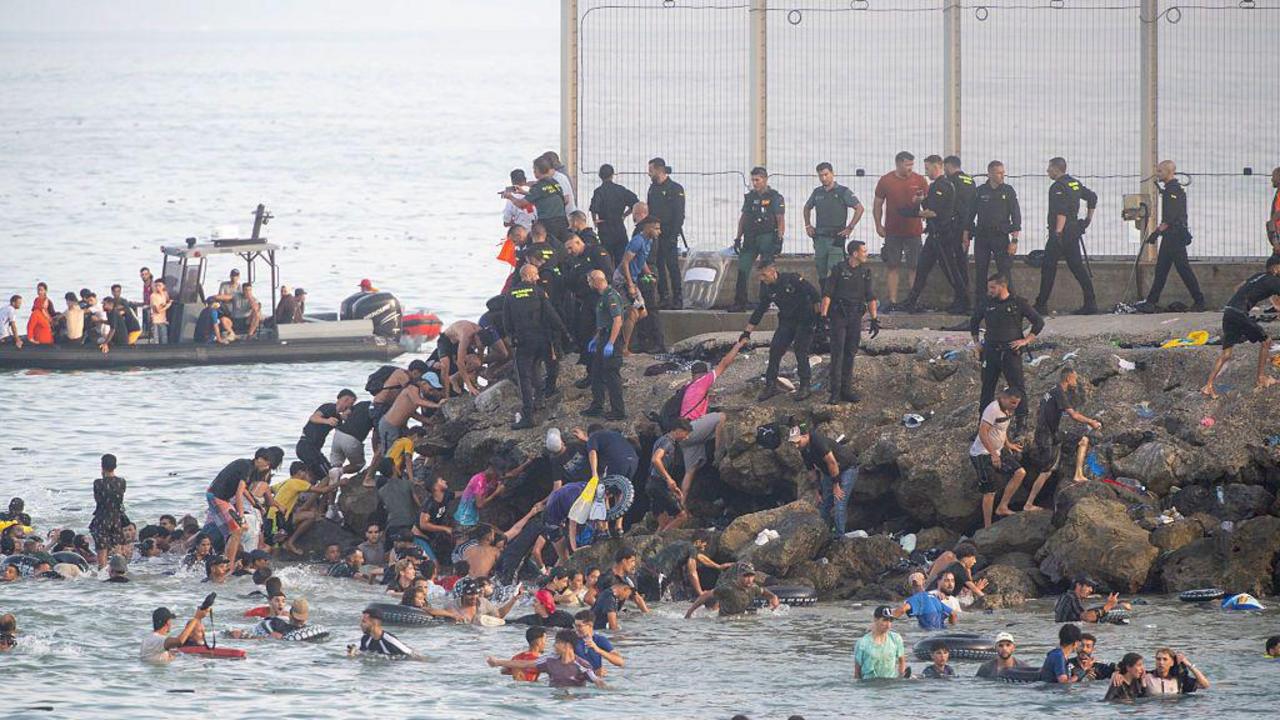
Local officials had appealed to Madrid for help after a recent rise in attempted crossings, but there were chaotic scenes on Thursday as border controls apparently broke down.
Ceuta's President Juan Jesús Vivas said the situation was "unsustainable" and that the recent arrivals amounted to around 70% of the city's population - which sits at around 83,600 according to the latest local figures.
Spain's Interior Ministry told the BBC that its estimates were slightly lower, citing 50,000 arrivals since the early hours of Thursday.
It also added that more than 25,000 people have left Ceuta en route back to Morocco from Friday morning up to 13:00 local time (11:00 GMT).
The ministry said the rate of departures from Ceuta is at 150 people per minute, though it did not provide any further information on this.
Spain has now deployed its armed forces to bolster security in Ceuta and at its sister city of Melilla, where between 300 to 400 crossings were also reported overnight.
Speaking on Friday during a visit to Ceuta, Sánchez said that the government would be looking at reinforcing the border with Morocco. He blamed criminal networks for manipulating the Supreme Court's recent ruling, adding that incorrect information had "spread like wildfire in recent hours".
He said authorities in Morocco were co-operating with plans to return those who had entered illegally.
Ceuta and Melilla trace their Spanish past to the 15th Century, and they have enjoyed a limited degree of self-government since 1995.
Coveted by Morocco, they have long been a flashpoint in diplomatic relations between the two countries. They form the European Union's only land borders with Africa.
One migrant told Reuters news agency that he was returning to Morocco, adding:
"It's not good at all, and it's not fun either.
"I mean, people are dying here. I beg you, please, if you haven't come yet, don't come. Don't do it."
Local media reported chaos on the streets of Ceuta since Thursday, with one resident telling Spain's ABC that people were scared.
"Nobody is going out on the street. They're afraid.
"This is stronger and more aggressive than what we've experienced before," a hospital security guard told the Spanish site.
The last time there was a surge in arrivals - though on nowhere near this scale - was in 2021. At that point, the Moroccan authorities allowed some 8,000 people to cross the border following a dispute with Madrid over the sovereignty of the Western Sahara.
That diplomatic dispute has flared again recently, after Sánchez travelled to Algeria which backs independence for the region.
BBC Verify has looked into migration data released by the UN, external, which reported 2,826 people had crossed into Ceuta up until 15 July this year with another 181 entering via Melilla.
The number of migrants crossing into these two territories was already high compared with recent years, which saw 994 migrants enter in 2025, 476 in 2024 and 467 in 2023.
Source note
First published by BBC News
This article was supplied by BBC News through its RSS feed and formatted for Crooli Signal. The reporting remains with the original publisher.
Read the original at BBC News