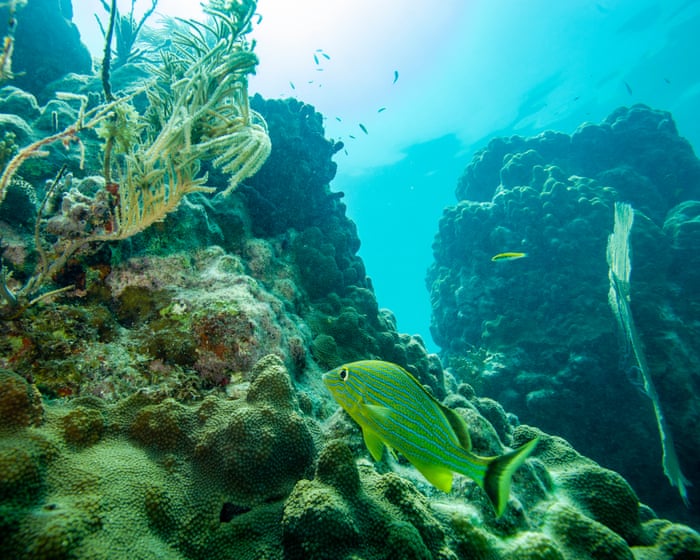
From disappearing manatees to bleached coral reefs, gender-changing turtles and oyster beds destroyed by hurricanes, no other state’s marine life faces the magnitude of climate-related challenges than Florida’s.
Now, wildlife authorities are attempting to bring some cohesion to tackling the diverse slate of issues by borrowing from a playbook that has already proved successful on land.
The Florida Fish and Wildlife Conservation Commission (FWC), and its charitable arm, the Fish and Wildlife Foundation of Florida (FWFF), have announced the creation of an ambitious “coastal corridor”, an interconnected chain of ocean-based projects and enhancements designed to preserve and nourish vulnerable marine creatures.
It replicates to a significant degree the state’s wildlife corridor, an 18m-acre (7m-hectare) project established in 2021 to provide a safe, contiguous habitat spanning much of Florida where rare or threatened land-based species including birds, reptiles, panthers and bears can flourish.
Featuring projects including habitat restoration, fisheries enhancement and improved public access and coastal resilience along Florida’s Atlantic and Gulf coasts, the project aims to create a connected network of artificial reefs, oyster beds, seagrass and mangroves on which marine life can thrive.
“The goal is to protect and connect all these important habitats for fish and wildlife,” said Nick Wiley, the former head of FWC who was appointed in April as executive director of FWFF.
“Everyone has seen how successful the wildlife corridor initiative has been, rallying everybody around the mission. The wildlife species needed these travel lanes and corridors across the state, but it also highlighted how private landowners contribute to federal, state and county public lands and how all that fits together.
“Our board members were really inspired by that, looking at our coast, our fisheries and the coastal communities, and from the beaches, estuaries, all the way out into the deeper water.”
The coastal corridor is designed to not only protect Florida’s precious marine legacy, but also the economic riches of its waters. Recreational fishing alone brings in $14bn a year, and provides 120,000 jobs, the foundation said. Another $3.1bn and 39,000 jobs come from creating and maintaining artificial reefs.
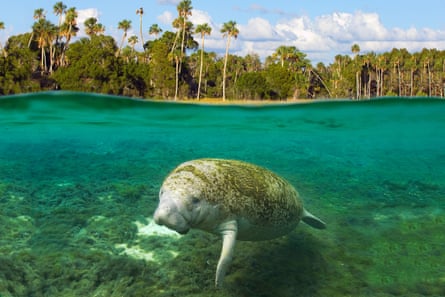
A manatee in the Crystal River, in west-central Florida. Photograph: All Canada Photos/Alamy
Additionally, more than 2 million out-of-state anglers visit Florida each year, renting charter boats and plowing plenty of dollars into hotels and restaurants.
“If you had to list what sets Florida apart and makes it such an iconic place for people to go and enjoy the outdoors, and the water and the fish and everything, our coast is our treasure,” Wiley said.
“But we hadn’t really looked at it as a connected corridor all the way around the coastline. It’s like the wildlife corridor’s sister on the coast that shows how you connect our estuaries all the way out through the grass flats into the deeper water.
“We already have a lot of partners from local government, non-profit, federal government, and state that are doing a lot of great work to protect our coastlines and provide habitat for fisheries, but it’s like here and there, scattered along the coastline.
“This pulls us all together under one great umbrella to inspire and provide a vision that we can all celebrate and leverage, and identify where we need to do better, make improvements, where we need to restore places and where we need to add habitat, from coral reefs all the way up to the grass flats.”
FWC and FWFF leaders are partnering with local governments, scientists, reef builders, conservation organizations and coastal communities. One early project, planned for next month, is a collaboration with Collier county to lay a sizable new artificial reef some 13 miles from shore in the Gulf of Mexico.
Mike Norberg, a marine biologist with decades of experience in artificial reefs, who is also the coastal corridor’s project director, said a chain of prefabricated concrete structures 8ft-15ft would be lowered onto the seabed, and would mimic natural reefs to attract fish.
“There’s a number of benefits for artificial reefs,” he said. “It removes pressure from natural reefs, which obviously have a lot of ongoing challenges, especially in south Florida, and also creates habitats in areas where none might have existed.
“In parts of the coastal waters, it’s largely just sand sea floor and not a ton of natural reefs, especially when you look in the northern Gulf or north-eastern side of Florida. So it’s a win-win both for the ecosystem as well as recreational access opportunities, whether that’s fishing and diving or just going out and sightseeing and having fun.”
Norberg said strategic reef deployments were a priority for the first year, with other projects under way in Okaloosa county in the Panhandle, and Duvall county on the northern Atlantic coast.
Future plans, he said, include exploring coastal restoration projects to help address beach erosion, the loss of coastal mangroves that protect against storm surge during tropical events and the reduction in natural food stocks that sustain declining species, such as seagrass for manatees.
“We’ve got a number of different projects that are in various stages of development in different parts of the state,” he said.
“We’re looking at various oyster bed restoration opportunities and how that can help tie in to this network of connected habitats, living shorelines. That’s a huge thing, one that helps improve coastal resiliency from a community perspective.
“It also provides habitat for juvenile fish and adult fish to spend their time within an estuary before they move offshore. So there really is this opportunity to tie both inshore to offshore habitats and use that as a tool for marine resource management.”
To Wiley, the creation of the coastal corridor represents what he says is a peak of his decades-long career in wildlife conservation in Florida.
“I see more excitement and opportunity on this one than anything I’ve touched,” he said. “It speaks to me so well in my heart about bringing people together to do great things for Florida’s environment and Florida’s coast, and I just see so much potential and opportunity for everybody to come in and be a part of it.
“As we’ve seen on the wildlife corridor, it will bring a deeper, richer identity to the state that will enrich and enhance the value of Florida for people that live here, and the people that want to come visit.”
Source note
First published by The Guardian US
This article was supplied by The Guardian US through its RSS feed and formatted for Crooli Signal. The reporting remains with the original publisher.
Read the original at The Guardian US