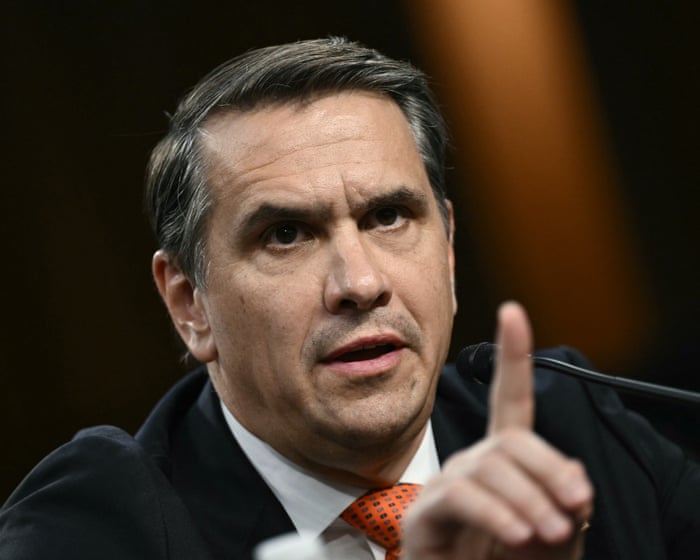
The author of an infamous internal Democrat party report on the 2024 presidential election loss has claimed that an entire section that included a discussion of generational wealth established by high-ranking elected officials was cut from the draft version leaked and later released earlier this summer.
Paul Rivera, the author of the autopsy, told the New York Times that a section titled “What Happened in 2024” was missing from the published version but had been included in the version he personally handed to embattled party chairman Ken Martin in January.
The Democratic National Committee has previously claimed the autopsy had been released “in its entirety”.
Rivera said that elements of the report that were excised included questions about Joe Biden’s decision to run for re-election and the policy influence of Democrat party operatives who had become “generationally wealthy off politics”.
While the chapter did not name those who had become enriched he wrote that Democrats seeking change “keep banging their heads up against a system proven to be inflexible and self-enriching.
“Whether that was a conscious decision on their part to bury the section for the purposes of hiding a paragraph, I don’t know,” Rivera told the Times. “That’s a them question. What I can tell you is they had it, and they made a decision not to release it.”
Martin disputed that account in statement to the paper, saying “this alleged report section was not in any binder I reviewed”. Had it been included, he added, “we would have released it with the rest of the report.”
The report was released in May to resounding disappointment that it had failed to address why the party, or its two presidential candidates, Biden and later Vice-President Kamala Harris, had failed to gain sufficient traction to win against Donald Trump.
The missing chapter, provided by Rivera and published in full by the Times, states that Democrat wins before the election led the party “to believe they were stronger than they actually were. President Biden, seeing those results, made the consequential decision to seek re-election even when Americans were already sending a very strong signal: they were unhappy with the status quo.”
The report said that Democrats had failed to do enough to convince voters that Trump was an unacceptable candidate and made wrongful assumptions about Latino and male voters. It pointed to successful Democrat candidates in swing states who concentrated on economic and cost-of-living messaging more than identity politics.
The Democrat party now heads into the midterm elections in November and the 2028 presidential election with a significant $2m cash deficit while the Republican party nationally reports a positive balance over $128m. A recent supreme court decision indicates that the cash gap could widen.
Among the topics Rivera attempted to address in the disputed “What Happened” chapter were entries about Biden’s decision to seek re-election; a loss of support among Hispanic, Black, Asian American and Native American voters; and the issue of party officials and consultants being insulated or divorced from voter’s concerns by wealth.
“It is therefore possible the people ‘in the room’ at the highest levels of 2024 decision making misunderstood the mood and practicalities facing everyday America,” Rivera wrote, according to missing section. “They missed important signals about why people were frustrated with Democrats, who seemed not to appreciate or understand their situation.”
The Times report may now set off a new round of question about its direction as Democrat primary voters head to the polls in Michigan tomorrow to chose between moderate and progressive Senate candidates Haley Stevens and Abdul El-Sayed.
Martin said the party would have released the disputed or missing chapter “that went after self-enriching consultants” if it had had them and that he personally had campaigned for the party chairmanship “to hold the consultant-industrial complex accountable and ensure the party only pays for work that actually helps us win”.
Rivera said he was now going public with the claim, along with his own 564-page review of the election loss. “It’s coming from a place of hope and, honestly, a little bit of desperation,” he told the outlet. “I think that we need some disruption here to force change.”
Source note
First published by The Guardian World
This article was supplied by The Guardian World through its RSS feed and formatted for Crooli Signal. The reporting remains with the original publisher.
Read the original at The Guardian World