Banksy works cost public almost £150,000
Image source, PA Media
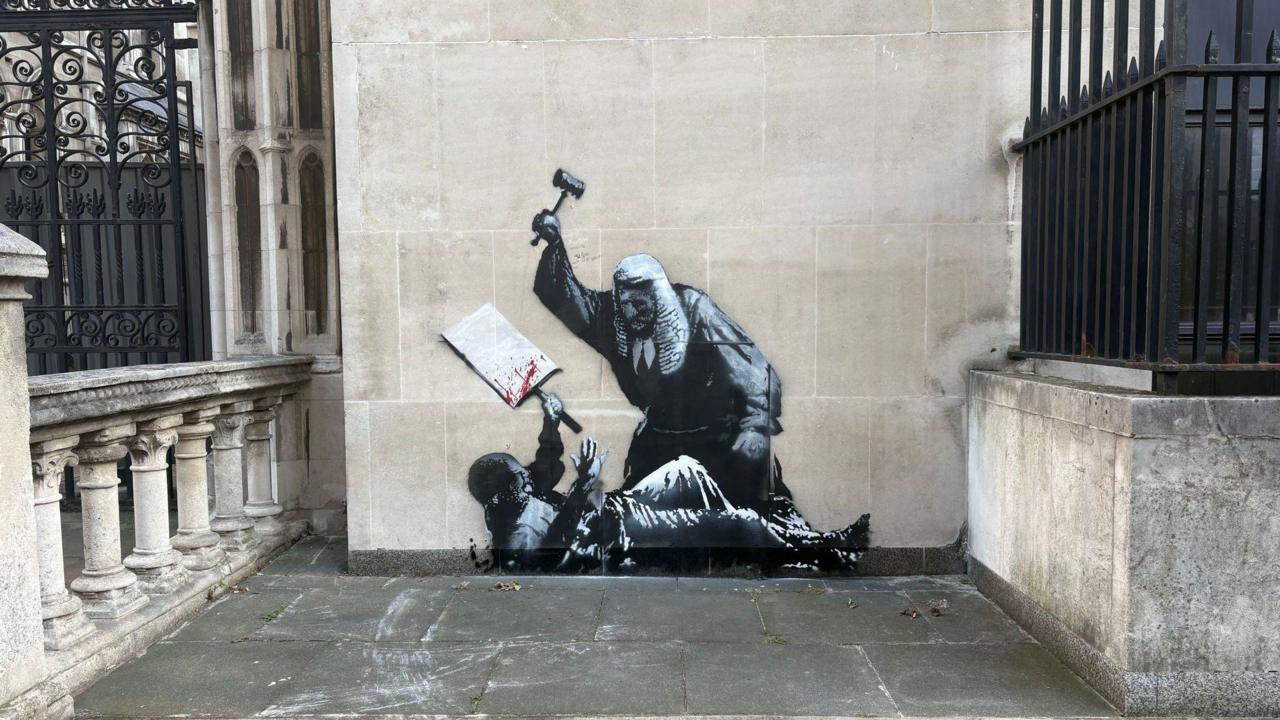
Image caption, Banksy stencilled a mural on a wall of the Royal Courts of Justice in 2025
ByAnthony Ward
Bristol
Three artworks by street artist Banksy have cost taxpayers almost £150,000 in cleaning operations and security so far, with the bill expected to rise.
The largest single cost relates to a mural painted on the Royal Courts of Justice in September 2025, where removal efforts and security have so far cost more than £85,000.
The Ministry of Justice (MoJ) says it has spent £50,000 trying to remove paint from the wall of the Grade II-listed building in Carey Street. A further £35,300 was spent on overtime and security costs.
The spending was disclosed to the BBC through Freedom of Information requests and is likely to reignite debate over whether Banksy's work is vandalism or valuable public art.
Banksy, who emerged from Bristol's graffiti scene in the 1990s and became one of the world's most famous street artists, is known for murals and installations that often appear overnight and attract large crowds.
The latest costs relate to a mural depicting a judge in a wig battering a protester with his gavel, which appeared on the Royal Courts of Justice in London on 8 September 2025.
Banksy claimed the image as his own work, by posting it on his website and Instagram account.
Costs mount at Royal Courts
A HM Courts and Tribunals Service (HMCTS) spokesperson said: "The Royal Courts of Justice is a listed building and HMCTS are obliged to maintain its original character."
The Metropolitan Police have confirmed: "On Monday, 8 September officers received a report of criminal damage to the side of the Royal Courts of Justice.
"At this time, no arrests have been made and the investigation remains ongoing."
Court staff barricaded off the area and guarded it. Attempts to clean off the mural began immediately.
Image source, Reuters
Image caption, Security guards screened off the mural and stood guard
But the fact he has painted on an historic court has divided opinion.
Shadow Justice Secretary Nick Timothy said: "It's outrageous that tens of thousands of pounds of taxpayers' money – maybe more – will have to be spent cleaning up after Banksy, who seems to believe he has a right to deface public buildings with impunity.
"Our courts are a national symbol of justice and the rule of law.
"Banksy's vandalism should be stopped and he should foot the bill for the costs he imposes on others."
However, art critic Estelle Lovatt defended Banksy's work and pointed to the benefits for tourism: "Some people visit Buckingham Palace and others visit Banksy's art.
"His work brings people together in a way that politics can divide us. He's like the Pied Piper or a town crier.
"It can be intimidating if a mural appears on your building, in terms of the crowds, but he makes art accessible because there's no gallery fee."
Image caption, Cleaning efforts are continuing behind scaffolding, panelling and a locked doorway
It's not the first time Banksy has painted on a listed building.
His early works in Bristol included a mural of a man hanging from a window, on a Georgian house.
First attempts to scrub off the paint on the court were not completely successful, so contractors have been on site using "laser technology".
Westminster City Council will have to inspect the wall and if the removal is deemed incomplete, another cleaning method will have to be used.
As a final option, the affected stonework may have to be removed and replaced.
A Listed Building Consent (LBC) application has been submitted for the installation of railings across the wall that Banksy targeted.
If approval is granted then the costs to install the railings are not yet known.
Previous works incurred expenses
The court mural is not the first of Banksy's works to create costs for public bodies.
In April, a statue of a man carrying a flag appeared in Waterloo Place near Trafalgar Square.
The flag covers the man's face and he appears to be about to step and fall from the plinth.
Banksy claimed responsibility with a video on Instagram showing the night-time installation.
Westminster City Council, which owns the land, says it had no prior knowledge of the statue.
The authority said it had spent almost £60,000 on safety barriers, administration and paying for a security guard to keep watch over it.
Image source, PA Media
Image caption, Westminster City Council has spent £60,000 dealing with the statue
In response to a Freedom of Information request, Westminster Council said: "Ownership of the statue now sits with the council as landowner.
"The council has notified the artist's agent that it is reviewing options for the short, medium and long term."
The BBC has asked for more clarification on this statement.
Image source, PA Media
Image caption, Banksy painted a Piranha fish on a City of London Police sentry box in 2024
In August 2024, Banksy painted piranha fish on a City of London Police sentry box.
The sentry box had been installed in the 1990s as part of security measures introduced after IRA attacks in the City of London.
After Banksy painted it, the box was removed at a cost of £2,200 and was never replaced.
It was put in storage and is due to be displayed at the London Museum when it reopens in November.
The works are a reminder of Banksy's continuing influence more than three decades after he first became known in Bristol, where surviving murals remain among the city's best-known tourist attractions.
Get in touch
Tell us which stories we should cover in Bristol
Related topics
- Bristol
- Banksy
- Street art
- Statues and sculptures
- Graffiti
- Metropolitan Police Service
- City of London Police
- Westminster Council
- London
- City of London
- Art
Source note
First published by BBC Culture
This article was supplied by BBC Culture through its RSS feed and formatted for Crooli Signal. The reporting remains with the original publisher.
Read the original at BBC Culture