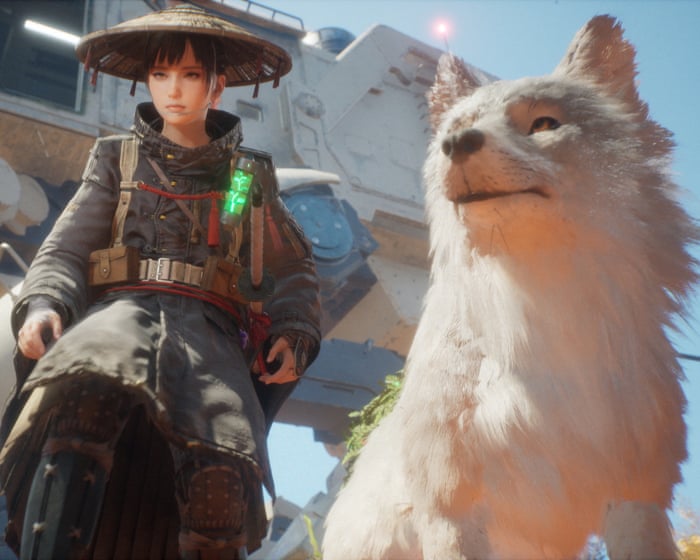
Most of your time in Beast of Reincarnation is spent collecting last words. You cross paths with robots lying on the ground, who muster whatever energy they have left to provide guidance. These interactions are fleeting. Attempt to talk to them a second time, and protagonist Emma makes their fates painfully clear: “They’ve already passed on.”
The latest detour by Game Freak, the studio best known as the primary developer of Pokémon games, is an action RPG set in a post-apocalyptic Japan. Taking cues from Sekiro: Shadows Die Twice, Final Fantasy VII Remake, and NieR: Automata, you wield the sword of an outcast accompanied by an ever-loyal canine. The pair embark on a taxing and often monotonous journey to defeat the titular beast, which nonetheless serves a thematic purpose to bolster a decaying reality, while reflecting a possible future for ours.
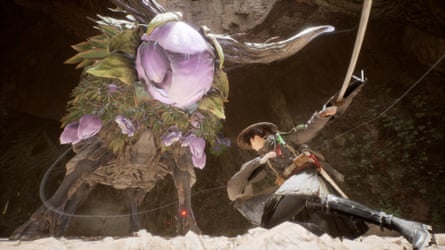
A decaying reality … Beast of Reincarnation. Illustration: Game Freak
Game Freak hasn’t marketed Beast of Reincarnation as a Soulslike – the video game subgenre fostered by FromSoftware’s Dark Souls series – but there are many similarities. Smackdowns are challenging, boss encounters are frequent, and you rest at campsites scattered across each zone. However, as director Kota Furushima told Famitsu (translated by GamesRadar+), the team aims for the experience to be “enjoyable for even those who aren’t good at action games”.
That design ethos is clear from start, as you’re able to select the difficulty level. My 20 hours with Beast of Reincarnation were spent in normal difficulty, with quite a few retries at first. As time passed, I realised just how much the mechanics want you to succeed – veering into hand-holding territory.
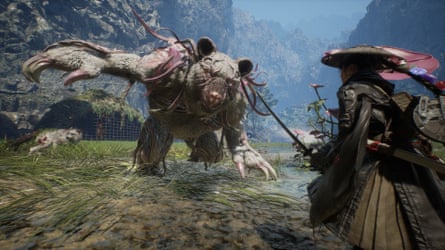
Aiming to be ‘enjoyable for even those who aren’t good at action games’ … Beast of Reincarnation. Illustration: Game Freak
Take Koo as an example. The pup is an invaluable combat companion for Emma. Yet, he is also a four-legged wiki. He sniffs out nearby enemies, valuable materials, chests, and characters – even before they’re in view. Despite exploration being encouraged and often rewarded, Koo’s actions ensure virtually no sense of discovery. Even forgetting to pick up an item from the ground is done for you, as he fetches it before you can even turn around.
This streamlining extends to pretty much everything. Both Emma and Koo have robust skill trees to unlock abilities, which progressively turn the pair into a powerhouse. Yet mechanics such as cooking and harvesting are automated in the background as you fight. There are campsites aplenty, often with a merchant nearby, and returning to them after a defeat doesn’t have any consequences. You quickly repurpose yourself and try again, your body still drenched in blood from the previous attempt.
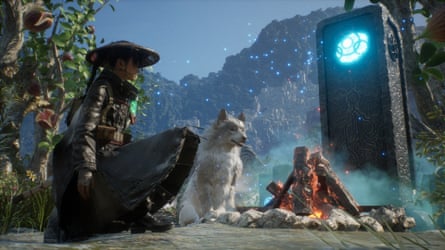
There are campsites aplenty, often with a merchant nearby … Beast of Reincarnation.
These decisions aptly correlate to Emma as a character. She is, by design, a person devoid of memories and emotions – oblivious to the grief of the robots she encounters (referred to as golems), who carry human souls inside, trapped in machines designed to serve a single purpose, before shutting down. By learning about feelings from the characters around her and what drives them, Emma’s purpose in the world is questioned. Yet, she, and by extension you, is not offered any alternative.
The senseless cycle of violence is even more pronounced in the second half, with enemies and boss encounters being largely recycled. Again, this feels like an attempt to placate you, by presenting obstacles you’ve already overcome. Almost every mechanic is designed to grant you what you need, exactly when you need it.
When you’re approaching a boss’s lair, the environment around you morphs. Flora transforms, and the sky turns orange, clouds obscure the sunshine. It’s a striking vista, and one similar to reality, as wildfires have affected air quality in North America and Canada, and their damage is yet to be calculated. A similar anxiety prevails when learning about the origins of golems, with the idea of human souls being digitised in the face of imminent calamity. There are many parallels to current reality, in a time when we are encouraged to lease our creativity, emotions, and autonomy to machines, as we’re algorithmically encouraged to stay oblivious to the action and inaction of those in power in the face of human-made disasters.
Every time Emma defeats a boss, she obtains its power, depicted as a flower added to her braided hair. Using said power in combat creates an inflorescence out of thin air. It’s almost ironic to use a sword to re-establish colour to a world that is actively in a state of erosion. Despite being rooted in conflict and grief, Beast of Reincarnation doesn’t culminate in a nihilistic afterthought. Rather, it uses whichever energy it has left to muster a glimmer of hope – like the sight of a flower blooming on an empty, barraged field.
- Beast of Reincarnation is out now
Source note
First published by The Guardian Technology
This article was supplied by The Guardian Technology through its RSS feed and formatted for Crooli Signal. The reporting remains with the original publisher.
Read the original at The Guardian Technology
