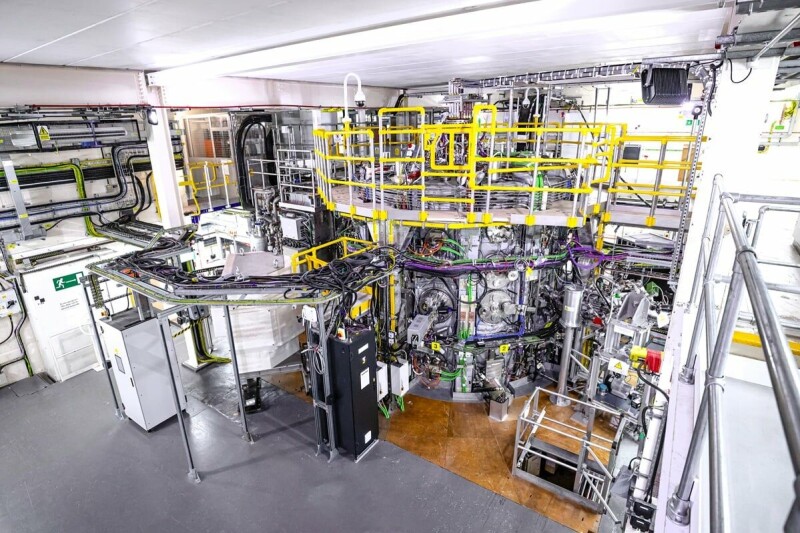
Scientists at the UK Atomic Energy Authority (UKAEA) say that they have overcome plasma instability issues standing in the way of commercial fusion power plants. The boffins overseeing the MAST (Mega Amp Spherical Tokamak) Upgrade installation at UKAEA's Culham Campus in Oxfordshire conducted a fifth series of experiments on it during 2025 and 2026 and produced more than 1,100 fusion plasmas. During these experiments, the team demonstrated the highest pressure ever achieved with the MAST Upgrade machine, without the super-hot plasma destabilizing, they say. One of the challenges they set out to address is to figure out how to suppress instabilities known as Edge Localised Modes or ELMs. These are described as “sudden bursts at the plasma’s outer edge” that can cause a loss of plasma pressure and also lose up to a tenth of its stored energy in a single event. Over time, these occurrences will damage the tokamak’s inner wall and exhaust components, and were therefore seen as a serious obstacle to commercial viability. To cure this, the team adopted two techniques already previously tested to avoid these damaging heat bursts; Quasi-Continuous Exhaust mode (QCE-mode) and Resonant Magnetic Perturbations (RMP). With QCE, the plasma edge experiences high-frequency, low-amplitude filaments that act to bleed off pressure before it can build to a destructive level. Likewise, RMPs use a magnetic field to induce small perturbations at the edge of the plasma that bleed off the pressure leading to ELMs. The team also accessed two additional stable operating regimes known as Quiescent H-mode (QH-mode) and I-mode (Intermediate-mode), improved plasma confinement techniques that deliver better energy confinement while mitigating issues associated with large ELMs. QH-mode is understood to tackle ELM using an edge electromagnetic instability called the Edge Harmonic Oscillation (EHO) to steadily remove excess heat, while I-mode is a confinement technique that features a steep thermal barrier at the edge that allows particles to escape, again preventing the buildup of pressure. The Culham scientists also claim to have developed a technique for controlling the plasma’s position. This involves measuring visible light created by deuterium emitted from the machine’s upper and lower outer divertors (the exhaust system), allowing minute positional imbalances to be detected in real-time. Detecting changes in position is a step towards automated, real-time control systems that future commercial power plants will need to operate without constant manual intervention, according to the team. The series of experiments also explored “negative triangularity” plasma shapes that allow high-power operations without ELMs. This is said to be an approach being closely watched by the international fusion community. This MAST Upgrade installation is set to get further enhancements this year. These will include two new neutral beam injectors, doubling the machine’s heating capacity, and the installation of an Electron Bernstein Wave (EBW) system that will provide an additional 1.6 MW of heating power. Following this further upgrade, a sixth series of experiments is planned for 2028. EBW systems use high-frequency, electrostatic plasma waves to heat and drive currents in dense fusion plasmas, and the technology is planned for use in STEP, (Spherical Tokamak for Energy Production), the UK’s pilot fusion power plant to be built at the site of a former coal power station in Nottinghamshire. “These findings take us another step closer to practical fusion energy,” claimed James Harrison, head of MAST Upgrade science at UKAEA. “The results genuinely shape the design of future fusion power plants. Accessing four stable high-performance plasma regimes demonstrates that MAST Upgrade is producing science at the leading edge of what is possible.” Earlier this year, the UKAEA published a roadmap of targets it wants scientists to hit before the end of the decade, in order to drive forward development of working commercial fusion reactors. Reg readers will no doubt be aware of the old chestnut that working fusion power is perpetually 30 years away, but there have been developments in recent years, such as “ignition” being achieved at the National Ignition Facility (NIF) at Lawrence Livermore National Laboratory (LLNL) in California, while UK fusion firm Tokamak Energy said it expected to deliver commercial fusion energy in the next decade. ®
Source note
First published by The Register
This article was supplied by The Register through its RSS feed and formatted for Crooli Signal. The reporting remains with the original publisher.
Read the original at The Register