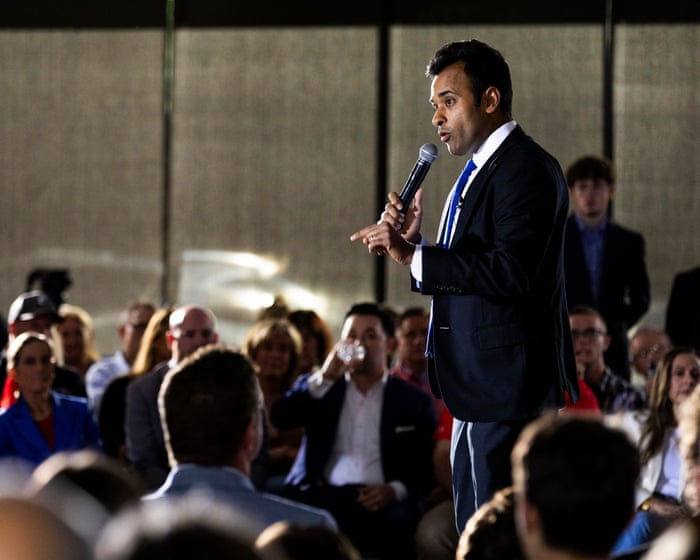
At the Hindu Temple of Dayton in south-west Ohio, there’s no little pride for gubernatorial candidate Vivek Ramaswamy – he and his parents have been coming here to pray for decades.
On a quiet recent Tuesday afternoon, a priest lights incense sticks at the mandir of the temple. Outside, a group of first-time visitors to the temple take a relaxed walk around the grounds.
“I remember him coming here with his parents when he was a little child,” says Shri Ashwani Kumar, a priest from India’s Himachal Pradesh state who has served at the temple since the early 1990s, and says he intends to vote for Ramaswamy in November’s election.
“We are citizens, so we always support our [vote]. Real Hindu people believe in goodness,” he says. “Peace and goodness.”
Making up the largest immigrant group in the state, Ohioans of Indian heritage are set to see one of their own in Ramaswamy take center political stage ahead of the gubernatorial election this November. But their support for Ramaswamy, amid a rocky campaign, is not a guarantee.
Harvard- and Yale-educated Ramaswamy, whose parents immigrated from Kerala before he was born in Cincinnati in 1985, received Donald Trump’s much-coveted endorsement for Ohio governor in February 2025 – nearly two years before the election – to the shock of many in Ohio’s Republican establishment circles. Having secured Trump’s endorsement, Ramaswamy then met little opposition in the Republican primary election last May, winning 82% of the vote.
But for a host of reasons ranging from xenophobia and outright racism from the right (a recent report found that Ohio’s classrooms are among the most segregated in the country) to accusations that he is a rich opportunist from the left, Ramaswamy, who made billions of dollars as a biotech entrepreneur, has struggled so far to connect with voters.
His difficulties have now led to pollsters at the Cook Political Report shifting the Ohio gubernatorial race from “leans Republican” to a “toss-up” this month, despite the state not electing a Democrat to the role for two decades and Trump winning Ohio by more than 11 points in the 2024 presidential election.
Ramaswamy created a major stir in December 2024 when appearing to criticize American workers, writing on X that, “Our American culture has venerated mediocrity over excellence for way too long … A culture that celebrates the prom queen over the math olympiad champ, or the jock over the valedictorian, will not produce the best engineers.”
In May, he struggled to offer a straight answer when asked by a television reporter in Youngstown to name his favorite place to stop by at in the city, responding: “I love long drives.” More recently, Ramaswamy was criticized for spending part of the Fourth of July holiday weekend in Paris.
“I think that Vivek, unfortunately, is out of touch from the struggles and concerns of the community – both the Indian American community, and the majority of Ohioans,” says Priya Tamilarasan, an attorney and Democrat based in the metro Columbus area whose parents immigrated from Tamil Nadu in southern India decades ago.
“I think it’s very telling that, especially during the campaign cycle, especially during America 250 that he chose to focus on his own lavish lifestyle [by traveling to France]. Connection with and trusting the candidate requires deeper bonds than just someone that looks like you, or speaks the same language as you, or who has a name like you,” says Tamilarasan.
In January, an Ohio-based security person who worked for Ramaswamy was arrested on drug trafficking charges. Ramaswamy’s campaign team fired the security company that employed the bodyguard shortly thereafter.
Ramaswamy has little political experience, failing in his 2024 Republican presidential bid before quickly becoming a staunch backer of Trump, the eventual winner. In November, he is running against a fellow political novice, Democrat Amy Acton, who led Ohio’s response to the Covid-19 pandemic for several months in 2020.
Still, his national profile and entrepreneurial success have seen some among Ohio’s Indian community gravitate towards him.
Last November, the Ohio chapter of Americans4Hindus, a political action committee (Pac), was formed and immediately endorsed Ramaswamy.
“The Indian American community in Columbus and across Ohio is strongly supportive – I’d say in the range of 70% to 80%. People are excited. They see Vivek as someone who understands both our cultural roots and the American Dream,” says Neil Patel, the Pac’s president.
“He’s a proud Ohioan, a successful entrepreneur, and a father who wants the same opportunities for every child that he and his family have been blessed with. There’s a real sense of pride and optimism in the community about what he can do for the state.”
A poll released in February by the Carnegie Endowment for International Peace found that support for Democrats among Indian Americans nationally has slipped, with the number of people identifying as Democrat declining from 52% in 2020 to 46% this year.
“He has a clear, practical plan that speaks to what Ohio families actually care about – putting more money in people’s pockets and giving kids a world-class education,” says Patel.
An estimated 18,000 Indian immigrants live in metro Columbus, many who are students or faculty at Ohio State University, whose current president, Ravi Bellamkonda, is from Telangana in southern India.
In the wealthy suburb of Dublin situated north-west of Columbus, the 6,000-strong Indian American community is so prominent that local movie theaters show Bollywood films throughout the day.
The Dublin Cricket Club has about 100 players, says Himavanth Ganta, a club board member who moved from Hyderabad to the US for college in 2012.
“It’s the sport that every Indian boy plays; it’s my passion,” he says. “We got our own cricket ground in 2016. Close to 70% to 80% of our members of people of Indian heritage.”
For him, when it comes to choosing a good political candidate, the character of the person outweighs their personal background.
“My friends say that [Ramaswamy] is someone to be proud of, being Indian,” says Ganta, who works in software for a large banking institution.
“I really don’t care what the candidate’s origin is. They have to do the right things for the people. Our priority is not to have an Indian as a governor; instead, we want them to take care of the people of Ohio.”
Source note
First published by The Guardian US
This article was supplied by The Guardian US through its RSS feed and formatted for Crooli Signal. The reporting remains with the original publisher.
Read the original at The Guardian US