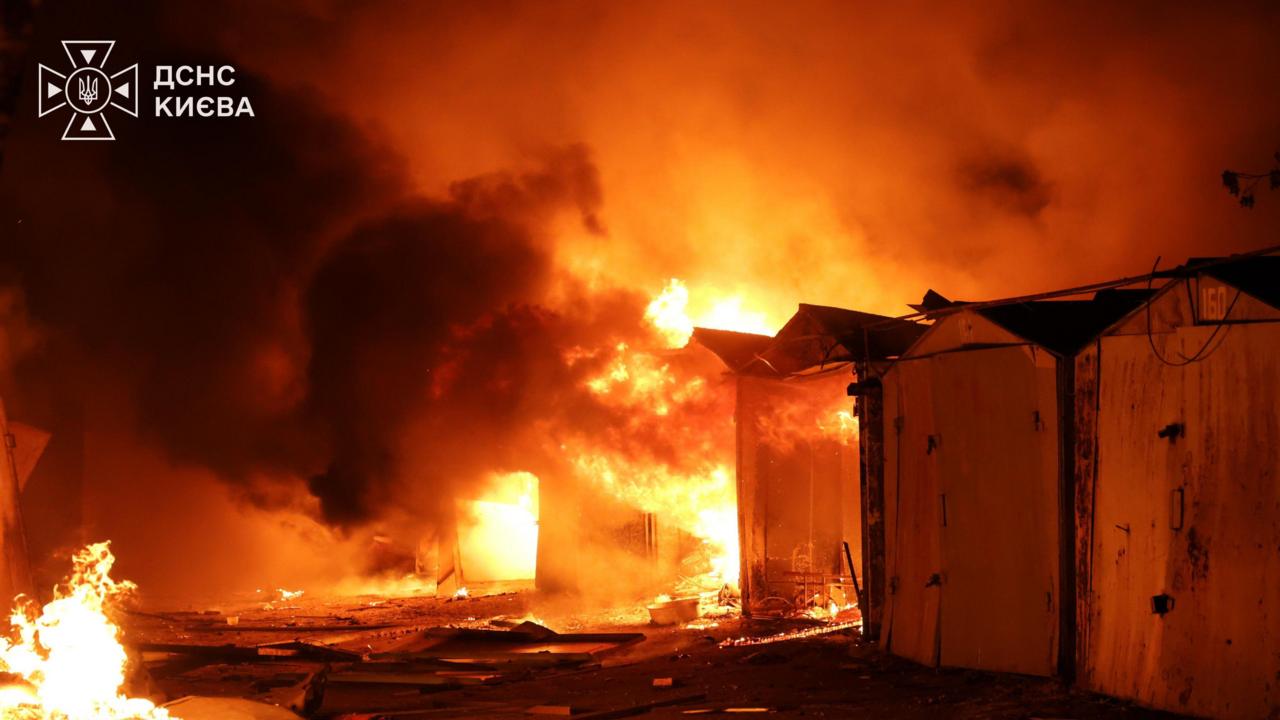
At least three people, including a child, have been killed in overnight Russian attacks near the Ukrainian capital Kyiv, a local official said.
Another three people were injured as ballistic missiles hit east of Kyiv, head of the regional military administration Timur
The new attack comes just days after 21 people were killed as Russia intensifies its strikes, aware that Ukraine has been running out of Western-donated interceptor missiles used to defend its skies.
On Saturday, Ukrainian President Volodymyr Zelensky issued a fresh call for more US-made Patriot interceptor missiles, saying what his country was receiving was not enough.
Zelensky's plea comes days after US President Donald Trump appeared to go back on a promise to grant Ukraine a licence to manufacture the defensive systems. On Saturday, Ukraine's president still referred to an agreement with the US on a licence.
Since coming to office, Trump has scaled back direct military aid for Ukraine. Instead, Ukraine's European allies have been buying expensive US supplies - such as Patriot missiles - which are then donated to Ukraine.
"Ukraine does not have, nor will it ever have, the sort of funds that Russia has, which it is using to finance the war," Zelensky said on Saturday.
"We have what we need, thanks to European aid and support from other countries. But additional funding specifically for Ukrainian production is what is needed."
Earlier in the week, Zelensky said the supply of interceptors from allies had been "significantly reduced" this year.
The Ukrainian leader was speaking during his first trip to Serbia.
He met President Aleksandar Vučić to discuss economic ties, security issues and relations with the European Union.
Zelensky is trying to build wider support for Ukraine, but Vučić, a close ally of Russian President Vladimir Putin, has refused to impose sanctions on Russia.
Serbia is trying to join the EU and has provided aid to Ukraine and promised to help it rebuild after the war.
At the joint news conference with Zelensky in the capital, Belgrade, Vučić focused on Ukraine's European accession and pledged to support it.
Putin launched a full-scale invasion of Ukraine in February 2022.
Since then, Russia has seized parts of Ukraine in the east, but the front lines have remained unchanged for a long time.
Trump's efforts to mediate an end to the conflict have faltered recently, leading to an escalation of attacks between the two warring sides.
Ukraine has developed advanced drones able to hit deep into Russian territory in an effort to take the war to Russia.
In the latest such attack, the Ukrainian military hit Russia's Ilsky and Syzran oil refineries during overnight attacks, causing fires at both, the Ukrainian general staff said on Saturday.
Moscow-linked vessels in the Black Sea were also hit - according to Zelensky the intention is to limit oil revenues used by Russia to "finance" its war.
The Russia-Ukraine war has threatened to spill over into neighbouring countries. There have been several instances of drones or missiles flying into their territories. On most occasions, Russia has been blamed, but denied any involvement.
On Saturday, a drone entered Bulgarian airspace and exploded near an international gas pipeline, its prime minister said, after crossing from Romania.
Rumen Radev said it had been carrying a "significant" amount of explosives but there had been no casualties or reports of damage.
Bulgaria's defence ministry said it appeared to be a Maya decoy drone, which is known to be used by Ukraine.
"At the moment, there is no reason to believe that the incident was intentional," the ministry said.
Later, Heorhii Tykhyi, spokesman for Ukraine's foreign ministry, was quoted as saying that "we can say with certainty that the Ukrainian Armed Forces did not intentionally direct any assets toward Bulgaria", but stopped short of admitting the drone was Ukrainian.
Source note
First published by BBC World
This article was supplied by BBC World through its RSS feed and formatted for Crooli Signal. The reporting remains with the original publisher.
Read the original at BBC World