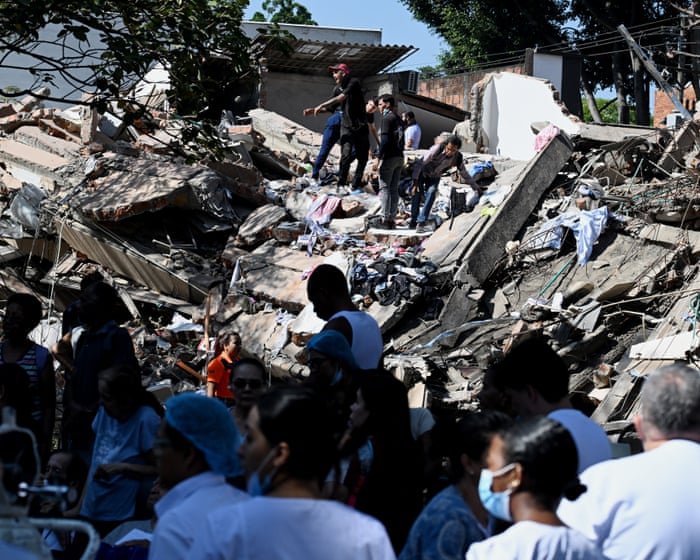
Colombian volunteers and rescuers have been sifting through rubble with bare hands and buckets into Monday evening, hunting for survivors after the huge quake in the country’s west that has left at least 111 people dead.
Colombia’s new president, Abelardo de la Espriella, declared a state of emergency and vowed a concerted rescue effort.
In the city of Cali, volunteers quickly went to work with picks, basic tools and their own hands to try to find survivors.
Andres Felipe Mejia was among those who joined a make-shift crew, telling Agence France-Presse:
\n We are trying to get everyone out alive. One of the rescuers asked anyone trapped to whistle, and someone whistled back.\n
“They pulled out a man and a baby, but the wife is still in there,” he said near a collapsed multi-story building.
Rescuers formed human chains to remove bricks and masonry, stopping every few minutes to listen for signs of life from those trapped below.
Mejia said:
\n A lot of people have come, with supplies, with food, helping the firefighters, helping the people.\n
Hospitals in five Colombian cities were put on red alert on Monday and a nighttime curfew was declared in Cali, according to local authorities. At least six local airports suspended operations, the civil aeronautics agency said.
The quake was felt across Colombia, including the capital of Bogota, where crowds of people rushed out into the street in their pyjamas.
Colombia’s president says the national government “stands with the people of Chocó” and that “immediate economic resources and humanitarian aid have already been allocated to support the more than 1,400 affected families and individuals”.
Abelardo de la Espriella – facing his first major crisis as president – also said on X that injured people and those requiring priority medical attention were being transferred to Medellín “with all available hospital capacity”.
His post said (in a translation):
\n Additionally, temporary rental subsidies will be implemented for families whose homes were damaged.\n Our priority is and will continue to be the lives and well-being of the affected communities.\n
De la Espriella finished his post:
\n ¡Firme por la Patria!” (Steadfast for the Homeland)\n
The US has announced $15.5m in earthquake aid for Colombia and said it is ready to support the new president’s response.
The state department said on social media the funding would go to “emergency shelter, food, protection and earthquake assessments”.
The post said:
\n We are united in prayer with the Colombian people and stand ready to support President [Abelardo de la Espriella] and his government as they assess the needs on the ground.\n
At the weekend the state department announced the Trump administration would provide $1bn in security assistance to the government of the new rightwing president, who used his inaugural speech to pledge a fight against drug trafficking as well as austerity measures to restore economic confidence.
- \n At least 111 have died and 87 people injured after dozens of buildings collapsed following a 7.4 magnitude earthquake that struck western Colombia on Monday morning – the largest to hit the country so far this century. After declaring a state of national disaster, Colombia’s new president, Abelardo de la Espriella, said in an address to the nation that his government had deployed all of its capabilities “to protect lives, assist affected communities and deliver aid wherever it is needed”. “The first priority is rescuing the people trapped under the rubble,” he said after around 1,600 buildings had been damaged, including at least 61 that completely collapsed.
- \n The president declared an emergency to expedite funding for the quake recovery while saying he would visit the disaster zone. “We aren’t going to leave people alone. They are in our hearts and we are going to tend to people with our full determination,” he said.
- \n The quake hit the remote Chocó region around 7.30am local time on Monday morning and was felt as far as the capital Bogotá (250 miles away), as well as neighbouring countries Ecuador, Venezuela and Panama. The epicentre was in San Jose Del Palmar, a community of about 4,800 people, and the initial quake was followed by two 2.8 and 4.8 magnitude aftershocks.
- \n Local officials confirmed deaths across several regions, including the coffee region of Risaralda and in Valle del Cauca, while rescue teams race to free people trapped under debris of collapsed buildings. Among the worst-hit areas was the city of Pereira, where at least 40 people have been killed, according to the mayor. In the department of Chocó, at least 12 people were killed, according to the local governor there, and at least 27 deaths have been reported in the neighbouring Valle del Cauca department, including at least three children and including 15 people in Cali, Colombia’s third-largest city.
- \n The United States and countries across Europe and Latin America offered support. The Trump administration is “closely monitoring” the earthquake, US secretary of state Marco Rubio said earlier, adding that Washington “stands ready to support” the people and the pro-Trump government. Other countries including Ecuador, France, Mexico and Brazil also offered support.
- \n It all comes less than two months after two earthquakes devastated parts of Venezuela, killing more than 6,100 people.
The mayor of Pereira has declared a state of public emergency and manifest urgency, along with a curfew that will be in effect from 6pm on Monday until 5am Tuesday in the following areas: Centro, Comuna Universidad, and SubCentro de la Comuna Cuba.
A car-free day measure will also start at 4pm on Monday and all day on Tuesday. Classes in educational institutions are also suspended.
“As mayor of Pereira, I must appeal to the solidarity of all Pereirans to go home because we need traffic to flow for emergency response agencies. We need to address this emergency. That is why, starting at this moment, I declare the Exceptional State of Curfew. Starting at this moment and indefinitely, classes are suspended in all educational institutions,” said Mauricio Salazar.
In the city, located in the heart of the coffee-producing mountains of Colombia and around 35 miles from the earthquake’s epicentre, 40 people have been reported dead. According to the mayor’s update, 65 buildings collapsed in the metropolitan area, and people are assumed trapped in 15 of them.
Several clinics were forced to close due either to demand on services or infrastructure risks, while Matecaña airport “suffered damage to its facilities, with several people deceased”.
Several people are also trapped in gondolas in Megacable, and the mayor said the rescue process for them would begin soon, but for the time being “their lives are not in danger at this moment” and “priority is being given to collapsed buildings”.
Santiago Velázquez, an industrial advisor, was driving to his son’s school in the suburbs between Pereira and Cartago, in Colombia’s Risaralda province, when the quake hit.
All the cars had to stop because they were being thrown around as the earth shook, Velázquez said.
He was already outside when it happened. “But people were falling and being struck by things as they tried to get out of their buildings,” he said.
Traffic is totally stuck at the moment, so Velázquez is getting a motorbike into the centre to try and help friends and family.
He knows of one landslide that carried away a few houses, and he had heard reports of some five-storey buildings in the suburbs that are “totally cracked”.
Some areas were without water, light or gas. A “disaster”, Velázquez said.
Colombia’s new president, Abelardo de la Espriella, said the death toll from the earthquake has now reached 111, Reuters is reporting.
At least 87 were injured and 61 buildings collapsed, he said, noting the rescue of survivors was his priority.
The death toll continues to climb after a powerful earthquake hit western Colombia on Monday.
At least 82 people have been confirmed dead, Reuters is reporting.
The province of Risaralda, in Colombia’s coffee-growing region, has suffered the highest toll so far, with governor Juan Diego Patino reporting 42 fatalities.
Dozens of injuries and heavy damage to buildings were also reported in Choco, the province closest to the epicentre of the 7.4 magnitude quake.
Abelardo De La Espriella, who was only sworn in as president a few days ago, has declared a national state of emergency to coordinate rescue efforts.
In the last hour, President Abelardo De La Espriella officially declared a situation of national disaster as the preliminary death toll rose to at least 72.
This will allow the executive branch to bypass bureaucratic hurdles to more quickly mobilise emergency funds and reallocate state resources to the most affected regions.
The decision was taken as the president convened an emergency meeting at the crisis room of Colombia’s National Unit for Disaster Risk Management in Bogotá.
We have another update to the fast-changing death toll.
More than 70 people have died after a powerful earthquake struck western Colombia, collapsing and severely damaging buildings in major cities including Cali and Pereira.
Citing government officials, the newspaper El Espectador said at least 72 people had been killed, 40 of them in Risaralda.
The mayor of Manizales, Jorge Eduardo Rojas Giraldo, said at least 12 buildings and 20 homes had been partially or completely or destroyed there.
- \n At least 47 people have been killed, according to the latest figures from officials, and dozens of buildings have collapsed in cities across western Colombia. The quake caused serious damage to buildings and prompted evacuations as far away as Bogota.
- \n People remain trapped in Cali, one of Colombia’s largest cities, after more than two dozen structures collapsed, mayor Alejandro Eder said. He added that the city had asked authorities in Bogota and Medellin to send disaster teams to support rescue efforts.
- \n Colombia’s Geological Service said that it had been “the highest magnitude earthquake registered in Colombia in the last decade” and that it had been followed by two 2.8 and 4.8 magnitude aftershocks. Authorities also reported that flights were suspended in the airports of Manizales, Quibdo, Armenia, Cartago y Buenaventura and Pereira.
- \n Colombian president Abelardo de la Espriella said in a post on X that he will personally supervise recovery efforts and install an emergency centre in San Jose del Palmar. The quake follows two back-to-back 7.2 and 7.5 magnitude earthquakes in Venezuela in late June. Those earthquakes destroyed hundreds of buildings and killed more than 5,000 people.
- \n Manizales’ mayor, Jorge Eduardo Rojas Giraldo, said more than 12 buildings and 20 homes had been partially or completely destroyed in that city. He said citizens needed to be “completely ready” for aftershocks.
- \n Jorge Moncayo, a 64-year-old taxi driver in Colombia’s third-biggest city, Cali, said he saw plumes of dust shoot up across the city from him home in the mountains as buildings collapsed after the earthquake. Residents in the city and rescue workers were already searching the rubble of collapsed buildings Monday morning.
- \n Footage shared by local media outlets showed homes and small buildings collapsing in the cities of Pereira, Cali and Quibdo. In Manizales, a city about 190 miles (300km) west of Bogota, one of the towers of the neo-Gothic cathedral collapsed and fell on the nave.
- \n In Cali, a city of 2m people, mayor Alejandro Eder said that residents were trapped in at least 19 buildings that had collapsed. Small earthquakes, known as “temblores,” are common in central and western Colombia, but those above 6.0 magnitude are rare. In 1999, a 6.2 magnitude quake near the city of Armenia, killed more than 1,100 people.
- \n Six airports damaged in today’s earthquake in Colombia have suspended operations, the civil aeronautics agency said. These airports in western Colombia serve Pereira, Manizales, Quibdo, Armenia, Cartago and Buenaventura, the agency wrote on X.
At least 47 people have been killed, according to the latest figures from officials, and dozens of buildings have collapsed in cities across western Colombia.
The quake caused serious damage to buildings and prompted evacuations as far away as Bogota.
Colombian president Abelardo de la Espriella says he will personally oversee recovery efforts. The quake was also felt in neighbouring Ecuador.
The death toll has been revised to 22, officials confirmed, after a 7.4 magnitude earthquake caused destruction in Colombia.
Local mayors had already announced the death of 20 people as a result of the natural disaster.
In Manizales, mayor Jorge Eduardo Rojas said a further person had been killed, bringing the figure to three.
One person has also died in Buenaventura, Colombia’s main Pacific port, when a building collapsed.
The death toll after a strong earthquake that rocked western Colombia has risen to at least 20, authorities said.
In the town of Pereira, 18 people were killed and others were trapped in buildings that collapsed, mayor Mauricio Salazar told Caracol Radio.
In Manizales, two people were killed, mayor Jorge Eduardo Rojas said in an interview with Blu Radio.
Six airports damaged in today’s earthquake in Colombia have suspended operations, the civil aeronautics agency said.
These airports in western Colombia serve Pereira, Manizales, Quibdo, Armenia, Cartago and Buenaventura, the agency wrote on X.
A powerful 7.4-magnitude earthquake struck western Colombia today, shaking the South American nation and neighbouring Ecuador and causing people to evacuate homes and buildings.
At least 20 buildings collapsed in an earthquake on Monday in the Colombian city of Cali, with people trapped inside, mayor Alejandro Eder said. The city has requested teams from Bogota and Medellin to aid in rescue efforts, he added.
The epicentre was in San Jose Del Palmar, a municipality in the Choco region about 250 miles (400km) west of Colombia’s capital, Bogota, the US Geological Survey and Colombia’s counterpart reported. The USGS said it struck at a depth of 66 miles (107km).
Choco governor Nubia Córdoba said on social media that in the regional capital, “there are injuries and serious damage to buildings,” without providing further details.
The temblor follows two back-to-back 7.2 and 7.5 magnitude earthquakes in Venezuela in late June. Those earthquakes destroyed hundreds of buildings and killed more than 5,000 people.
Key events
- 7m agoSearchers race to find quake survivors under building rubble
- 2h agoColombian president says aid allocated to quake victims
- 2h agoUS pledges $15.5m for Colombia quake relief
- 4h agoThe day so far
- 5h agoMayor of Pereira declares state of emergency
- 7h agoEyewitness: 'People were falling and being struck by things'
- 8h agoMore than 100 people dead after earthquake: Colombian president
- 8h agoAt least 82 killed after powerful earthquake hits western Colombia
- 8h agoColombia declares state of national disaster after 7.4 magnitude earthquake
- 9h agoMore than 70 people killed in Colombia earthquake
- 9h agoWhat we know so far
- 10h ago47 dead and buildings collapsed after 7.4-magnitude earthquake shakes western Colombia
- 10h agoEarthquake death toll revised to 22 - officials
- 11h agoAt least 20 dead after Colombia earthquake
- 12h agoSix airports in Colombia suspend operations
- 12h agoEarthquake on Colombia's Pacific Coast causes injuries and damage
Searchers race to find quake survivors under building rubble
Colombian volunteers and rescuers have been sifting through rubble with bare hands and buckets into Monday evening, hunting for survivors after the huge quake in the country’s west that has left at least 111 people dead.
Colombia’s new president, Abelardo de la Espriella, declared a state of emergency and vowed a concerted rescue effort.
In the city of Cali, volunteers quickly went to work with picks, basic tools and their own hands to try to find survivors.
Andres Felipe Mejia was among those who joined a make-shift crew, telling Agence France-Presse:
double quotation markWe are trying to get everyone out alive. One of the rescuers asked anyone trapped to whistle, and someone whistled back.
“They pulled out a man and a baby, but the wife is still in there,” he said near a collapsed multi-story building.
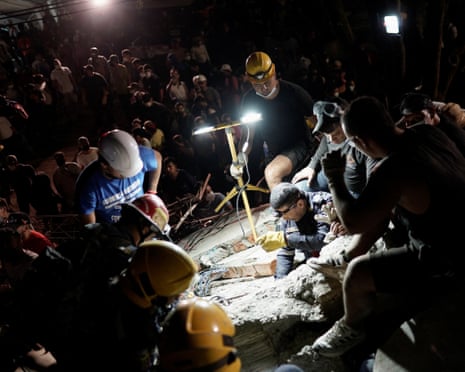
Rescuers work at the site of a collapsed building in Cali, western Colombia, on Monday evening. Photograph: Sergio Acero/Reuters
Rescuers formed human chains to remove bricks and masonry, stopping every few minutes to listen for signs of life from those trapped below.
Mejia said:
double quotation markA lot of people have come, with supplies, with food, helping the firefighters, helping the people.
Hospitals in five Colombian cities were put on red alert on Monday and a nighttime curfew was declared in Cali, according to local authorities. At least six local airports suspended operations, the civil aeronautics agency said.
The quake was felt across Colombia, including the capital of Bogota, where crowds of people rushed out into the street in their pyjamas.
More reports are emerging of the chaotic scenes that followed the earthquake that struck several cities across Colombia’s picturesque coffee region and Pacific, sending panicked residents on to the streets and damaging at least 1,500 buildings.
“People ran out naked, people jumped from the second floor of their homes” Wilmer Cuesta, a law student in Quibdo, told Agence France-Presse, recounting violent shaking.
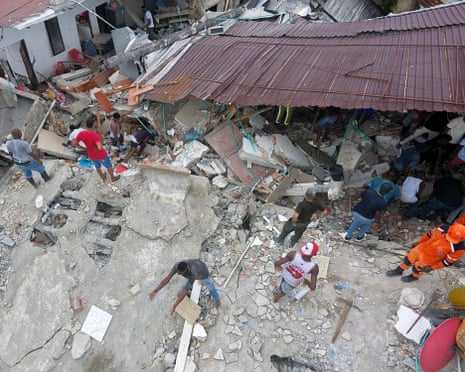
An aerial photograph of civilians searching through rubble of a building destroyed in Quibdo. Photograph: Jean Arriaga/EPA
Dentist Julian Pena was at home in Quibdo when he felt “very, very strong” shaking.
“People were praying in the street. It was overwhelming,” he told AFP. “I ran outside carrying nothing and found hundreds of people there.”
double quotation markThere are many buildings with gaps, with cracks. There are others that have completely collapsed.
There were scenes of destruction in several cities, with furniture and fabrics sandwiched between concrete, walls and floors tossed into irregular angles, and cabling strewn across roads.
Here are some of the latest images coming in from western Colombia as searches continue through the rubble of damaged buildings after the 7.4-magnitude earthquake – the country’s strongest recorded this century.
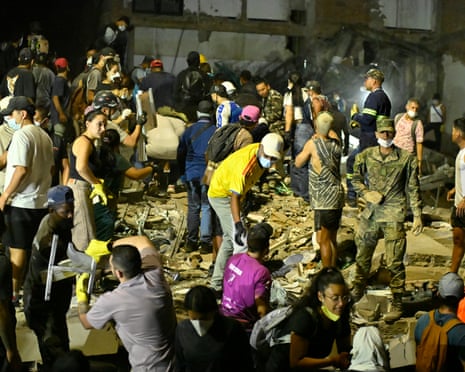
People and rescuers search for victims amid debris of a collapsed seven-story building at Plaza Bolivar in Pereira, Colombia. Photograph: Gabriel Aponte/Getty Images
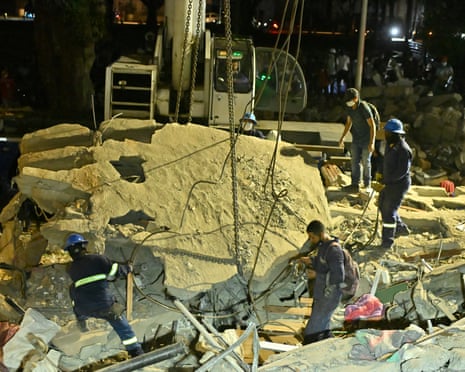
Rubble is moved amid the search at Plaza Bolivar. Photograph: Gabriel Aponte/Getty Images
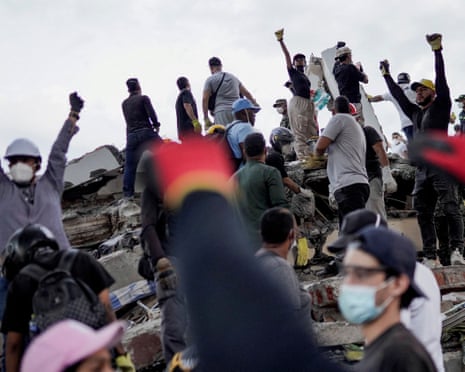
People raise their fists to call for silence to locate victims at the site of a collapsed building in Cali. Photograph: Sergio Acero/Reuters
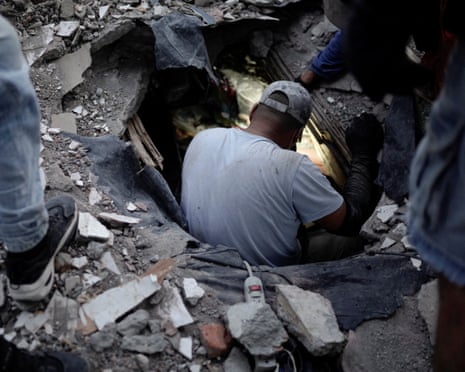
Rescuers at work in Cali. Photograph: Sergio Acero/Reuters
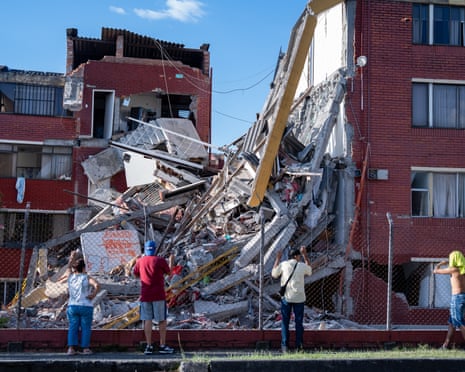
Damaged homes in Pereira, where mayor Mauricio Salazar on Monday declared a curfew in areas from 6pm to 5am ‘to protect the city’s businesses’. Photograph: Leonardo Castaneda/EPA
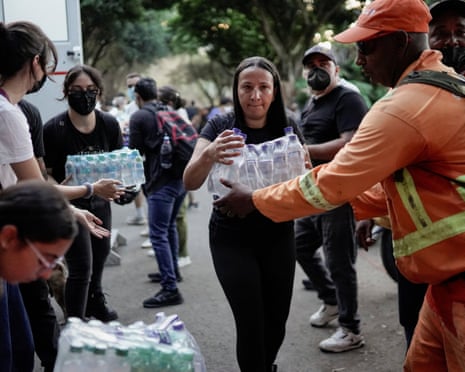
People distribute packs of bottled water in Cali. Photograph: Sergio Acero/Reuters
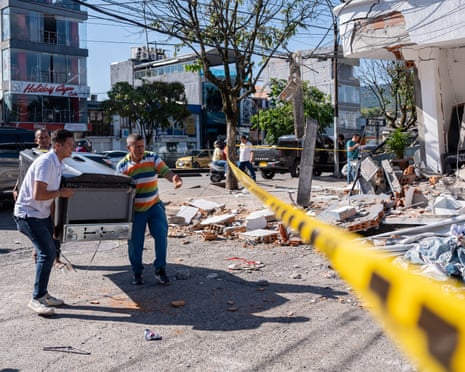
People remove a refrigerator from a damaged home in Pereira. Photograph: Leonardo Castaneda/EPA
Colombian president says aid allocated to quake victims
Colombia’s president says the national government “stands with the people of Chocó” and that “immediate economic resources and humanitarian aid have already been allocated to support the more than 1,400 affected families and individuals”.
Abelardo de la Espriella – facing his first major crisis as president – also said on X that injured people and those requiring priority medical attention were being transferred to Medellín “with all available hospital capacity”.
His post said (in a translation):
double quotation markAdditionally, temporary rental subsidies will be implemented for families whose homes were damaged. Our priority is and will continue to be the lives and well-being of the affected communities.
De la Espriella finished his post:
double quotation mark¡Firme por la Patria!” (Steadfast for the Homeland)
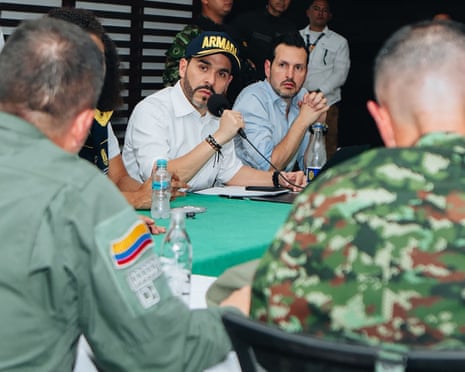
New president Abelardo de la Espriella (C) at a meeting with the armed forces on Monday after the 7.4-magnitude quake. Photograph: Colombian presidency/AFP/Getty Images
US pledges $15.5m for Colombia quake relief
The US has announced $15.5m in earthquake aid for Colombia and said it is ready to support the new president’s response.
The state department said on social media the funding would go to “emergency shelter, food, protection and earthquake assessments”.
The post said:
double quotation markWe are united in prayer with the Colombian people and stand ready to support President [Abelardo de la Espriella] and his government as they assess the needs on the ground.
At the weekend the state department announced the Trump administration would provide $1bn in security assistance to the government of the new rightwing president, who used his inaugural speech to pledge a fight against drug trafficking as well as austerity measures to restore economic confidence.
Further to the last post: Mauricio Andrade, a firefighter in Colombia’s third-largest city of Cali, said his team had rescued two adult women and two children from a collapsed building.
As he spoke, his team was preparing to rescue more people from the rubble.
“They are alive,” he told Reuters. “We are making space so we can free them and get them out.”
Juan Carlos Osorio told Caracol Television that the collapse of one building “sounded like a bomb”, as he helped remove debris from a collapsed structure in Cali.
double quotation markAll of us neighbours are working together, forming human chains. We need heavy equipment. There are many people trapped.
Reports from Chocó, near the epicentre of the quake, have been slowed by communications outages, with some areas still lacking mobile phone service hours after the earthquake.
Governor Nubia Carolina Cordoba said 12 people had been killed and 84 injured in the largely rural area.
The quake’s heaviest casualties appeared to be concentrated in Risaralda, part of Colombia’s coffee-growing region. Pereira, the department’s capital, suffered extensive damage, with rescue workers continuing to search collapsed buildings for survivors.
A four-story building crumbled in Pereira during the quake, according to Reuters-verified video, while footage from Manizales showed one of the side towers of the city’s landmark neo-Gothic cathedral collapsing and scattering debris onto nearby streets.
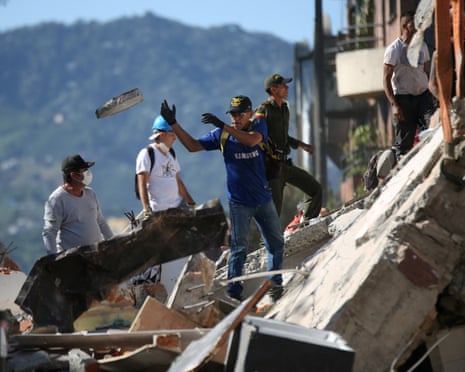
Residents in Pereira dig through the debris of a collapsed building after the quake. Photograph: Juan David Duque/Reuters
Reuters footage showed rescue workers, police and volunteers shovelling debris by hand and loading rubble into trucks as they searched for trapped survivors. Other footage showed damage to residential towers and emergency-service facilities, with debris crashing onto ambulances parked below.
Colombia’s Pacific region around the epicentre of the earthquake lies along the Ring of Fire, the line of seismic faults encircling the Pacific Ocean where most of the world’s quakes occur.
The Pacific, particularly the Chocó region where the quake hit, is one of Colombia’s poorest and is nestled in dense jungle. Much of the region is reachable only by boat or plane, which may pose a problem for authorities in assessing the wider toll, as the AP reports.
Northwestern University seismologist Suzan van der Lee said the quake’s powerful magnitude, inland location and strike-slip motion may have amplified damage in populated valleys despite its considerable depth.
“This one was far below the crust, and in theory it shouldn’t cause as much shaking,” she said, quoted by Reuters. “At this magnitude, it did actually cause a lot of shaking.”
The Colombia earthquake has left many people trapped under the debris of damaged buildings as their loved ones and rescue workers search through the rubble.
Search teams and civilians picked through the remains of destroyed buildings in the country’s third-largest city, Cali, passing large pieces of concrete and other rubble down a long line of volunteers.
“Our building has basically been left in ruins, and the building next to ours? Completely collapsed,” said Álvaro López, who cradled his dog as he watched the search.
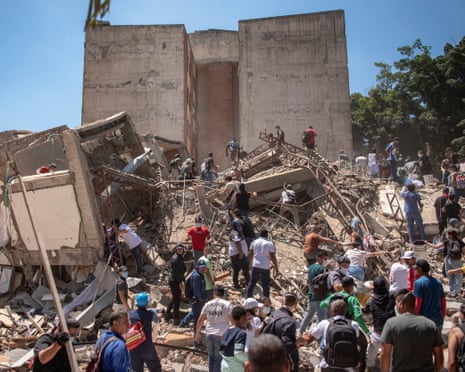
Residents digging through the debris of a collapsed building in Cali. Photograph: Christian EscobarMora/Reuters
The desperate scene recalled the searches still ongoing in neighbouring Venezuela weeks after that country was devastated by back-to-back quakes in June, the Associated Press reports.
Besides Cali, the quake-ravaged cities across western Colombia including Pereira, Quibdo and Manizales and was felt in neighboring Ecuador and Panama.
The day so far
- At least 111 have died and 87 people injured after dozens of buildings collapsed following a 7.4 magnitude earthquake that struck western Colombia on Monday morning – the largest to hit the country so far this century. After declaring a state of national disaster, Colombia’s new president, Abelardo de la Espriella, said in an address to the nation that his government had deployed all of its capabilities “to protect lives, assist affected communities and deliver aid wherever it is needed”. “The first priority is rescuing the people trapped under the rubble,” he said after around 1,600 buildings had been damaged, including at least 61 that completely collapsed.
- The president declared an emergency to expedite funding for the quake recovery while saying he would visit the disaster zone. “We aren’t going to leave people alone. They are in our hearts and we are going to tend to people with our full determination,” he said.
- The quake hit the remote Chocó region around 7.30am local time on Monday morning and was felt as far as the capital Bogotá (250 miles away), as well as neighbouring countries Ecuador, Venezuela and Panama. The epicentre was in San Jose Del Palmar, a community of about 4,800 people, and the initial quake was followed by two 2.8 and 4.8 magnitude aftershocks.
- Local officials confirmed deaths across several regions, including the coffee region of Risaralda and in Valle del Cauca, while rescue teams race to free people trapped under debris of collapsed buildings. Among the worst-hit areas was the city of Pereira, where at least 40 people have been killed, according to the mayor. In the department of Chocó, at least 12 people were killed, according to the local governor there, and at least 27 deaths have been reported in the neighbouring Valle del Cauca department, including at least three children and including 15 people in Cali, Colombia’s third-largest city.
- The United States and countries across Europe and Latin America offered support. The Trump administration is “closely monitoring” the earthquake, US secretary of state Marco Rubio said earlier, adding that Washington “stands ready to support” the people and the pro-Trump government. Other countries including Ecuador, France, Mexico and Brazil also offered support.
- It all comes less than two months after two earthquakes devastated parts of Venezuela, killing more than 6,100 people.
Source note
First published by The Guardian World
This article was supplied by The Guardian World through its RSS feed and formatted for Crooli Signal. The reporting remains with the original publisher.
Read the original at The Guardian World