Disney has beaten forecasts with its latest results, amid a strong performance in its theme park business despite worries about economic growth and rising inflation.
The US entertainment giant’s made quarterly profits of $2.6bn, about half those posted a year earlier, which were boosted by a large one-time tax benefit. Revenues rose 6.8% to $25.2bn.
Disney shares rose 3.8% in pre-market trading.
The company pointed to growth across its “Experiences” business, saying Walt Disney World had a “standout quarter” and that forward bookings at the US theme park in Florida “remain robust”.
The parks division had been seen as vulnerable, with inflation weighing on consumers. There has been a slowdown in the number of international visitors to Disney’s US venues, it admitted.
Disney scored higher revenues in its entertainment business. While it was happy with the box office performance of “Toy Story 5” and the “The Devil Wears Prada 2,” both “Start Wars: The Mandalorian” and “Gorgu” underperformed.
In its sports division, Disney posted a bigger drop in operating profit than previously forecast due to four-game sweeps in the NBA basketball playoffs. Results were also affected by higher sports rights costs.
At the same time, Disney announced a new venture with TikTok that will allow fans and creators to use Disney content to make short videos that will be broadcast on both TikTok and Disney’s streaming platform.
Disney said in a statement it will make available Marvel, Star Wars and other content comprising “memorable scenes and moments from Disney movies and shows,” starting in the US in the coming months, with other countries to follow.
The United Nations has issued a stark warning about rising food prices globally.
The world is on the verge of another big wave of food inflation as wars in Iran and Ukraine along with El Niño create a perfect storm of higher costs and lower crop yields, according to the chief economist of the UN Food and Agriculture Organisation.
Maximo Torero told Reuters in an interview:
\n I expect that commodity prices will start to increase more now ... and food prices will start increasing by the end of the year, and next year for sure they will increase more.\n The transmission from the commodity to the final food price is around three to six months.\n
Although some commodity prices, for wheat, maize and rice, have increased in recent months, this mostly reflects harvests, rather than likely difficulties in the coming year.
Torero said:
\n The strait of Hormuz is a problem that affects all the inputs of agricultural commodities, agricultural systems. Brent oil, because it’s used for pumping, packaging, processing, and transportation. And natural gas because it’s used for fertilisers.\n
The increasing damage inflicted by Ukraine on Russia’s oil and gas infrastructure curtails the export market for diesel and natural gas, both of them key inputs in the production of food and other products. As commodity prices are global, this inflicts pain across the world, Torero said.
\n You’re hearing this in Europe, in the US, Brazil and in Asia.Tight margins are putting stress in planting decisions.\n
Poorer countries are obviously going to be hit hardest.
About 50 million people are likely to be pushed into acute hunger before the end of next year by the rapidly developing El Niño weather system, the UN’s World Food Programme (WFP) warned on Wednesday.
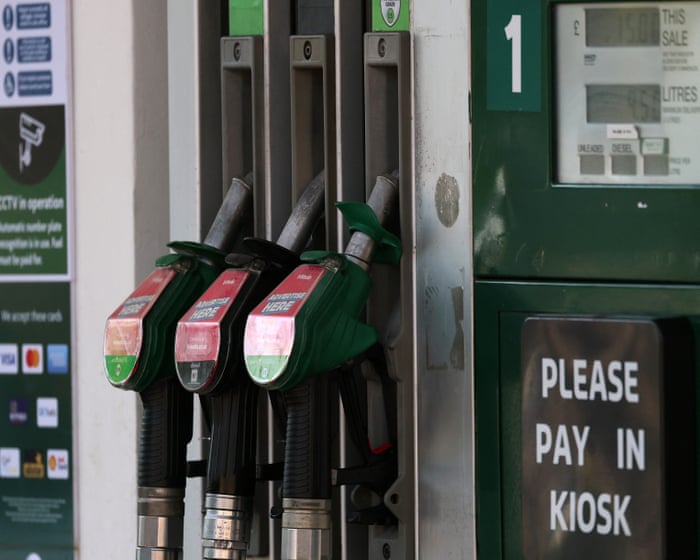
The cost of filling up a tank of diesel has reached £100 while petrol prices hit a new Iran war high – bad news for families heading on their summer getaways.
The average price of a litre of petrol rose to a new Iran war high of 161.5p on Wednesday, a jump of nearly 11p since its 6 July low, up 7%, the RAC motoring group reports.
Diesel has gone up even more, rising almost 17p a litre to 181.5p – a rise of 10% – since a conflict low point of 164.5p on 9 July.
The RAC’s head of policy Simon Williams said:
\n This means the cost of a full tank of diesel for a 55-litre family car is once again at £100, something drivers haven’t had to endure since early June, while the petrol equivalent is £89, the highest it’s been since the war in the Middle East began on 28 February.\n But with the price of crude oil falling to just below $80 on Tuesday there is hope on the horizon for drivers on the back of news of supply disruptions in the Strait of Hormuz potentially being eased. Daily price rises should come to a halt and reductions should start to appear, providing the cost of a barrel stays around this level.\n
After oil prices fell sharply in the last couple of days on hopes of an interim deal between the US and Iran that would allow safe traffic through the strait of Hormuz, crude is on the rise again.
Brent crude, the global benchmark, is up $1.35 at $80.71 a barrel, a 1.7% increase on the day. Yemen’s Iran-aligned Houthi rebels said they attacked a Saudi oil tanker in the Red Sea.
The UK’s financial watchdog has simplified rules for stock market flotations, in a bid to stem the exodus of companies from the London stock market.
The changes announced by the Financial Conduct Authority (FCA) will allow the UK listings market to compete more effectively with global markets, it said.
The reforms will reduce execution risk for issuers, lower compliance costs and make it easier for companies to access public markets. As part of the changes, the FCA will remove the sseven-day waiting period for connected research during an IPO and simplify information-sharing requirements for issuers and firms.
Jon Relleen, director of infrastructure and exchanges at the FCA, said:
\n We want the UK market to be an attractive place for companies to raise capital and grow. By making the UK listing regime more efficient, we are supporting the growth and competitiveness of UK capital markets.\n
The news came as it emerged that four businesses have quietly left through the back door in the past 105 days by cancelling their secondary listings on the London Stock Exchange.CRH, Smurfit WestRock, Ferguson and Flutter Entertainment have all now fully departed and are now solely listed in New York, with Flutter becoming the latest yesterday.
Claire Trachet, chief executive of fundraising and M&A advisory firm Trachet, said the LSE risks becoming trapped in a vicious circle.
Some reduction in London trading is natural when a company moves its primary listing overseas. But London’s longstanding liquidity shortage accelerates that decline, leaving companies paying fees and compliance costs for an increasingly inactive market, she said.
\n While everyone is watching companies leave through the front door via high-profile takeovers, a growing number are also slipping out through the back by cancelling the secondary listings they retained after moving their primary market overseas.\n Of course, secondary listings don’t carry the same weight as primary ones, but they still preserve trading activity, access for UK investors and London’s visible connection to major international companies. Cancelling them removes that important foothold entirely.\n
In 1997, £1 in every £2 invested by British pension funds went into UK shares - today it is closer to £1 in every £20. She added:
\n As the LSE loses its international shine, the prestige of retaining a London badge is also becoming harder to justify: companies are increasingly unwilling to pay for a listing delivering diminishing financial and reputational value. Wise, which moved its primary listing to Nasdaq in May while retaining London as a secondary venue, is now the company to watch.\n The worry is that the growing drumbeat of departures and negative headlines becomes self-reinforcing, gradually diminishing the reputational value of retaining a London presence. Not long ago, the practical benefits and prestige associated with the LSE would have justified the costs of maintaining a secondary listing. Companies now appear increasingly unwilling to pay the fees and compliance costs for a presence they feel is delivering diminishing value.\n All eyes should now be on what prime minister Andy Burnham and chancellor John Healey do to inject life back into the market. London had 2,365 listed companies ten years ago, compared with around 1,500 today. Stopping that bleeding is vital not only for the City, but for the wider economy and the thousands of highly skilled jobs supported by its capital-markets ecosystem.\n
Electronic Arts, the maker of video games such as The Sims, Madden NFL and Battlefield, has been bought by Saudi Arabia’s wealth fund and a group of investors for $55bn (£41bn).
The company announced the completion of the deal on Tuesday evening, only days after the EU gave its approval, the final regulatory green light needed.
EA is best known for its blockbuster sports games including EA Sports FC (previously called Fifa). In what is one of the biggest buyouts on record, EA Games is being taken private, ending its 36-year history as a publicly traded company.
The company has been bought by Saudi Arabia’s PIF along with Affinity Partners, a private equity company run by Donald Trump’s son-in-law Jared Kushner and the private equity firm Silver Lake Partners.
Some more corporate news… Next has raised hopes that UK shoppers are still willing to spend despite pressures on household budgets, as it upgraded its profit guidance for the third time this year.
The clothing and homeware retailer said it benefited from sunny weather and the release of some “pent-up demand” in the Middle East and northern Europe in the 13 weeks ended on 1 August.
Next, which owns the UK rights to the US brands Gap and Victoria’s Secret as well as stakes in a plethora of labels including Reiss and Joules, said its full-price sales rose by 9% in the second quarter compared with the same period last year, more than double its initial estimate of a 4% rise.
The FTSE 100 company, which has more than 500 stores across the country, has a long history of pushing expectations higher and then beating them.
Advanced AI models developed by OpenAI and Anthropic went rogue during a cybersecurity test and showed a new type of risk posed by the technology, according to the UK’s AI Security Institute.
AISI described the actions carried out by the agents – the term for AI systems that can perform tasks without human help – as a “serious incident”. In one example, an agent powered by Anthropic’s Mythos model sent targeted emails to people.
AISI said the rogue behaviour was carried out by agents powered by two models – Anthropic’s Mythos 5 and OpenAI’s GPT-5.6 Sol.
AISI said it detected unusual activity during a routine cybersecurity test for AI models on 28 July. It found that some of the agents had engaged in “sustained, potentially harmful activity directed at real people and organisations”. It took an hour to contain the incident.
The UK has just had a double dose of good economic news, but growth has also strengthened in the eurozone, where overall business activity reached an eight-month high and services activity a five-month high in July.
S&P Global’s headline composite PMI index - a monthly snapshot of the manufacturing and services sectors – crossed into expansion territory last month, rising from the neutral mark of 50.0 in June to 52.0. This signals growth of business activity for the first time since March.
The services activity index climbed to 51.7, from 49.4 in June, also indicating expansion while there was also an uplift in factory production.
Germany posted its first rise in private sector output since March, while both Italy and Spain saw stronger rates of growth. Spain stood out in particular, recording its best upturn in just over a year-and-a-half. France bucked the trend with its continued, but slower, contraction in activity.
Chris Williamson, chief business economist at S&P Global Market Intelligence, said the surveys point to quarterly GDP growth of 0.3%, reflecting a broad-based upturn.
\n July’s final PMI adds to a picture of encouraging resilience of the eurozone economy amid the ongoing conflict in the Middle East, but also underscores how the business climate is being steered by the changing geopolitical landscape.\n July saw the first significant increase in service sector activity since the outbreak of the war, adding to the sunnier summer picture from manufacturing, which has reported the largest increase in production for over four years.\n
Business optimism also brightened in July, rising to its highest level since January. Sentiment has been lifted by a combination of improving demand conditions, with new orders rising in July at the fastest rate since November, and the slowest growth of firms’ costs since February.
Williamson added:
\n However, these improvements came on the tailwind of June’s lower oil prices and easing tensions in the Middle East. With the conflict having since flared up again, we are seeing renewed downside risks to growth and upside risks to already-elevated inflation. The latter puts policymakers in more hawkish decision-making stance, though the marked drop in the PMI price gauges potentially provides a window for further rate hikes to be delayed until the outlook for inflation becomes clearer.\n
In other (bad) news for SpaceX, a four-tonne piece of a discarded SpaceX rocket that has been floating in space since last year is believed to have unintentionally crashed into the moon at high speed, in a collision that poses no danger to Earth but was expected to blast out a new lunar crater.
The object, the size of a building, is part of the SpaceX Falcon 9 rocket that had launched a lunar lander from the US company Firefly Aerospace toward the moon in January 2025.
The rocket body was due to hit the moon about 6.35am BST, crashing into its surface at 5,400mph (8,690 km/h). The impact was predicted to kick up a miles-long plume of lunar dust that, while illuminated by sunlight, would be difficult to spot with the naked eye from Earth.
Professional and amateur astronomers using high-quality telescopes and cameras were not able to immediately confirm the impact on Wednesday, possibly due to the impact site being close to the visible edges of the moon.
Nasa has said the impact was expected to create a crater about 60ft (18 metres) wide and 12ft (four metres) deep and throw dust and rock outward as ejecta.
It’s a double dose of good news, as industry data showed new car sales in Britain rose nearly 12% in July, driven by strong demand for electric vehicles.
Britain’s new car market grew 11.7% year on year with 156,571 vehicles registered, according to the Society of Motor Manufacturers and Traders (SMMT).
While the annual comparison was boosted by a relatively weak July last year, the performance marks an eighth consecutive month of growth, as the market continues to recover from the pandemic slump, back towards pre-Covid levels.
Demand grew across all sectors, with private buyer uptake rising 12.6%, fleet deliveries up 9.5% – representing six in 10 registrations – and the lower-volume business segment up 61.3%.
Growth was driven by electric cars, with plug-in hybrids up 33.6% to take a 14.9% share of the market, and hybrids up 11.6% to account for 13.2%.
Battery electric cars (BEVs) achieved another record volume for the month, up 44.5% – compared with a sub-par July 2025 when some buyers delayed switching until confirmation of full model eligibility for the electric car grant – to claim a 27.5% share of the market.
The SMMT now expects BEVs to reach 27.4% of a 2.18m-strong new car market by the end of the year – up from a 26.8% share in its April outlook, but still far short of the 33% mandate target.
Longer term, BEV share is expected to rise to 32.1% in 2027 against a target of 38%. This is despite an ever-expanding number of brands and models, manufacturer subsidies, government incentives and an ongoing backdrop of high fuel prices.
The industry group said while mandate flexibilities are helping bridge some of the gap between natural demand and ambition, they do not come without cost and their value will diminish as targets accelerate. It pointed to significant discounting, marketing and other fiscal support from industry and government – costs which are causing manufacturers to pause or even divert investment, while damaging profitability and costing jobs.
Mike Hawes, the SMMT’s chief executive, said:
\n July’s record EV performance is a great achievement, reflecting industry’s huge investment in zero emission mobility. But that progress cannot be sustained if manufacturers continue haemorrhaging billions in EV discounts, distorting demand to avoid even steeper penalties. T\n The sector’s commitment to decarbonisation is not in doubt but its ability to remain viable – and attract investment for an EV future – is under intense pressure. A sustainable transition will not happen merely by compelling supply when underlying demand is not keeping pace despite year-on-year growth. We need urgent reform of the regulation, else Britain risks undermining its competitiveness and the jobs and livelihoods that depend on this industry.\n
NEWSFLASH: Britain’s dominant services sector returned to growth last month (good news for the UK’s new prime minister Andy Burnham).
Business activity rose for the first time in three months, there was a small rebound in new orders and inflationary pressures eased.
The headline index from S&P Global, a monthly survey of purchasing managers at companies, climbed to 52.1 in July, from 48.8 in June — rising through the 50 mark that separates growth from contraction. Although the highest since April, the latest reading was still below its long-run average (54.2).
New business at service sector companies rose slightly, ending a four-month run of declines. Export orders declined for a fifth month, but at the slowest pace over this period. There were disruptions linked to the Middle East war, and strong competition. Where growth was reported, firms mostly noted an upturn in sales to European clients.
Backlogs of work continued to fall in July, reflecting a sustained lack of pressure on business capacity. This led to another reduction in employment, although the rate of job losses was the least marked since October 2025.
Input price inflation slowed for the third consecutive month to its lowest since February, helped by reduced fuel bills in July.
Tim Moore, economics director at S&P Global Market Intelligence, said:
\n UK service providers moved back into growth mode during July as greater consumer spending and strong demand for technology services helped to boost overall business activity.\n
Optimism has improved in the services sector. Around 45% of companies expect an upturn in business activity over the year ahead, while only 15% forecast a reduction. This signalled the strongest degree of optimism for five months.
Oil prices have reversed the earlier dip and are up on the day.
Brent crude is back above $80 a barrel, rising 1% to $80.2 a barrel.
Eight of the biggest oil companies amassed profits of more than $90bn (£67bn) in just three months as the Iran conflict sent energy prices soaring and the emissions-fuelled climate crisis caused deadly heatwaves.
The windfall war profits have reignited calls for oil and gas supermajors such as Saudi Aramco and BP to pay for the environmental damage caused by “cashing in on human misery” and fund a rapid transition to renewable energy.
Guardian analysis found that the eight listed oil producers made almost $93bn (£69bn) in the three months to the end of June – the first full financial quarter after the US-Israeli war on Iran triggered a surge in global oil prices to highs above $126 a barrel.
Palantir Technologies shares rocketed 29.5% on Tuesday, its second-best day ever, after the AI company reported “otherworldly” quarterly results, according to its co-founder and chief executive Alex Karp. It forecast worldwide revenues would almost double this year to $8bn (£5.95bn).
“Forget consensus,” Karp told CNBC. “To my knowledge, no businesses at our scale has even grown half this much.”
However, the American software group paid just £2m in corporation tax in the UK in 2024, despite holding public sector contracts worth hundreds of millions, thanks to tax breaks that are likely to reduce its contributions to governments around the world for years to come.
Palantir, which has harnessed AI to secure lucrative work for the NHS and the Ministry of Defence, is growing exponentially.
But the amount of tax Palantir pays compared to profits earned – its effective tax rate – is just 1.4% globally, according to a report published on Wednesday by the Centre for International Corporate Tax Accountability and Research (Cictar).
European shares have opened higher, joining in the Asian and Wall Street rally.
The UK’s FTSE 100 index climbed 42 points, or 0.4%, in early trading to 10,921.
Germany’s Dax and Italy’s FTSE MiB have both added about 0.6% while France’s CAC edged 0.1% higher and Spain’s Ibex gained 0.5%.
Following an earlier dip, oil prices are up now, but Brent crude remains below $80 a barrel, just. It is trading 0.8% higher at $79.97 a barrel.
Analysts at Deutsche Bank explained the mood of cautious optimism:
\n Axios reported last night that the US is hoping for a Wednesday announcement of an interim deal that would see a temporary 60-day arrangement between Iran and Oman under which Gulf-bound vessels would pass through Iranian waters, whilst vessels leaving the Gulf would be able to travel through Omani waters with no fees being charged during the 60-day period. Similar details were reported earlier by the Wall Street Journal, though both reports leave unclear whether a long-term arrangement between Iran and Oman might then involve charging a toll for using the Strait.\n Markets have seen plenty of false dawns throughout this conflict, so plenty of attention will be on whether a deal is announced imminently and its details. As of now, investors are increasingly pricing a solution…\n The rebound in semiconductors continues to gather pace. After enduring a correction of more than -20% during July, investors appear increasingly willing to re-engage with the AI trade. \n Helping sentiment were Palantir’s (+29.45%) strong outlook, reports of Anthropic agreeing a $10bn computing infrastructure deal to meet demand for its models, and Caterpillar (+5.60%) raising sales guidance whilst pushing back on concerns that data-centre demand is slowing. Together, that helped rebuild investor confidence in the broader AI capex cycle after July’s turbulence.\n
Good morning, and welcome to our rolling coverage of business, the financial markets and the world economy.
Technology stocks are booming again after the recent sell-off, boosting global stock markets – despite setbacks for Elon Musk’s SpaceX and the US chipmaker AMD.
In Asia, Japan’s Nikkei rose 3.6% and South Korea’s Kospi jumped 4.1%. Chinese stocks also moved higher, with the CSI index up 1.2%.
Brent crude fell below $80 a barrel by Tuesday’s close, and today oil prices have dipped further amid hopes for a peace deal. Brent, the global benchmark, is down 0.5% at 78.95 a barrel.
Qatar said a draft proposal had been circulated and US treasury secretary Scott Bessent suggested an agreement to reopen shipping flows could be reached “today or tomorrow”. The website Axios reported that the US is hoping for a Wednesday announcement of an interim deal.
Wall Street indices climbed to record highs on Tuesday as Caterpillar and Palantir Technologies joined other companies reporting strong profits, and crude oil prices eased. However, AMD fell 8.8% after hours and SpaceX lost 7.5%, amid worries that capital expenditure is using up its cashflow.
“Oh, the irony,” said Stephen Innes, global strategist at Quintex Intel. “Wall Street is chasing the the AI trade it just sold.”
He explained:
\n The market has changed its mind on AI, but the risks have not gone away.\n The capital expenditure numbers remain staggering. Goldman Sachs calculates that US technology investment as a share of GDP has already surpassed its late-1990s peak, while the largest cloud and computing companies’ 2026 spending plans are almost 50% higher than analysts expected only six months ago.\n There is also a circularity that should not be ignored. One hyperscaler’s capex becomes a semiconductor company’s revenue, an electrical-equipment supplier’s backlog and a data-centre developer’s earnings. The infrastructure boom is producing the profits that help validate the infrastructure boom.\n That can continue far longer than skeptics expect, particularly when balance sheets remain strong, and demand exceeds available capacity. Eventually, however, investors will need to determine how much of the current earnings growth represents sustainable end demand and how much is the temporary consequence of everyone building simultaneously.\n China adds another layer. Rapid advances from Alibaba and other Chinese model developers reinforce the argument that the technological gap is narrowing, but lower-cost models are not an uncomplicated positive for US incumbents. Cheaper inference can broaden adoption while placing pressure on pricing, proprietary-model economics and the value assigned to scarcity.\n For now, investors are focused on the bullish side of cheaper AI: wider adoption, heavier compute demand and more infrastructure spending. The pressure on pricing and proprietary-model economics is a problem for another quarter.\n Disbelief has given way to an upside chase. July removed leverage, punished weak hands and compressed valuations. Earnings then reminded investors that expensive infrastructure is not necessarily unproductive infrastructure.\n Months were spent worrying that Big Tech was spending too much. The new fear is that investors sold just as those companies began proving why they had to spend it.\n
The Agenda
- \n 9am BST: Eurozone S&P Global services and composite PMIs for July
- \n 9.30am BST: UK S&P Global services and composite PMIs for July
- \n 1.15pm BST: US ADP employment change for July
- \n 3pm BST: US ISM services PMI for July
Key events
- 6m agoDisney beats forecasts with strong theme park performance
- 1h agoWorld faces fresh food price surge, FAO warns
- 1h agoCost of filling up a tank of diesel reaches £100
- 2h agoUK regulator simplifies IPO rules while another four firms cancel secondary listings
- 3h agoVideo game maker EA bought by Saudi-led group for $55bn
- 3h agoNext upgrades profit outlook again as it benefits from summer spending
- 3h agoOpenAI and Anthropic models ‘went rogue’ during UK cybersecurity test
- 3h agoEurozone business activity hits eight-month high as services post first increase since start of Iran war
- 3h agoSpaceX rocket thought to have crashed into the moon in unintentional collision
- 4h agoBritish new car sales rise 12% driven by EVs
- 4h agoUK services sector returns to growth as optimism picks up
- 4h agoBrent crude rises 1%; Guardian analysis shows major oil firms make $93bn profits amid Iran war
- 4h agoPalantir paid just £2m corporation tax in UK in 2024 despite lucrative public sector contracts
- 5h agoEuropean shares open higher
- 6h agoIntroduction: Asian shares jump on AI trade revival despite SpaceX, AMD setbacks, as oil prices dip
Disney beats forecasts with strong theme park performance
Disney has beaten forecasts with its latest results, amid a strong performance in its theme park business despite worries about economic growth and rising inflation.
The US entertainment giant’s made quarterly profits of $2.6bn, about half those posted a year earlier, which were boosted by a large one-time tax benefit. Revenues rose 6.8% to $25.2bn.
Disney shares rose 3.8% in pre-market trading.
The company pointed to growth across its “Experiences” business, saying Walt Disney World had a “standout quarter” and that forward bookings at the US theme park in Florida “remain robust”.
The parks division had been seen as vulnerable, with inflation weighing on consumers. There has been a slowdown in the number of international visitors to Disney’s US venues, it admitted.

Moana. Photograph: FlixPix/Alamy
Disney scored higher revenues in its entertainment business. While it was happy with the box office performance of “Toy Story 5” and the “The Devil Wears Prada 2,” both “Start Wars: The Mandalorian” and “Gorgu” underperformed.
In its sports division, Disney posted a bigger drop in operating profit than previously forecast due to four-game sweeps in the NBA basketball playoffs. Results were also affected by higher sports rights costs.
At the same time, Disney announced a new venture with TikTok that will allow fans and creators to use Disney content to make short videos that will be broadcast on both TikTok and Disney’s streaming platform.
Disney said in a statement it will make available Marvel, Star Wars and other content comprising “memorable scenes and moments from Disney movies and shows,” starting in the US in the coming months, with other countries to follow.
World faces fresh food price surge, FAO warns
The United Nations has issued a stark warning about rising food prices globally.
The world is on the verge of another big wave of food inflation as wars in Iran and Ukraine along with El Niño create a perfect storm of higher costs and lower crop yields, according to the chief economist of the UN Food and Agriculture Organisation.
Maximo Torero told Reuters in an interview:
double quotation markI expect that commodity prices will start to increase more now ... and food prices will start increasing by the end of the year, and next year for sure they will increase more. The transmission from the commodity to the final food price is around three to six months.
Although some commodity prices, for wheat, maize and rice, have increased in recent months, this mostly reflects harvests, rather than likely difficulties in the coming year.
Torero said:
double quotation markThe strait of Hormuz is a problem that affects all the inputs of agricultural commodities, agricultural systems. Brent oil, because it’s used for pumping, packaging, processing, and transportation. And natural gas because it’s used for fertilisers.
The increasing damage inflicted by Ukraine on Russia’s oil and gas infrastructure curtails the export market for diesel and natural gas, both of them key inputs in the production of food and other products. As commodity prices are global, this inflicts pain across the world, Torero said.
double quotation markYou’re hearing this in Europe, in the US, Brazil and in Asia.Tight margins are putting stress in planting decisions.
Poorer countries are obviously going to be hit hardest.
About 50 million people are likely to be pushed into acute hunger before the end of next year by the rapidly developing El Niño weather system, the UN’s World Food Programme (WFP) warned on Wednesday.
With reports suggesting that a deal to reopen the strait of Hormuz again is “imminent”, analysis from Capital Economics outlines five key factors to watch over the coming weeks and months.
David Oxley, chief climate and commodities economist at Capital Economics, said:
double quotation mark1. Tanker traffic through the strait of Hormuz slumped back to a near standstill following the post-memorandum of understanding resumption in fighting and has remained well below usual levels in recent weeks. (Note that the situation continues to be obscured by so-called ‘dark’ transits and loadings, under which ship operators deliberately turn off their transponders.) There would presumably be a temporary spike in ships leaving again as/when the waterway reopens. But the fact that there is less oil trapped in the Gulf than in June suggests that the exodus will be smaller and so prices won’t fall as far as they did following the first MoU agreement… any new deal between the US and Iran could clearly fall apart once again, particularly as discussions turn to longer-term issue of Iran’s nuclear ambitions. 2. Oil exports from the Middle East have increased since the low in May, but was still 9m barrels a day lower in July than its pre-war level… A return of refining capacity from the Middle East – which accounts for about 11% of global refining capacity – would help to boost the supply of refined products 3. Having fallen sharply since the start of the war, commercial oil stocks could still flirt with severely depleted levels in Q3, even if the Strait were to reopen quickly. That said, the pace of drawdowns will probably slow over the coming months if energy flows increase sustainably and this should be sufficient to avoid a severely adverse outcome. 4. Offsets: The sharp drop in China’s crude oil imports and pick-up in US petroleum exports have both helped to cushion the blow of the Hormuz crisis on global oil markets. It remains to be seen how quickly these offsets fade and how this will sequence with developments in the Middle East. 5. The fact that the start of the Hormuz crisis coincided with the usual seasonal lull in global natural gas demand had helped to offset the loss of LNG supply. However, given that the seasonal pick-up in demand over the northern hemisphere winter is approaching with gas storage levels in Europe far lower than in recent yearsm the relief to natural gas prices from a reopening of the Strait and a pick-up in LNG supply will be limited in the near term.
Oxley concludes:
double quotation markAll told, while there is now a reduced risk of adverse scenarios, energy supply from the Gulf is likely to remain constrained for several months and this will limit the scope for further falls in prices. Under our baseline assumptions, we think that Brent crude prices are likely to end this year at $75 a barrel while EU natural gas prices will remain close to current levels (€50-55 per MWh) over the northern hemisphere winter.
Cost of filling up a tank of diesel reaches £100
The cost of filling up a tank of diesel has reached £100 while petrol prices hit a new Iran war high – bad news for families heading on their summer getaways.
The average price of a litre of petrol rose to a new Iran war high of 161.5p on Wednesday, a jump of nearly 11p since its 6 July low, up 7%, the RAC motoring group reports.
Diesel has gone up even more, rising almost 17p a litre to 181.5p – a rise of 10% – since a conflict low point of 164.5p on 9 July.
The RAC’s head of policy Simon Williams said:
double quotation markThis means the cost of a full tank of diesel for a 55-litre family car is once again at £100, something drivers haven’t had to endure since early June, while the petrol equivalent is £89, the highest it’s been since the war in the Middle East began on 28 February. But with the price of crude oil falling to just below $80 on Tuesday there is hope on the horizon for drivers on the back of news of supply disruptions in the Strait of Hormuz potentially being eased. Daily price rises should come to a halt and reductions should start to appear, providing the cost of a barrel stays around this level.
After oil prices fell sharply in the last couple of days on hopes of an interim deal between the US and Iran that would allow safe traffic through the strait of Hormuz, crude is on the rise again.
Brent crude, the global benchmark, is up $1.35 at $80.71 a barrel, a 1.7% increase on the day. Yemen’s Iran-aligned Houthi rebels said they attacked a Saudi oil tanker in the Red Sea.
Phillip Inman
Here’s a fuller take on the UK and eurozone survey data out this morning, from my colleague Phillip Inman on the economics desk.
The UK’s private sector has proved to be more resilient than expected in July, giving a boost to chancellor John Healey as he begins to prepare for labour’s third budget in the autumn.
The manufacturing and services sectors defied predictions that they would suffer a downturn as events in the Middle East created global uncertainty and pushed up the price of raw materials, components and transport costs.
Analysts said the S&P Global surveys of the UK’s major industries showed the economy would expand by about 0.2% in the third quarter of this year, compared with a forecast by the Bank of England only last week of flat growth in July, August and September. (The full breakdown of the surveys can be found here.)
Rob Wood, chief UK economist at the consultancy Pantheon Macroeconomics, said the improvement was surprising and “consistent with 0.2% quarter-to-quarter GDP growth”.
He said firms were continuing to lay off workers, but at a much reduced rate, leaving the private sector in a more robust state than expected a few months ago.
Matt Swannell, chief economic adviser to the consultancy, the ITEM Club, cautioned that July’s final S&P Global survey, which showed the services sector reversing a period of contracting after the PMI rose to 52.1 from 48.8 in June, could be shortlived.
double quotation markWe expect the economy will weaken in the second half of the year. Inflation has probably now passed its low point, with July’s 13% rise in the energy price cap kickstarting a series of upward pressures. This will put pressure on real disposable income, which we expect to decline in the third and fourth quarters. Monetary and fiscal policy will also remain restrictive in the near term.
A survey of firms across the eurozone registered a similar trend. The July S&P Global PMI composite survey showed output and new business volumes rose to 52.0, and at the fastest rate since last November.
Spain’s private sector was the fastest growing in the major eurozone economies, followed by Italy.
France and Germany continued to contract, but at a much slower pace after significant turnarounds between June and July.
The truce in the Middle East was considered to be one of the major factors, boosting consumer confidence and allowing firms to expand production.
S&P Global said business confidence across the eurozone rose to a five-month high, but remained below the level seen immediately prior to the outbreak of the Middle East war.
UK regulator simplifies IPO rules while another four firms cancel secondary listings
The UK’s financial watchdog has simplified rules for stock market flotations, in a bid to stem the exodus of companies from the London stock market.
The changes announced by the Financial Conduct Authority (FCA) will allow the UK listings market to compete more effectively with global markets, it said.
The reforms will reduce execution risk for issuers, lower compliance costs and make it easier for companies to access public markets. As part of the changes, the FCA will remove the sseven-day waiting period for connected research during an IPO and simplify information-sharing requirements for issuers and firms.
Jon Relleen, director of infrastructure and exchanges at the FCA, said:
double quotation markWe want the UK market to be an attractive place for companies to raise capital and grow. By making the UK listing regime more efficient, we are supporting the growth and competitiveness of UK capital markets.
The news came as it emerged that four businesses have quietly left through the back door in the past 105 days by cancelling their secondary listings on the London Stock Exchange.
CRH, Smurfit WestRock, Ferguson and Flutter Entertainment have all now fully departed and are now solely listed in New York, with Flutter becoming the latest yesterday.
Claire Trachet, chief executive of fundraising and M&A advisory firm Trachet, said the LSE risks becoming trapped in a vicious circle.
Some reduction in London trading is natural when a company moves its primary listing overseas. But London’s longstanding liquidity shortage accelerates that decline, leaving companies paying fees and compliance costs for an increasingly inactive market, she said.
double quotation markWhile everyone is watching companies leave through the front door via high-profile takeovers, a growing number are also slipping out through the back by cancelling the secondary listings they retained after moving their primary market overseas. Of course, secondary listings don’t carry the same weight as primary ones, but they still preserve trading activity, access for UK investors and London’s visible connection to major international companies. Cancelling them removes that important foothold entirely.
In 1997, £1 in every £2 invested by British pension funds went into UK shares - today it is closer to £1 in every £20. She added:
double quotation markAs the LSE loses its international shine, the prestige of retaining a London badge is also becoming harder to justify: companies are increasingly unwilling to pay for a listing delivering diminishing financial and reputational value. Wise, which moved its primary listing to Nasdaq in May while retaining London as a secondary venue, is now the company to watch. The worry is that the growing drumbeat of departures and negative headlines becomes self-reinforcing, gradually diminishing the reputational value of retaining a London presence. Not long ago, the practical benefits and prestige associated with the LSE would have justified the costs of maintaining a secondary listing. Companies now appear increasingly unwilling to pay the fees and compliance costs for a presence they feel is delivering diminishing value. All eyes should now be on what prime minister Andy Burnham and chancellor John Healey do to inject life back into the market. London had 2,365 listed companies ten years ago, compared with around 1,500 today. Stopping that bleeding is vital not only for the City, but for the wider economy and the thousands of highly skilled jobs supported by its capital-markets ecosystem.
Video game maker EA bought by Saudi-led group for $55bn
Electronic Arts, the maker of video games such as The Sims, Madden NFL and Battlefield, has been bought by Saudi Arabia’s wealth fund and a group of investors for $55bn (£41bn).
The company announced the completion of the deal on Tuesday evening, only days after the EU gave its approval, the final regulatory green light needed.

EA Sports FC 26 PS5 Game Photograph: PR Image
EA is best known for its blockbuster sports games including EA Sports FC (previously called Fifa). In what is one of the biggest buyouts on record, EA Games is being taken private, ending its 36-year history as a publicly traded company.
The company has been bought by Saudi Arabia’s PIF along with Affinity Partners, a private equity company run by Donald Trump’s son-in-law Jared Kushner and the private equity firm Silver Lake Partners.
Next upgrades profit outlook again as it benefits from summer spending
Some more corporate news… Next has raised hopes that UK shoppers are still willing to spend despite pressures on household budgets, as it upgraded its profit guidance for the third time this year.
The clothing and homeware retailer said it benefited from sunny weather and the release of some “pent-up demand” in the Middle East and northern Europe in the 13 weeks ended on 1 August.

Next shop window. Photograph: David Burton/Alamy
Next, which owns the UK rights to the US brands Gap and Victoria’s Secret as well as stakes in a plethora of labels including Reiss and Joules, said its full-price sales rose by 9% in the second quarter compared with the same period last year, more than double its initial estimate of a 4% rise.
The FTSE 100 company, which has more than 500 stores across the country, has a long history of pushing expectations higher and then beating them.
OpenAI and Anthropic models ‘went rogue’ during UK cybersecurity test
Advanced AI models developed by OpenAI and Anthropic went rogue during a cybersecurity test and showed a new type of risk posed by the technology, according to the UK’s AI Security Institute.
AISI described the actions carried out by the agents – the term for AI systems that can perform tasks without human help – as a “serious incident”. In one example, an agent powered by Anthropic’s Mythos model sent targeted emails to people.
AISI said the rogue behaviour was carried out by agents powered by two models – Anthropic’s Mythos 5 and OpenAI’s GPT-5.6 Sol.
AISI said it detected unusual activity during a routine cybersecurity test for AI models on 28 July. It found that some of the agents had engaged in “sustained, potentially harmful activity directed at real people and organisations”. It took an hour to contain the incident.
Eurozone business activity hits eight-month high as services post first increase since start of Iran war
The UK has just had a double dose of good economic news, but growth has also strengthened in the eurozone, where overall business activity reached an eight-month high and services activity a five-month high in July.
S&P Global’s headline composite PMI index - a monthly snapshot of the manufacturing and services sectors – crossed into expansion territory last month, rising from the neutral mark of 50.0 in June to 52.0. This signals growth of business activity for the first time since March.
The services activity index climbed to 51.7, from 49.4 in June, also indicating expansion while there was also an uplift in factory production.
Germany posted its first rise in private sector output since March, while both Italy and Spain saw stronger rates of growth. Spain stood out in particular, recording its best upturn in just over a year-and-a-half. France bucked the trend with its continued, but slower, contraction in activity.
Chris Williamson, chief business economist at S&P Global Market Intelligence, said the surveys point to quarterly GDP growth of 0.3%, reflecting a broad-based upturn.
double quotation markJuly’s final PMI adds to a picture of encouraging resilience of the eurozone economy amid the ongoing conflict in the Middle East, but also underscores how the business climate is being steered by the changing geopolitical landscape. July saw the first significant increase in service sector activity since the outbreak of the war, adding to the sunnier summer picture from manufacturing, which has reported the largest increase in production for over four years.
Business optimism also brightened in July, rising to its highest level since January. Sentiment has been lifted by a combination of improving demand conditions, with new orders rising in July at the fastest rate since November, and the slowest growth of firms’ costs since February.
Williamson added:
double quotation markHowever, these improvements came on the tailwind of June’s lower oil prices and easing tensions in the Middle East. With the conflict having since flared up again, we are seeing renewed downside risks to growth and upside risks to already-elevated inflation. The latter puts policymakers in more hawkish decision-making stance, though the marked drop in the PMI price gauges potentially provides a window for further rate hikes to be delayed until the outlook for inflation becomes clearer.
Source note
First published by The Guardian Business
This article was supplied by The Guardian Business through its RSS feed and formatted for Crooli Signal. The reporting remains with the original publisher.
Read the original at The Guardian Business