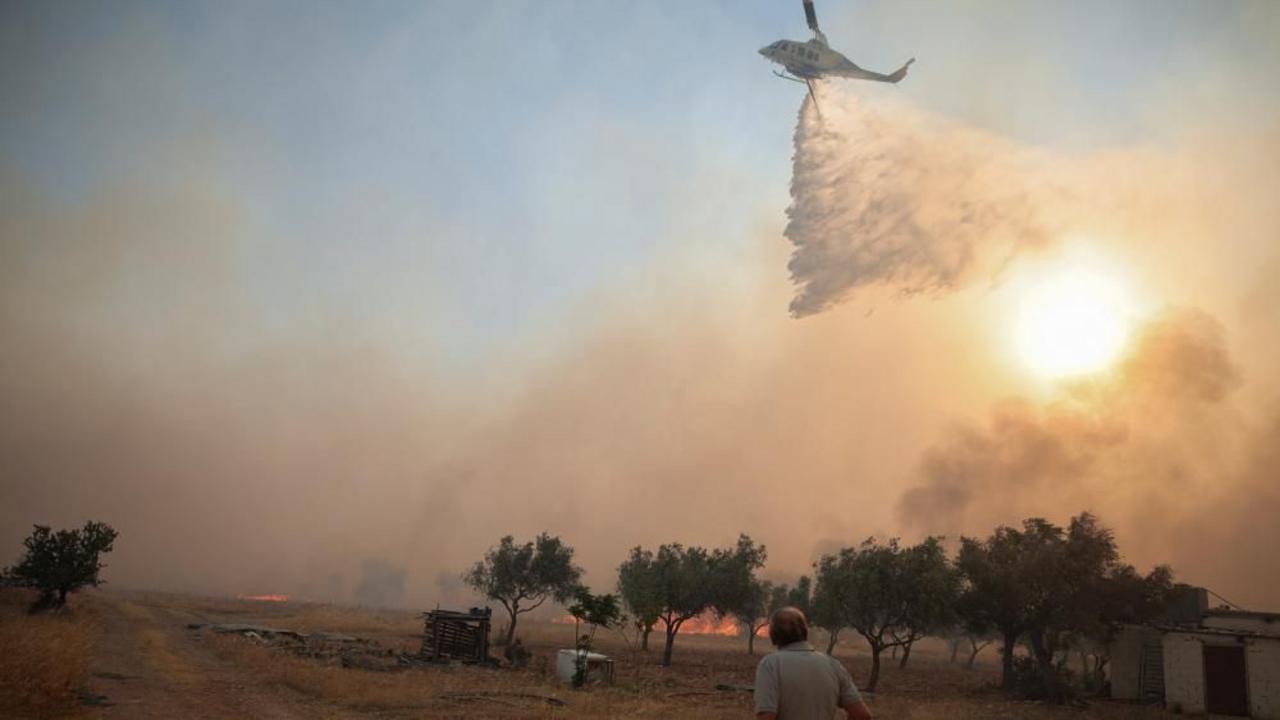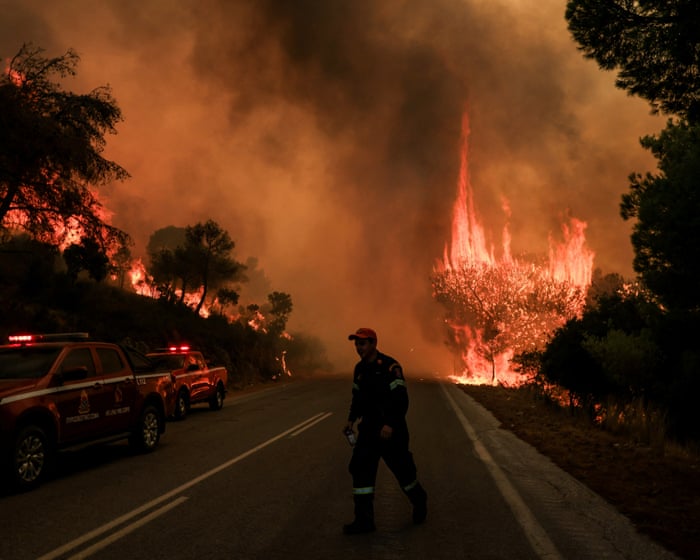
Europe’s wildfire crisis fractured along starkly different fronts on Sunday: gale-force winds drove flames deeper into the Athens region and forced fresh evacuations, France guarded a still-burning scar four times the size of Paris against renewed spread, and Spain’s major fires finally stopped advancing.
The centre of immediate danger was Greece. Gale-force winds drove flames deeper into western Attica, the administrative region that includes the capital, threatening villages and an industrial district outside the city of Megara as violent gusts prevented firefighting aircraft from collecting water from the sea.
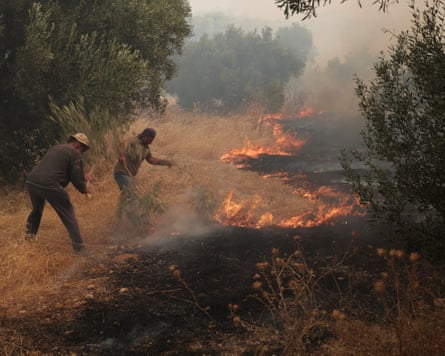
People using olive branches to beat back the flames in the Megara valley. Photograph: Louisa Gouliamaki/Reuters
But the easing emergency farther west offered little sense of an ending. France’s largest wildfire remained contained after 224,000 people were forced to flee in what may have been the largest peacetime evacuation in French history. Yet active pockets still burned across 420 sq km (162 sq miles) of devastated forest.
Thousands remained unable to return home, and nearly 3,000 firefighters were deployed against the Gironde megafire and a second blaze in Provence that had stopped advancing but remained uncontained.
Fires in France and Spain alone have driven roughly a third of a million people from homes and holiday sites, emptied communities at the height of the summer and stretched firefighters, aircraft and emergency services across simultaneous disasters.
The crisis is unfolding on the world’s fastest-warming continent. Europe has heated at more than twice the global average since the 1980s, according to the EU’s Copernicus Climate Change Service.
Higher temperatures and prolonged drought leave forests and scrubland drier and more combustible, allowing fires to spread faster and burn more intensely. Human-caused climate breakdown doubled the likelihood of the extreme fire conditions that fuelled the French blazes, scientists at World Weather Attribution calculated in a rapid analysis on Thursday while the fires were still burning.
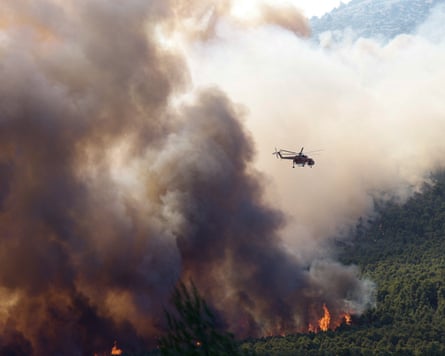
A firefighting helicopter flies over a wildfire near Porto Germeno in Attica. High winds later hampered aircraft. Photograph: Louisa Gouliamaki/Reuters
Greek authorities ordered the evacuation of three more communities on Sunday as flames advanced through western Attica, threatening villages along the Geraneia mountains and an industrial district outside Megara.
Nearly 500 firefighters and 23 aircraft were deployed, but gale-force winds strengthened the fire while crippling the response. The winds drove flames through dry forest and made it impossible for some aircraft to descend to the sea for water.
Smoke rose over the mountains as evacuation orders were issued for the communities of Kandili, Agia Skepi and Toutouli. The prime minister, Kyriakos Mitsotakis, was briefed on the operation, with authorities particularly concerned about Porto Germeno, a seaside community on the Gulf of Corinth.
The fire began on Friday near Agios Vasileios before sweeping toward Porto Germeno and into the forested mountains west of Athens.
Firefighters evacuated 254 people by sea from Agios Vasileios on Friday and another 12 from Porto Germeno on Saturday — an escape route of last resort in coastal communities where fire and smoke can cut the few roads out.
A wildfire meteorologist, Theodore Giannaros, estimated on Saturday that the blaze had affected 40 to 50 sq km (15 to 19 sq miles), though authorities had not issued an official figure.
“A pristine forest, a paradise, was surrendered to the hands of the fire,” a local farmer, Minas Tzortzanis, said on Saturday. “There are no words to explain what has happened. Destruction. Total destruction.”
The danger carried grim resonance in Greece. In 2018, a wind-driven wildfire trapped residents in the seaside community of Mati, east of Athens, killing 104 people in Europe’s deadliest wildfire this century.
In south-western France, the Gironde megafire remained contained Sunday but was still burning after scorching 420 sq km (162 sq miles) of forest in just 10 days.
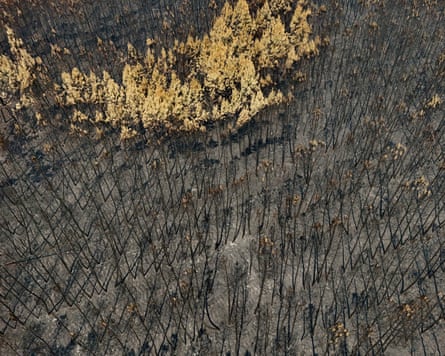
Le Temple, Gironde: the fire is contained, but the entire region remains on high alert. Photograph: Yves Herman/Reuters
“The fire is now fixed, which does not mean that the fire is extinguished,” the Gironde prefecture said on Sunday, using the French firefighting term for a blaze whose advance has been stopped and whose perimeter has been contained.
after newsletter promotion
The region remained under France’s highest red forest-fire alert. Dry conditions and soaring temperatures around Bordeaux, combined with afternoon winds, created a continued risk of renewed flames.
Additional firefighters from Ukraine, Lithuania and French Polynesia were expected on Sunday and Monday to reinforce the operation.
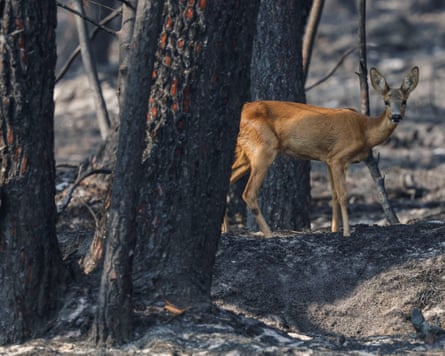
A deer in the forest in Le Temple, Gironde. Photograph: Yves Herman/Reuters
Hundreds of miles away, nearly 1,500 firefighters were battling a separate fire in the south-eastern Var department that tore through roughly 18 sq km (7 sq miles) in little more than a day.
Authorities said the fire in the Gros Bessillon hills was stabilised on Sunday morning, meaning its perimeter had not expanded overnight. But unlike the Gironde fire, it had not yet been declared contained.
Firefighting aircraft supported crews working to keep the flames away from villages among the vineyards, olive groves and wooded hills of the region known as Green Provence.
About 2,500 people were evacuated as the fire threatened communities.
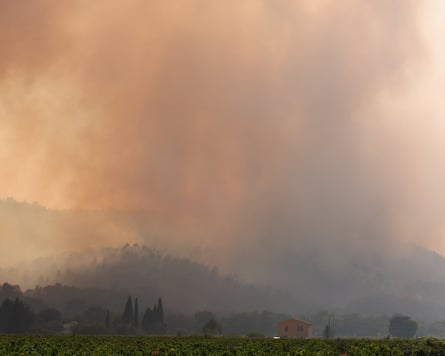
Smoke above Montfort-sur-Argens, near Correns, in Var. Photograph: Manon Cruz/Reuters
The blaze was the fourth major fire to strike the central Var since July 19. A separate, smaller fire near Brignoles earlier in the week forced the Hollywood actor George Clooney and his family, along with about 700 other residents, to evacuate before it was brought under control.
The prime minister, Sébastien Lecornu, said France’s wildfires were generally under control but cautioned that conditions remained highly changeable.
He also announced that a national coordinator attached to the prime minister’s office would oversee reconstruction in fire-ravaged areas.
More than 1,170 sq km (452 sq miles) have burned across France since the beginning of the year.
Source note
First published by The Guardian World
This article was supplied by The Guardian World through its RSS feed and formatted for Crooli Signal. The reporting remains with the original publisher.
Read the original at The Guardian World