Gianni Infantino held talks about rebranding the ill-fated European breakaway competition the “Fifa Super League”, with negotiations going as far as the term sheet for an agreement that would have changed the face of European football.
The term sheet, whose full contents can be revealed for the first time, is dated October 2020 and proposes renaming any new competition under Fifa’s branding. It outlines the extent to which Infantino’s administration were implicated in a scheme that caused widespread revulsion among fans and excluded clubs in April 2021. It also reveals that Fifa was prepared to sideline its member associations in pushing plans to cut back the number of international windows and outlines how global football’s governing body would have been given special governance and political rights with a “golden share”.
In a week when football is reeling from the fallout after Infantino scrapped his plan to sell chunks of the World Cup to private investors, the document shows Fifa’s leadership was deeply involved in another attempt to put the sport’s major competitions under corporate control. It sets out a partnership of at least 12 years between Fifa and the Super League and proposes a joint venture that would have run its commercial operations.
The document also proposes that an iteration of Fifa’s expanded Club World Cup, referred to as the “global club competition”, would be held annually over an enshrined three-week period and tied directly to the Super League. That tournament would have been a straight knockout competition rather than the group-based version that relaunched in 2025. While the term sheet states that the new tournaments would have to be passed by Fifa’s annual congress and the Fifa council, federations around the world are understood to have been bypassed in the plan’s formation.
Infantino was among a number of Fifa staff involved in the project and is understood to have been fully aware of its progression. The term sheet says the founding clubs “want to agree the terms of a partnership” between the Super League and Fifa, leading to the creation of the two competitions. It follows an initial proposal to Fifa by the breakaway clubs, also seen by the Guardian, that sketches the framework for a potential agreement. While non-binding, a term sheet is generally the precursor to a definitive contract and suggests discussions between Fifa and the Super League’s creators were nearing a conclusion at the time.
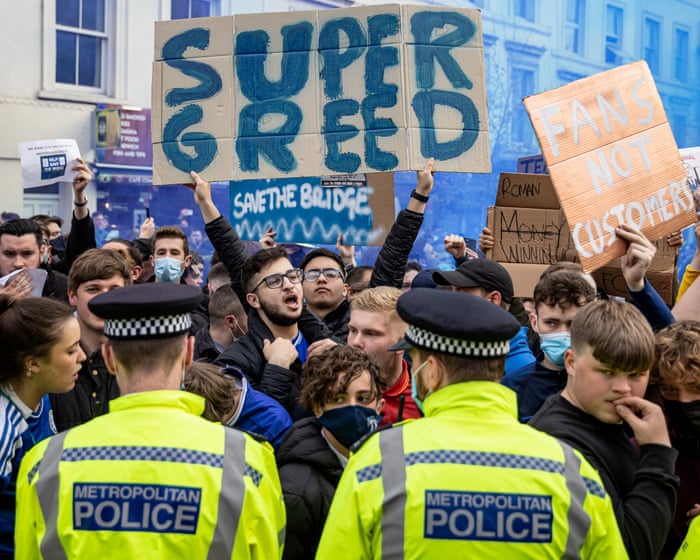
It is unclear whether Infantino and Fifa progressed their role in the project beyond the term-sheet stage. After a version of the scheme was infamously launched without Fifa’s direct involvement in April 2021, ultimately scrapped following large-scale protests, Infantino addressed Uefa’s congress in Montreux saying his organisation could “only strongly disapprove the creation of the Super League”. Multiple sources have stated that an earlier conversation with the Uefa president Aleksander Ceferin, convened by a third party, hastened Fifa’s president distancing himself from the new venture. Infantino is understood to have told associates afterwards that he had no wish to work against football’s institutions.
Yet the evidence of Fifa’s outline agreement with the Super League, coupled with Infantino’s disastrous Football Forward Enterprise scheme, casts doubt on that assertion and suggests multiple attempts to reshape the game without consulting its most important stakeholders. The league would have contained 15 permanent members and five clubs qualifying from existing competitions. It also commits to creating a women’s equivalent, using the same clubs, by an unspecified date. The term sheet refers to Fifa under the name “WO1”, which is also the name used in the British army for a high-ranking army officer.
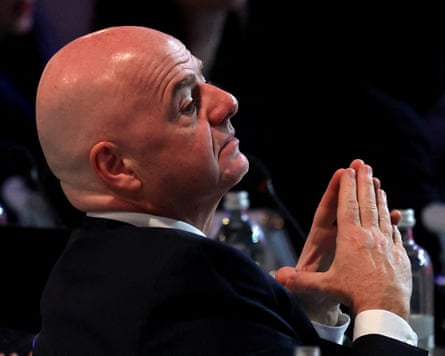
Gianni Infantino later changed tack in relation to a European breakaway. Photograph: Louisa Gouliamaki/Reuters
In a section outlining the agreement’s key components, it says the Super League “is open to discuss naming the competition WO1 SL”. It also confirms Fifa would be “granted a preferred equity stake in the Super League”, which would give it decision-making capability on format changes, calendar alterations, distribution of solidarity money and the appointment of a chief executive for the competition.
Senior figures within European football are understood to have been shocked by the plan to drastically shrink the number of international windows, squeezing them into two fortnight-long spaces each year. Member associations, many of whom are being courted for support by Infantino as he battles to save his tenure this week, may have lost the commercial opportunities available from added visibility for their national teams and found themselves at the behest of a privately run club competition.
after newsletter promotion
A separate point in the earlier proposal also notes “reduction of leagues” as a point for discussion. The term sheet states that “a new international match calendar” devised by Fifa, the Super League and “other relevant stakeholders” would be reviewed and implemented with Fifa’s agreement.
Clubs participating in the Super League would have been required to join the World Football Club Association (WFCA), which was a short-lived representative body launched by the Real Madrid president Florentino Pérez in 2019. Real were key drivers of the Super League scheme and only closed the door on the project when announcing an agreement with Uefa in February this year.
Fifa’s close proximity to the Super League proposal adds to the growing number of privately backed ventures brought to the table by Infantino during his 10-year reign. In 2018 he pressed the case for a $25bn offer from SoftBank, the Japanese institution, to create an expanded Club World Cup and global Nations League. Close allies within Fifa are understood to have cautioned him against the plan, which failed to gain support after opposition from Europe.
Fifa was approached for comment.
Source note
First published by The Guardian Sport
This article was supplied by The Guardian Sport through its RSS feed and formatted for Crooli Signal. The reporting remains with the original publisher.
Read the original at The Guardian Sport