From
France to strengthen controls at French-Spanish border in response to Ceuta crossings, minister says
And France’s interior minister Laurent Nuñez has just said the government will do exactly that.
In a post on X, he said:
“In response to the situation observed in the Ceuta enclave, I gave instructions as of last night to immediately strengthen the controls at the Spanish border. Furthermore, I am activating the Rapid Intervention Border Force for in-depth checks.”
And France’s interior minister Laurent Nuñez has just said the government will do exactly that.
In a post on X, he said:
\n “In response to the situation observed in the Ceuta enclave, I gave instructions as of last night to immediately strengthen the controls at the Spanish border. Furthermore, I am activating the Rapid Intervention Border Force for in-depth checks.”\n
The crisis also prompted some strong reactions in France.
Far-right presidential candidate Marine Le Pen said:
\n “Faced with the massive and coordinated influx of migrants into Spain, encouraged by the Spanish government, France must without delay strengthen controls at its borders. And in 2027, we will put an end to this madness by reserving Schengen free movement for EU nationals.”\n
Former prime minister Michel Barnier struck a fairly similar tone:
\n “The European Union now has an essential tool thanks to the advances achieved by the @EPP & @fxbellamy in the European Parliament with the new return directive. \n It is time to move from texts to action: every person in an irregular situation who is not meant to stay must be effectively returned. \n France cannot suffer the consequences of its neighbours’ migration choices. If a Member State makes decisions that create a pull factor for migration, we must be able to immediately protect our borders, particularly with Spain.\n Mastering immigration is a condition of sovereignty, security, and trust between European states. The rules exist: they must be applied firmly, in the interest of France and Europe.”\n
in Madrid
The opposition People’s party (PP) is calling on Sánchez to produce a swift and tough response, saying the small military and police reinforcements announced last night are insufficient.
The PP’s leader, Alberto Núñez Feijóo, is not dialling down his language.
“People have continued to arrive in Ceuta throughout the night, and those on the ground describe an occupied city, with nothing sufficient being done to prevent it,” he’s just posted on X.
\n “In Melilla, too, around 400 irregulars have entered. I insist that Sánchez must defend our national security, our territorial integrity, and our coexistence.\n As prime minister, he has instruments and means at his disposal, and all that remains is for him to give the orders.\n As serious as what is happening is the fact that the Government is reacting with this weakness. All of Spain stands with Ceuta and Melilla.”\n
The far-right Vox party, meanwhile, is calling the influx “an invasion”.
in Madrid
The Spanish interior ministry has just said that more than 49,000 people are believed to have swum or walked into Ceuta over the past 24 hours.
That, obviously is a huge number, and dwarves the 10,000 people who entered the territory during the border crisis in 2021.
That mass crossing came amid heightened tensions between Madrid and Rabat over Spain’s decision to allow a western Sahara independence leader to be treated for Covid-19 in Spain.
To give some perspective, the population of Ceuta is around 85,000.
The Spanish prime minister, Pedro Sánchez, is en route to Ceuta, where he is expected to visit the Tarajal border and speak to the media some time after midday local time.
At least 18 people died as thousands of migrants breached the Spanish-Moroccan border in Ceuta yesterday, prompting concerns about a fresh migration crisis and questions over the implications for the European Union.
A spokesperson for the Guardia Civil force, which polices Spain’s borders, said the migrants were “massively entering from the sea” through the Tarajal breakwater, but could not provide an estimate of the numbers.
Spain’s interior minister said on Friday that it estimated some 49,000 migrants crossed into Ceuta over the past 24 hours.
More people were reported crossing into the enclave over night, with Spanish media reporting “passivity” from the Moroccan police.
In response, the Spanish government is deploying extra troops and police officers to protect the border between the tiny African enclave and neighbouring Morocco. Spanish prime minister Pedro Sánchez is expected to visit the territory later today.
But the fresh migration crisis sparked also a conflict within the European Union as Italian authorities demanded Spain to be suspended from open border Schengen area until they restore control.
In a rare direct clash between two EU countries, Italy’s far-right prime minister Giorgia Meloni angrily said that pictures coming from Ceuta demonstrated that “uncontrolled illegal immigration poses a concrete threat to the security of Europe’s borders.”
“Italy will not stand by and watch. … We are prepared to intervene with extraordinary measures to defend the borders and the safety of citizens, including the suspension of the Schengen Area with Spain,” she said.
Italian foreign minister Antonio Tajani backed her calls, saying he was in favour of Spain’s suspension, and linking the migration crisis with a recent decision with the Spanish government’s decision to regularise over 500,000 undocumented migrants resident in Spain.
In response, Spanish foreign minister José Manuel Albares said the Italian comments were “unbecoming of a foreign minister of a partner and friendly country” dismissing them as “partisan demagoguery,” and said he would summon the Italian ambassador to Madrid on Friday.
Instead, he linked the influx of migrants with a recent decision by Spain’s supreme court saying that migrants intercepted at sea while attempting to reach Ceuta or Melilla could not be summarily returned under the enclaves’ special border rejection regime.
I will bring you all the updates as the day progresses.
It’s Friday, 31 July 2026, it’s Jakub Krupa here, and this is Europe Live.
Good morning.
Key events
- 1h agoFrance to strengthen controls at French-Spanish border in response to Ceuta crossings, minister says
- 2h agoLe Pen, Barnier call for France to strengthen border controls in response to Spain migration crisis
- 2h agoSpanish opposition calls on Sánchez to 'defend our national security'
- 2h ago49,000 people believed to cross into Ceuta, more than half of its population
- 2h agoMorning opening: Spain faces migration crisis in north African enclave of Ceuta
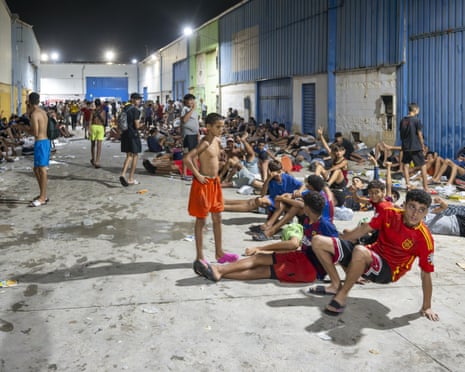
We are getting some more pictures from Ceuta, showing the people who arrived last night waiting in parts of the city with El Mundo reporting long queues at local supermarkets.
But also there are reports that some migrants are choosing to return to Morocco.
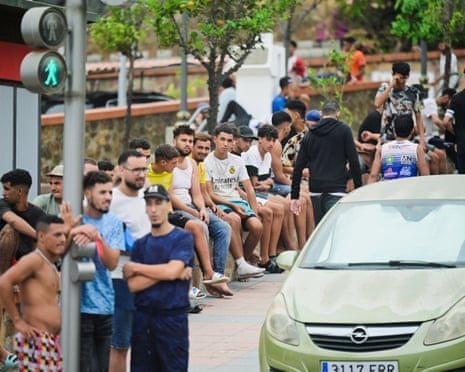
Migrants gather in downtown Ceuta, Spain. Photograph: Fabian Bimmer/Reuters
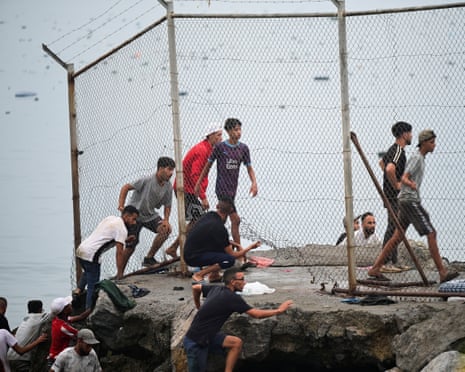
Migrants return back to Morocco, as seen from Ceuta, Spain. Photograph: Fabian Bimmer/Reuters
Local police in Ceuta are fencing off the centre of the enclave as Spanish prime minister Pedro Sánchez is expected to visit in the coming hours, public broadcaster RTVE reported.
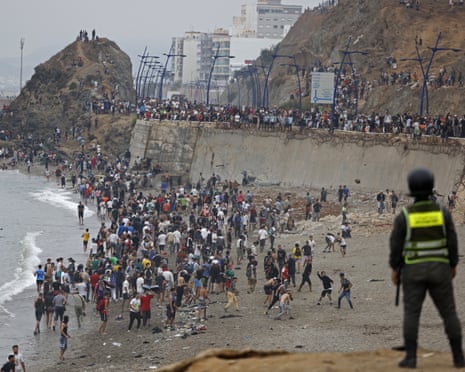
People gather along the fence at the site of clashes near Fnideq, on the Morocco-Spain border. Photograph: Abdel Majid Bziouat/AFP/Getty Images
Sánchez is set to get there just before midday local time (11am UK).
Spanish King Felipe VI spoke by telephone with prime minister Pedro Sánchez and Ceuta’s president Juan Jesús Vivas to discuss the unfolding crisis, the Royal Household said.
France to strengthen controls at French-Spanish border in response to Ceuta crossings, minister says
And France’s interior minister Laurent Nuñez has just said the government will do exactly that.
In a post on X, he said:
“In response to the situation observed in the Ceuta enclave, I gave instructions as of last night to immediately strengthen the controls at the Spanish border. Furthermore, I am activating the Rapid Intervention Border Force for in-depth checks.”
Le Pen, Barnier call for France to strengthen border controls in response to Spain migration crisis
The crisis also prompted some strong reactions in France.
Far-right presidential candidate Marine Le Pen said:
“Faced with the massive and coordinated influx of migrants into Spain, encouraged by the Spanish government, France must without delay strengthen controls at its borders. And in 2027, we will put an end to this madness by reserving Schengen free movement for EU nationals.”
Former prime minister Michel Barnier struck a fairly similar tone:
“The European Union now has an essential tool thanks to the advances achieved by the @EPP & @fxbellamy in the European Parliament with the new return directive. It is time to move from texts to action: every person in an irregular situation who is not meant to stay must be effectively returned. France cannot suffer the consequences of its neighbours’ migration choices. If a Member State makes decisions that create a pull factor for migration, we must be able to immediately protect our borders, particularly with Spain. Mastering immigration is a condition of sovereignty, security, and trust between European states. The rules exist: they must be applied firmly, in the interest of France and Europe.”
Spanish opposition calls on Sánchez to 'defend our national security'
Sam Jones
in Madrid
The opposition People’s party (PP) is calling on Sánchez to produce a swift and tough response, saying the small military and police reinforcements announced last night are insufficient.
The PP’s leader, Alberto Núñez Feijóo, is not dialling down his language.
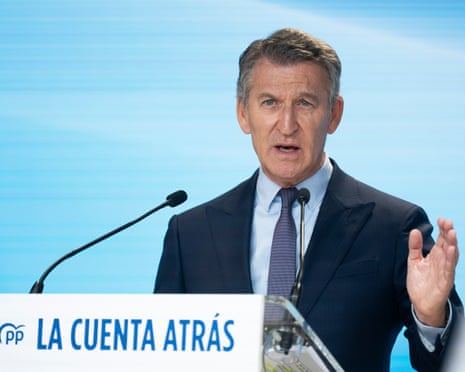
Alberto Nuñez Feijoo appears before the media at a press conference last week. Photograph: Atilano Garcia/SOPA Images/Shutterstock
“People have continued to arrive in Ceuta throughout the night, and those on the ground describe an occupied city, with nothing sufficient being done to prevent it,” he’s just posted on X.
“In Melilla, too, around 400 irregulars have entered. I insist that Sánchez must defend our national security, our territorial integrity, and our coexistence. As prime minister, he has instruments and means at his disposal, and all that remains is for him to give the orders. As serious as what is happening is the fact that the Government is reacting with this weakness. All of Spain stands with Ceuta and Melilla.”
The far-right Vox party, meanwhile, is calling the influx “an invasion”.
49,000 people believed to cross into Ceuta, more than half of its population
Sam Jones
in Madrid
The Spanish interior ministry has just said that more than 49,000 people are believed to have swum or walked into Ceuta over the past 24 hours.
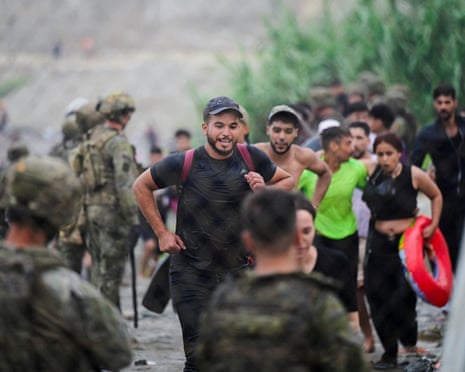
Migrants from Morocco arrive at the Spanish border, in Ceuta, Spain. Photograph: Fabian Bimmer/Reuters
That, obviously is a huge number, and dwarves the 10,000 people who entered the territory during the border crisis in 2021.
That mass crossing came amid heightened tensions between Madrid and Rabat over Spain’s decision to allow a western Sahara independence leader to be treated for Covid-19 in Spain.
To give some perspective, the population of Ceuta is around 85,000.
The Spanish prime minister, Pedro Sánchez, is en route to Ceuta, where he is expected to visit the Tarajal border and speak to the media some time after midday local time.
Morning opening: Spain faces migration crisis in north African enclave of Ceuta
Jakub Krupa
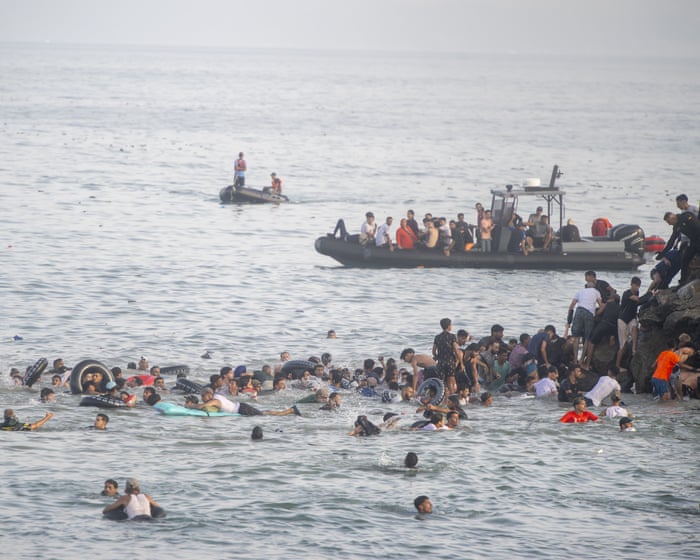
At least 18 people died as thousands of migrants breached the Spanish-Moroccan border in Ceuta yesterday, prompting concerns about a fresh migration crisis and questions over the implications for the European Union.
Hundreds of migrants run and cheer as they enter Spain’s enclave of Ceuta
A spokesperson for the Guardia Civil force, which polices Spain’s borders, said the migrants were “massively entering from the sea” through the Tarajal breakwater, but could not provide an estimate of the numbers.
Spain’s interior minister said on Friday that it estimated some 49,000 migrants crossed into Ceuta over the past 24 hours.
More people were reported crossing into the enclave over night, with Spanish media reporting “passivity” from the Moroccan police.
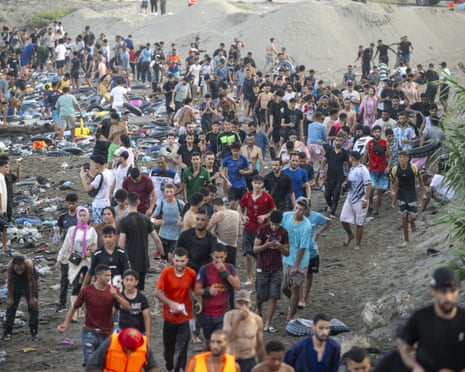
Hundreds of migrants have attempted to swim from Morocco to the Spanish city of Ceuta in north Africa. Photograph: Anadolu/Getty Images
Several migrants have attempted to swim from Morocco to the Spanish city of Ceuta in north Africa. Photograph: Anadolu/Getty Images
In response, the Spanish government is deploying extra troops and police officers to protect the border between the tiny African enclave and neighbouring Morocco. Spanish prime minister Pedro Sánchez is expected to visit the territory later today.
But the fresh migration crisis sparked also a conflict within the European Union as Italian authorities demanded Spain to be suspended from open border Schengen area until they restore control.
In a rare direct clash between two EU countries, Italy’s far-right prime minister Giorgia Meloni angrily said that pictures coming from Ceuta demonstrated that “uncontrolled illegal immigration poses a concrete threat to the security of Europe’s borders.”
“Italy will not stand by and watch. … We are prepared to intervene with extraordinary measures to defend the borders and the safety of citizens, including the suspension of the Schengen Area with Spain,” she said.
Italian foreign minister Antonio Tajani backed her calls, saying he was in favour of Spain’s suspension, and linking the migration crisis with a recent decision with the Spanish government’s decision to regularise over 500,000 undocumented migrants resident in Spain.
In response, Spanish foreign minister José Manuel Albares said the Italian comments were “unbecoming of a foreign minister of a partner and friendly country” dismissing them as “partisan demagoguery,” and said he would summon the Italian ambassador to Madrid on Friday.
Instead, he linked the influx of migrants with a recent decision by Spain’s supreme court saying that migrants intercepted at sea while attempting to reach Ceuta or Melilla could not be summarily returned under the enclaves’ special border rejection regime.
I will bring you all the updates as the day progresses.
It’s Friday, 31 July 2026, it’s Jakub Krupa here, and this is Europe Live.
Good morning.
Source note
First published by The Guardian World
This article was supplied by The Guardian World through its RSS feed and formatted for Crooli Signal. The reporting remains with the original publisher.
Read the original at The Guardian World