Skip to content
So long and thanks for all the bots
Google’s AI brain drain continues.
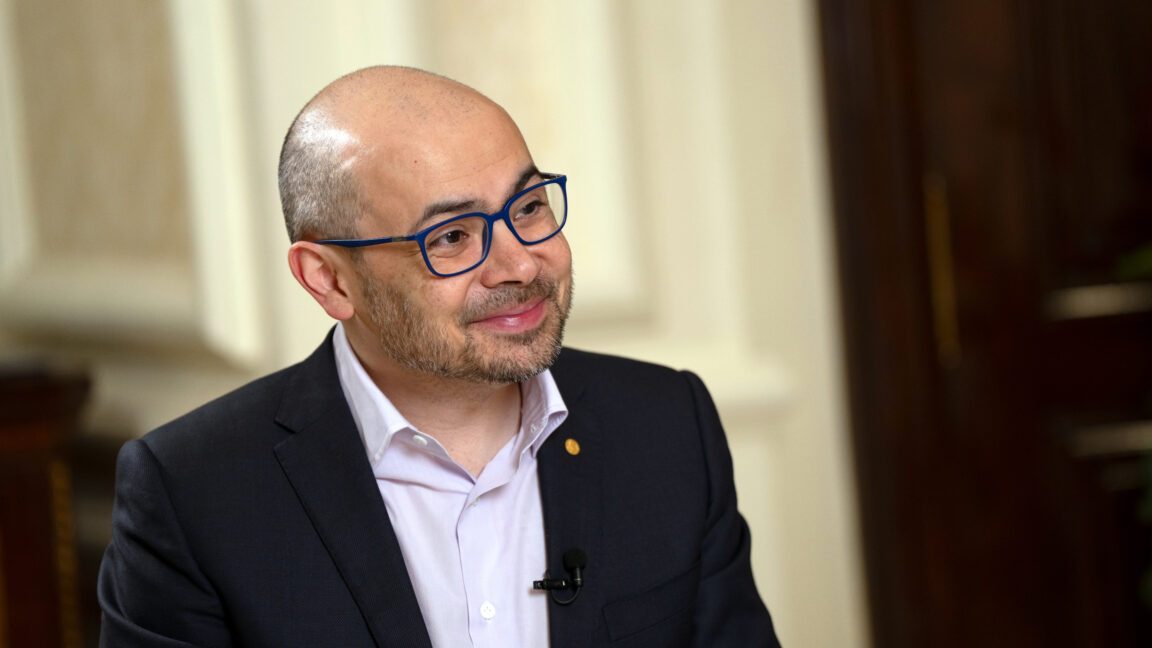
Demis Hassabis, the now former CEO of Google DeepMind, during an interview in 2026. Credit: Ruhani Kaur/Bloomberg via Getty Images
Google got a slow start with generative AI after seemingly being caught flat-footed by Microsoft’s Copilot reveal. What a difference a few years make. Now, Google is at the forefront of AI development (for better or worse), but new cracks are beginning to show. The company’s string of high-profile personnel departures continues, and DeepMind CEO Demis Hassabis has now said he will hand off day-to-day responsibilities to take on an oversight role at parent company Alphabet.
Hassabis was one of the founders of DeepMind, and he maintained a key leadership role after Google acquired it. As the generative AI boom took off, Hassabis has been one of the loudest voices predicting the impending creation of artificial general intelligence (AGI), which is typically described as an AI with human-like capabilities and intelligence.
In his memo announcing his decision to leave DeepMind, Hassabis again leans on the promise of AGI. “I’ve been working towards AGI my whole life and now, like many of you, I feel it is close at hand,” said Hassabis.
According to Hassabis, this shift will allow him to focus on the “big picture” work that is necessary at this moment. He will remain in charge of Google’s Isomorphic Labs, which uses AI to solve biomedical problems.
The daily operation of DeepMind, which works on the underlying AI research that fuels all of Google’s Gemini advances, will be handed off to Koray Kavukcuoglu. He will serve as DeepMind’s senior vice president, reporting directly to CEO Sundar Pichai. Hassabis, meanwhile, is becoming the chair of DeepMind and chief scientist at Alphabet.
While Hassabis is keeping his badge, some other prominent Google personnel have coincidentally announced their departure from the company at the same time. Key AI researchers Quoc Le, Oriol Vinyals, Jeff Dean, and Sanjay Ghemawat have decided to leave Google to found a startup called Discovery Loop. The startup’s goal is to use AI technology to automate scientific discovery. According to Steven Levy in Wired, the company was funded largely based on the sterling reputation of its founders.
Both Ghemawat and Dean are early Google hires who have left their mark on the company. Dean, in particular, is widely respected—you might even say idolized—within the company. As Google employee number 30, he had a hand in designing the systems that made Google search into the global information indexing powerhouse that it is today. Googlers even maintain an apocryphal list of “Jeff Dean Facts” that you can review on GitHub.
Jeff Dean was Google’s 30th employee and has been instrumental in designing Gemini models.
Credit: THOMAS SAMSON/AFP via Getty Images
Jeff Dean was Google’s 30th employee and has been instrumental in designing Gemini models. Credit: THOMAS SAMSON/AFP via Getty Images
More recently, Dean and Vinyals played a key role in designing Google’s Gemini AI models. Dean has also reportedly been among a group of employees pushing back on the company’s increased closeness with the Trump administration. Unlike Google, Discovery Loop is structured as a public benefit corporation, a for-profit entity intended to focus on public good. Although, both OpenAI and Anthropic have similar structures, so make of that what you like.
A troubling trend
Google’s announcement of the shakeup was framed in the typically cheery, PR-vetted language you’d expect when something goes wrong. The report from Levy notes that Google CEO Sundar Pichai tried mightily to keep the group, especially Dean and Ghemawat, from leaving. After “multiple meetings” with Pichai, the four decided to move forward with their plans to exit.
In a vacuum, these changes might not look so bad. After all, Hassabis isn’t leaving the company, and Google has a deep bench of AI talent. But this isn’t the only change in Google’s roster of late. Earlier this summer, Google saw a string of high-profile departures, including Noam Shazeer, Google’s previous vice president of engineering and a co-lead of Gemini.
Shazeer was the lead author of the seminal 2017 paper “Attention Is All You Need,” which first described the transformer architecture that powers today’s expansive generative AI systems. He’s now at OpenAI, a real coup for the Google rival.
Around the same time, Google DeepMind VP John Jumper announced he was leaving for Anthropic. Jumper is famous in AI circles for his role in creating the protein-folding AI known as AlphaFold. He was soon after joined at Anthropic by senior DeepMind researchers Jonas Adler and Alexander Pritzel, who were reportedly instrumental in getting Gemini off the ground.
Pichai’s statement on the changes emphasizes Google’s strong position. “We’ve got amazing talent, world-class compute, and products that bring AI to more people than any other company,” said Pichai.
These staffing changes happen against a backdrop of slowing progress. After rapidly closing the gap between Gemini and other frontier models last year, Google now appears to be lagging. At I/O this spring, Google said it planned to release Gemini 3.5 Pro, its latest frontier model, in June. However, here we are months later, and we’ve only gotten new, lower-power Flash models. In the meantime, OpenAI and Anthropic have both rolled out new models that can’t stop hacking everyone.
Ryan Whitwam is a senior technology reporter at Ars Technica, covering the ways Google, AI, and mobile technology continue to change the world. Over his 20-year career, he's written for Android Police, ExtremeTech, Wirecutter, NY Times, and more. He has reviewed more phones than most people will ever own. You can follow him on Bluesky, where you will see photos of his dozens of mechanical keyboards.
19 Comments
Source note
First published by Ars Technica
This article was supplied by Ars Technica through its RSS feed and formatted for Crooli Signal. The reporting remains with the original publisher.
Read the original at Ars Technica