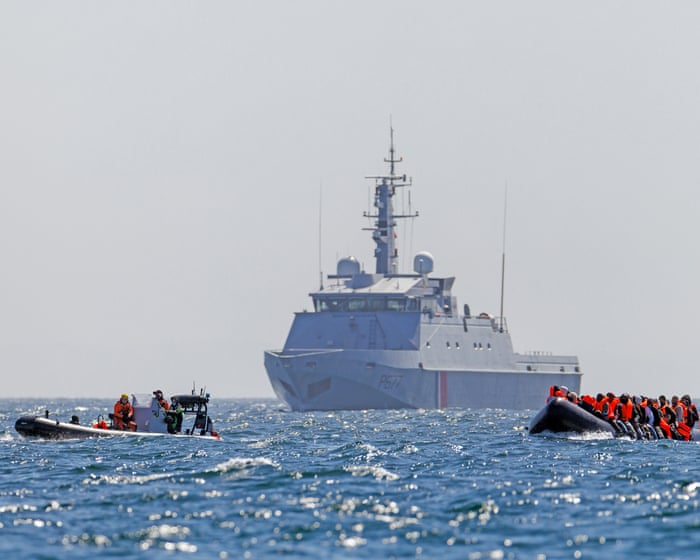
The headline figures show that small boats crossing the Channel are down by 43% compared with January to mid-July 2025 – from 21,690 last year to 12,469 over the same period this year.
Since Andy Burnham came to power on 20 July, however, there has been a small increase on the same period last year. Between 20 July and 2 August 2025 1,962 people crossed the Channel in small boats. Over the same period this year more than 2,000 have crossed.
Burnham visited Dover’s joint command room on Sunday where small boat movements across the Channel are tracked using surveillance drones. He said the government would be “relentless” in stopping the boats and would “bring back that control”.
Have ministers finally cracked a political problem that has dogged successive prime ministers for almost a decade and will Burnham’s pledges be fulfilled?
Does the reduction of almost 43% in small boat crossings this year mean that the number of people coming to the UK illegally has almost halved?
There is no doubt that the government initiatives to “stop the boats” have disrupted the business model of people smugglers in northern France. But it has certainly not destroyed it. In the past week more than 1,000 people have arrived as smugglers take advantage of a good weather window with 752 people arriving in nine boats on 29 July, the highest number in a single day so far this year and 326 arriving in four boats on Saturday.
While there has been a reduction in asylum claims, it has not been as significant as the reduction in small boat arrivals. In the year ending March 2026 93,525 people claimed asylum, a 12% reduction on the previous year. Of this number 42%, 38,980, arrived by small boats with the others already in the UK on a visa, or arriving in lorries or shipping containers.
Smugglers have evolved their business model.
Boat launches have spread out further across the coast with some now leaving from Belgium and others from as far south as Dieppe, which is a journey of 70 miles (113km) to the UK, compared with the Calais to Dover route of 27 miles. French officials told the Guardian this year they have recorded nine mega-dinghies with more than 100 people on board.
Smugglers are offering a more expensive lorry route to those who wish to claim asylum on arrival in the UK. Asylum seekers say that current prices for a place on a dinghy are €1,000 (£852) or less while a space in a lorry is between €4,000 and €5,000.
Have the measures deterred asylum seekers from trying to get to the UK?
According to charity organisations working in northern France – including Care4Calais, Project Play, Utopia 56 and Calais Food Collective – there are still a significant number of asylum seekers waiting to cross the Channel.
The UK government has agreed to pay France another £660m to curb the number of asylum seekers travelling across the Channel, including plans to fund a riot squad to “contain and disperse” people trying to board small boats.
French police enforcement and the “one in, one out scheme” where some asylum seekers who arrive in the UK on small boats are forcibly returned to France, while a similar number are brought legally to the UK from northern France, also appears not to have significantly deterred asylum seekers from trying to reach the UK, which is just a fraction of the total coming to Europe.
Amy Pope, director general of the International Organisation for Migration, has said that by the time asylum seekers have reached northern France after a long and arduous journey, sometimes crossing the Sahara and enduring slavery and torture in Libya, it is too late to turn them back.
Many asylum seekers who do cross the Channel have family connections in the UK or speak English. Some say they feel it is a safer place for them than France due to threats from people smugglers.
One Syrian asylum seeker who crossed the Channel twice in a small boat said that both times the thought going through his head when he stepped into the dinghy was: “I come or I die.”
What role has the weather played?
It is hard to measure the precise impact of adverse weather conditions on the reduction in small boat crossings. 2026 has been a windy year so far. Waves must be relatively flat before small boats can launch, meaning windy conditions make it harder to cross.
Why are so many asylum seekers returning to the UK after being removed to France under the one in, one out deal?
Asylum seekers involved in the one in, one out scheme estimate that up to 200 have returned to the UK. While Home Office sources say a smaller number have returned.
It is believed that some people are returning to the UK in lorries and living under the radar without the Home Office’s knowledge. Some have said they plan to come forward to the Home Office if and when one in, one out ends in October, as has been reported.
Lack of support and poor living conditions in France are among reasons given for returning to the UK after asylum claims are refused.
Others say they have been attacked by smugglers in northern France over money owed from their first crossing.
One asylum seeker said he planned to return to the UK because France had refused his asylum claim and planned to return him to his home country.
“If I’m sent back to my home country I am wanted by my government for political activity against them,” he said. “They will put me in prison and kill me there. I know if I come back to the UK the Home Office will lock me up but at least in the UK I will be locked up and I will live.”
Will the new prime minister escalate measures to stop small boat crossings?
Burnham echoed the home secretary, Shabana Mahmood, on the need for safe routes for asylum seekers, and to offer support to those who “genuinely need it” during his visit to Dover.
Safe routes are only likely to be accessible to a few hundred people, at least initially, while many are likely to continue embarking on a dangerous journey across the Channel.
As opposition parties increase the pressure on the small boats issue, including Conservative shadow home secretary Chris Philp’s recent foray into the Channel, and Reform UK’s announcement to deploy the UK’s combined military arsenal – Royal Navy, Royal Marines, RAF and British Army – to banish people fleeing war, it remains to be seen if the PM will ramp up the rhetoric and government actions in response.
Source note
First published by The Guardian UK
This article was supplied by The Guardian UK through its RSS feed and formatted for Crooli Signal. The reporting remains with the original publisher.
Read the original at The Guardian UK