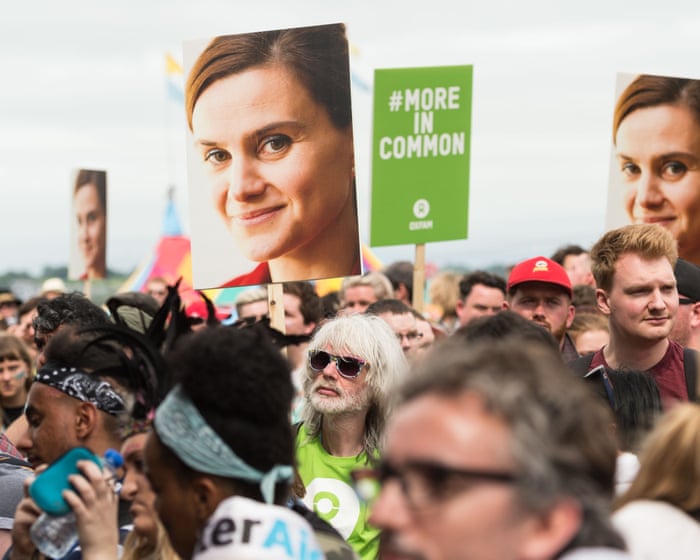
When my late wife Jo Cox was killed by a far-right extremist 10 years ago, the phrase “more in common”, taken from her maiden speech in parliament, became a rallying cry against extremism and division.
The phrase succinctly articulated that, no matter our differences, we have more in common than that which divides us.
In the decade since, that solidarity has faded. But it hasn’t just faded as time has elapsed: it has been replaced by a cynicism and a polarisation that it’s hard to overstate.
In an era of hostile states, algorithms designed to incite rage and collapsing community institutions, repeating the mantra that we have “more in common” is no longer enough. It’s time we mapped out that common ground.
Because what we have in common matters. It’s the strength of our connections that defines what we are willing to commit to each other. It determines the strength of our democracy and is the basis of social solidarity. It defines everything from our commitment to the welfare state to our ability to fight wars and defend ourselves.
So it’s pretty remarkable that we haven’t mapped the strength and nature of those connections. I guess we have taken them for granted in the past. Yet with a digital environment that now actively seeks to escalate, exacerbate and exaggerate our divisions, that complacency is no longer an option.
That’s where the Independent Commission on Community and Cohesion comes in, a cross-party group co-chaired by former Conservative chancellor Sajid Javid and former Labour MP Jon Cruddas. Central to the commission’s work is the National Conversation, a project with Oxford University to build the best picture we have ever had of what we have in common, what connects us, what divides us, and the kind of country we want to build together.
In any other era, that kind of national research exercise would have been prohibitively expensive. You would have needed thousands of researchers interviewing members of the public, classifying and coding responses, before trying to summarise the millions of data points.
AI makes this kind of exercise possible at scale for the first time. It means as part of the survey you can leave a 60-second voice note on your vision for the country. It means you can identify places on a map that bring you together or write open text. Our ability to gather all this information means the national conversation will provide the richest ever snapshot of what future we want to build together.
Our hope is that the results will help provide us all with a common understanding of our connections, perhaps some reassurance and a chance to play back to our country what vision connects us still.
But its insights will only be a strong as its inputs. Which is why I’m asking you to take just a few minutes to share your vision of the country you want to see. We’ll be publishing the results in a few months. Thousands of others have already joined the conversation but every voice that takes part deepens the insights and adds richness to our understanding of the nature of our connections.
In future, we hope the National Conversation will become an institution like the census – not answering who we are and where we live, but the country talking about what unites us. We’d like you to be part of the start of this journey by adding your voice today. Because in a world that is trying to tear us apart, the least we can all do is speak up for the future we want to see.
- Brendan Cox is co-founder of the Together Coalition, which acts as the secretariat for the Independent Commission on Community and Cohesion
- Do you have an opinion on the issues raised in this article? If you would like to submit a response of up to 300 words by email to be considered for publication in our letters section, please click here.
Source note
First published by The Guardian Politics
This article was supplied by The Guardian Politics through its RSS feed and formatted for Crooli Signal. The reporting remains with the original publisher.
Read the original at The Guardian Politics