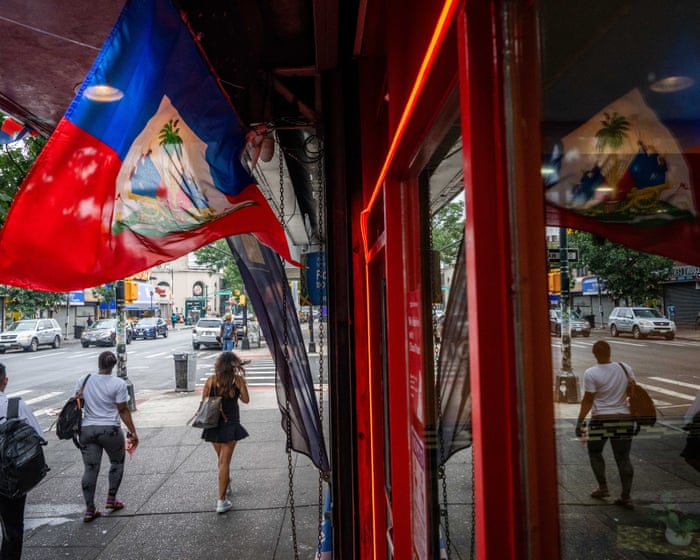
Right now, across the country, there are more than 330,000 Haitians collectively holding their breath over the future of lifesaving immigration protections provided through temporary protected status (TPS). Three hundred and fifty thousand is a big, meaningful number – but for many, it’s still just a number.
In the case of Donald Trump and his supporters in Congress, the number of lives at stake has mattered little. Trump has been incessant in his efforts to eliminate TPS for Haitians. In doing so, he’s broken with a bipartisan tradition dating back to 1990 of prioritizing the safety of people from other countries who cannot return home because of dangerous conditions. And it’s how he’s done it, too: without consideration for the ongoing violence, civil unrest, lack of infrastructure, and political instability in Haiti. But what Trump has also failed to acknowledge are the lives built here by that same huge number of people.
When I hear the figure, I think of all the Haitians I met on my long journey to the US. I think of the people who, forced to first pass through several other countries, lost their lives before they could find safety and stability in this country. Mothers, fathers, kids, young couples – all seeking safety, protection and a better life for themselves and their families, no different from anyone else. I think inevitably, though it brings me great pain, of the Haiti I was forced to leave behind more than 16 years ago before starting a new life in San Diego.
A magnitude-seven earthquake ravaged my homeland in 2010, killing more than 220,000 people and displacing millions. It remains one of the deadliest natural disasters in the history of the western hemisphere and has left an indelible mark on all Haitians, both those who fled and those who couldn’t.
In Haiti, the tremors we felt after the earthquake weren’t just tectonic; they were political, psychological, even existential – and they can still be felt today. The past decade and a half has seen Haiti taken over by widespread food insecurity, hurricanes, rampant gang violence and a full-blown cholera epidemic that has consumed part of the country. It’s why I made the difficult decision to leave everything behind and flee with my son, who was a toddler at the time.
I joined family members in the US, making a home in San Diego. Thanks to TPS, which was designated in 2010 and then redesignated in 2011, I obtained the stability needed to build a home and give back to the community that welcomed me with such warmth and kindness. I learned English and became a caregiver and then a nursing assistant. For a while, things started to get so much better with TPS that it almost felt like those familiar tremors – which followed Haitians like me across thousands of miles – had gone away. But not for long.
Because the Trump administration refused to redesignate TPS for Haitians, thousands of people were left without legal status and vulnerable to callous immigration raids. My husband was one of those people. Our young children still say that they never got to say goodbye to their dad. If TPS isn’t renewed for Haitians, they could lose their mother to the very same system.
Thankfully, there’s a glimpse of light and hope. In April, the House of Representatives voted to extend TPS for Haitians for three more years. The bill, S.4814, awaits a vote in the Senate; it’s why I am calling on our elected officials there to do the right thing, just as I’m calling on the public to stand up for our Haitian neighbors.
The Senate must stand with families and protect the stability of communities. Our Haitian neighbors, like our other community members, are business owners, workers, and church members, parents, students, caretakers and farm workers.
We work hard, we pay our taxes, we give back to our communities and we are a big part of the engine that keeps the United States workforce in many essential industries moving.
We deserve to stay here, with our families and loved ones.
- Josiane Valsaint is a TPS recipient and advocate for Haitian nationals who risk being deported by the Trump administration
Source note
First published by The Guardian US
This article was supplied by The Guardian US through its RSS feed and formatted for Crooli Signal. The reporting remains with the original publisher.
Read the original at The Guardian US