I was outside London Waterloo railway station and was looking for a bin to dispose of an empty coffee cup.
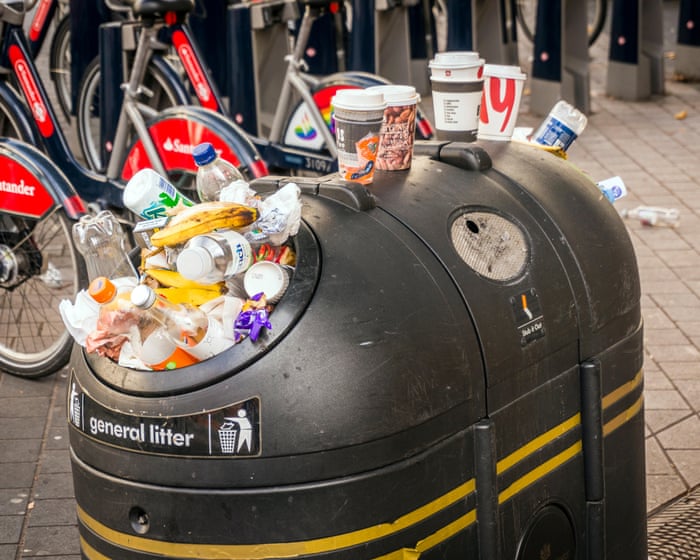
The only bin I could see was completely full, but there was a plastic bag containing rubbish at the base.
I put my cup in that bag and was stopped by an enforcement officer, who had been standing at a distance watching the bin. He told me I had violated the law and refused my offer to remove my cup. He asked for my details, including my passport.
After printing out a penalty notice, he remained in the same spot watching the overflowing bin. It seemed like a set-up.
I discovered I had been fined £500, payable within 28 days and reduced to £325 if paid within 14 days. There is no right of appeal, and failure to pay could result in prosecution and a £2,500 penalty. Can you advise me?
CP, Winchester
I have been reporting – with mounting alarm – on the large fines being handed out by councils for littering. Deliberate littering, I accept, is a blight on our streets and is indefensible.
What concerns me is that, in my view, the penalties are – in the cases I’ve seen – disproportionate. Enforcement can be heavy-handed, and councils’ interpretation of what constitutes littering is far wider than what most of us understand it to be.
One reader was fined for putting a cigarette butt in a refuse sack. In March this year, councils were given statutory powers to fine what the government called “litter louts” up to £500 – and many have opted to apply the full sum. This means a dropped receipt could cost you £80 in one London street and £500 in another.
A penalty of £500 is five times the fine for jumping a red light or for allowing a dog to foul a playground. It’s a sum unaffordable to many people who, nevertheless, have to stump up at speed to avoid it quintupling. And, unlike parking penalties, the only way to contest the fine is to go to court.
The same government guidance states that enforcement action should be proportionate and focused on the worst offenders rather those who have unwittingly littered. It was not unreasonable to assume that a plastic bag beside an overflowing bin (I have seen a photo) was the next-best option for your rubbish before you hurried into a meeting. It is also not unreasonable to expect councils to ensure their own rubbish disposal – including emptying brimming bins – is up to scratch.
I asked Lambeth council why people who were evidently unaware they were committing an offence were not given warnings instead of fines. It said that to be “consistent and fair,” it fined everyone, and it justified imposing the highest allowable penalty as a deterrent.
The south London council reportedly issued the second-highest number of fines for littering over a 12-month period. It outsources its enforcement to the parking company APCOA but says the company does not keep any of the revenue raised or receive incentives to issue tickets.
It refused to cancel your fine. If you challenge it in court, you lose the early payment discount. So my advice to you is to pay up through gritted teeth and stick to official bins in future.
Hazardous toys: an update

Five children’s toys on sale in Britain analysed in a Guardian investigation in May were found to contain asbestos. Photograph: Addictive Stock Creatives/Alamy
Four months ago I bought a selection of children’s toys to be tested for asbestos – and five came back positive. All were removed from sale when I shared the test results with retailers and the Department for Business and Trade (DBT). One small retailer issued a recall notice to customers within the hour. That was in mid-May.
It took the government’s Office for Product Safety and Standards (OPSS) 47 days to issue a recall notice on its website.
Two weeks after that, and two months after I alerted Amazon, I have received a recall notice from the Amazon marketplace seller, Nico Toys, which had sold me one of the contaminated items, telling me to stop using it immediately.
The delay means children could have been playing with a potentially hazardous toy for eight weeks.
Four days later came a recall notice for the same toy from Amazon’s product safety team. I asked Amazon – with which I had shared the test results in May – how it justified such a dangerous delay. It replied that the OPSS had prescribed actions for the seller, not Amazon, and that the item had been removed from sale in May.
The DBT, which oversees the OPSS, wrung its hands when I asked what steps it took to ensure customers were contacted immediately.
“Our product safety laws are clear: businesses must ensure the products they sell are safe and are required to act without delay where a safety risk has been identified,” said a spokesperson. “If they fail to meet their legal obligations, regulators will not hesitate to take action to protect consumers.”
Nico Toys was contacted for comment.
We welcome letters but cannot answer individually. Email us at consumer.champions@theguardian.com or write to Consumer Champions, Money, the Guardian, 90 York Way, London N1 9GU. Please include a daytime phone number. Submission and publication of all letters is subject to our terms and conditions.
Source note
First published by The Guardian Business
This article was supplied by The Guardian Business through its RSS feed and formatted for Crooli Signal. The reporting remains with the original publisher.
Read the original at The Guardian Business