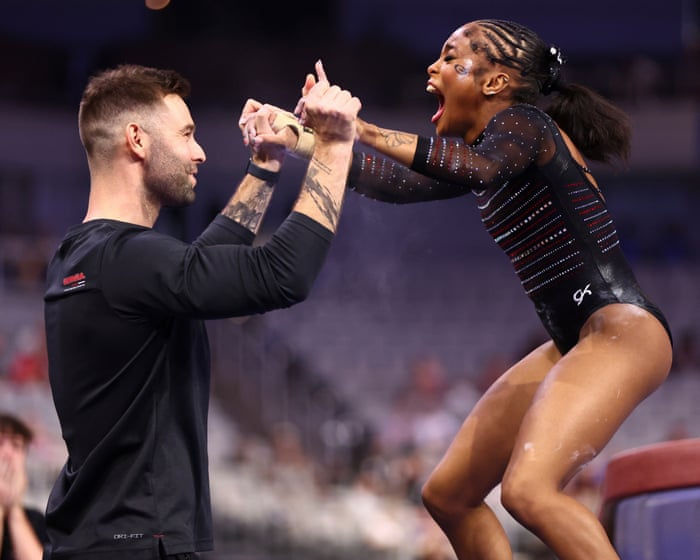
It’s a February Friday night at the University of Georgia, but Stegeman Coliseum is alive.
Situated in the center of the sprawling southern campus, the towering arena has hosted Georgia Bulldogs basketball, volleyball and gymnastics teams for over six decades. On 22 February 1964, Stegeman Coliseum hosted its first athletic event and, concurrently, its first win.
Some six decades later, on 20 February 2026, then-19-year-old Nyla Aquino salutes the judges before a sold-out crowd of more than 10,000 spectators. The No 6-ranked Bulldogs entered the final stretch in a close battle with Southeastern Conference rival No 4 Florida, and Aquino needs to deliver. Settling into her opening pose, the sophomore nonchalantly smiles, winks at her teammates, and begins.
Just three years before Stegeman Coliseum opened its doors, Aquino, a Black student athlete from Boston, would have had to fight to attend UGA. In 1961, the university admitted its first two Black students only after judicial order, and a mob of roughly 1,000 locals and Klan members rioted. Sixty-five years later, Aquino leads Georgia’s charge against Florida during Black History Month.
As the crowd rustles, Hollywood Swinging by Kool & The Gang cuts through the noise and Aquino takes off. The NCAA All-American launches into a massive tumbling pass, reaching the rafters in Stegeman and landing with a stick, a smile, and a roar.
Aquino soars through her routine: every move exuding confidence. She leaps to a track by Lil Jon & The East Side Boyz, tumbles to DMX and hits her final pose to Jay-Z. As she salutes the judges, Stegeman erupts. Her teammates swarm Aquino with hugs and the audience breaks into chants for a “perfect 10”. The arena is living, breathing – alive, all because of Nyla. She scores a 9.925 for the highest mark of the night.
Though Georgia fall just short of upsetting Florida, Aquino’s ovation doesn’t stop in Stegeman. Online, Aquino’s ode to Black culture took flight, reaching over 3m views on ESPNW’s TikTok.
On the floor, Nyla Aquino is one of the University of Georgia’s brightest stars, leading UGA to a resurgent sixth-place finish at the 2026 NCAA championships. But beyond the 60-year-old Coliseum doors and into the South, she faces a starkly different reality.
While Black athletes perform, tumble, and win for the Southeastern Conference, state lawmakers fight to redraw district lines and strip diversity, equity and inclusion (DEI) programs from the very universities they represent.
The SEC ‘just means more’
From Athens to Baton Rouge, the SEC has built something that doesn’t exist anywhere else in women’s college gymnastics: an undeniable culture.
“People who are SEC fans are usually die-hard SEC fans,” Aquino reflects. That mentality extends to gymnastics. “You see a lot of loyalty coming from the fans [and] alumni... no matter what sport they’re originally supporting or coming from, they are going to be die-hard for you as well.”
All nine SEC programs rank in the national top 20 for attendance. This March, Arkansas set the all-time SEC attendance record with 15,512 fans. “I love competing at Arkansas,” Aquino tells me. “That energy, that connection, and that community is something that you really only get when you’re competing in the SEC.”
This culture also wins – a lot. Five of the eight teams at the 2026 NCAA championships came from the SEC, and 28 of the sport’s 45 all-time team titles – 62% – belong to schools now in the conference. While the Oklahoma Sooners currently dominate the 21st-century title race, the sport’s winningest program of all time is none other than the University of Georgia.
For NCAA title-contending recruits like Aquino, their choices had long been limited to the SEC, UCLA, Utah – or a program with a marginal shot at a national title. There is no fourth door. While Aquino was heavily courted by the UCLA Bruins as a teen, the SEC’s southern drawl pulled her in. “As I got older and my family was more in tune with the SEC, I knew that the SEC was somewhere that I really wanted to be.”
“There’s so much culture – who doesn’t want to be in the SEC, right?”
Dr Amira Rose Davis, assistant professor and historian at the University of Texas-Austin, understands the appeal. Dr Davis’ cousin played women’s basketball at LSU, so she witnessed the cultural immersion firsthand. “There is a certain swag in the community… there’s nothing like being on campus watching their fans turn out.”
She says the SEC’s culture is uniquely fitted to amplify women’s sports. “In SEC spaces, [sports] matter socially in the fabric of those communities in a different way,” Davis says. From gymnastics to basketball, SEC women’s sports draw the crowds and headlines that other conferences don’t.
“You’re merging a kind of inherently southern culture and fandom that draws from a huge cross section of the community.” The SEC doesn’t just mean more – they “do it different,” Dr Davis adds. However, doing it differently inevitably has drawbacks.
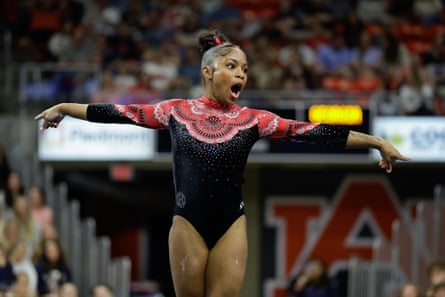
Nyla Aquino of the Georgia Bulldogs competes on the floor during a meet against the Auburn Tigers in February 2025. Photograph: Stew Milne/Getty Images
Conditional love
When Nyla Aquino’s floor routine went viral, overwhelming support flooded in. Dancing to an all-Black musical lineup in Black History Month, Aquino’s performance made waves in online communities. “She represented. Being unapologetically Black during OUR month in a predominantly white setting is so next level,” one user wrote.
However, not everyone who showed up to Stegeman – or engaged on TikTok – joined the ovation. While Aquino, a young Black athlete, delivered a winning performance for her Georgia teammates, she also delivered for a demographically mismatched donor base.
“These flagship SEC schools run on boosterism and donated dollars,” Dr Davis says. “Courting booster money means you are dealing with older alumni who might have very strong opinions about if you have hip-hop in your gymnastics routine.”
While the online support was plentiful, it also offered counters. “75% dancing like we’re in a club. 25% actual gymnastics. I miss the old days when gymnastics was actually an art,” a user complained. Comments rolled in with anonymous users criticizing Aquino’s choice of music and artistic expression.
On a night where Aquino delivered the top score of the night for her team, her performance still received pushback. Should she or one of her Black teammates make a mistake, the outcome can be far worse. “No matter how well I do, someone’s going to be racist,” she says.
That reality has come to light across the SEC in recent years, as majority-Black athletes and teams deliver winning results for white donors. That dichotomy is contentious. “Anytime you have the demographics of a fan base not necessarily matching up with the demographics of the athletic laborers, you set yourself up for some of these tensions,” Dr Davis attests.
In 2018, a top Ole Miss donor sent photos of Black women on the Oxford Square to a former dean. The alum complained that Oxford was being “overtaken by the wrong elements”, using derogatory language and arguing that the image did not represent the traditional culture of the university or town he remembered. “Goddamn, this is literally like being in the Congo jungle,” he wrote, per the Mississippi Free Press.
At Texas, alumni threatened to pull funding in 2021 after Longhorn student athletes disavowed the “Eyes of Texas” fight song. According to the Texas Tribune, the song was historically performed at campus minstrel shows and its title is linked to a saying from Robert E Lee.
“My wife and I have given an endowment in excess of $1 million to athletics. This could very easily be rescinded if things don’t drastically change around here,” one donor wrote to UT-Austin. “Has everyone become oblivious of who supports athletics?”
These donors disparage the same athletes they bankroll. Texas football, which reached the College Football Playoff in 2023 and 2024, features a majority-Black roster. Of the nine GymDogs that made the SEC Gymnastics All-Championship Team, five were Black.
Yet, after nearly two decades of competing as a Black, female athlete in a predominantly white sport, Aquino is accustomed to the emotional whiplash. She has learned to channel the distraction into action. Aquino’s identity is a point of pride, not a financial talking point.
“The whole point is to revolutionize,” she says. “I deserve to display my blackness on a pedestal, whether it makes you uncomfortable or not.”
The disappearing scaffolding
While Aquino and Black athletes lead with pride on the floor and field, administrators struggle to offer support as they face mounting sociopolitical roadblocks. Dr Davis has witnessed the structural collapse firsthand. Presently, it feels like the scaffolding is collapsing around her.
In 2023, Texas Governor Greg Abbott signed Senate Bill 17, prohibiting public institutions of higher education from engaging in “specified diversity, equity, and inclusion activities.” In 2025, the Trump Administration directed federal agencies to eliminate equity-related grants and DEI offices, pushing the Department of Justice to investigate universities’ diversity programs.
In just the past few years, UT-Austin has lost the Multicultural Center, the Black Studies department and countless supporting staff and administrative workers.
Full departments, resources, careers: gutted. Dr Davis and her colleagues feel much the same. Also lost are relevant courses, cultural resources and support for Texas’ Black student athletes. While the courses often attract significant interest from Black students, the instructors’ syllabi face rapidly intensifying scrutiny.
“They’re going through [our courses] with a fine-tooth comb,” she attests.
A simple stroll from the Gordon-White Building through campus paints a sobering picture. “It feels like two different worlds,” Dr Davis confesses. “It’s hard to walk through this campus and watch our department and other programs and services being taken away while they announce millions of dollars in investment to other corners of campus.”
When you reach Texas Memorial Stadium, the contrast becomes blinding. While Dr Davis and her colleagues face roadblock after roadblock, donors park rows of shiny vehicles to entice recruits. On the other side of town, historically Black Austin neighborhoods become further siloed from the institution at its center.
Though she pushes on, Dr Davis and her colleagues across the nation feel suffocated. Presently, the light at the end of the tunnel is dim. “It’s hard to imagine support systems... they’ve been eradicated and I haven’t seen them rebuilt.”
An avid gymnastics supporter, Dr Davis watched with excitement in 2022 as Fisk University announced the nation’s first gymnastics program at a Historically Black College or University. The move made headlines, and two more HBCUs – Talladega College and Wilberforce University – soon created programs of their own.
For the first time, Black gymnasts could bring their gymnastics talents to an HBCU. Shortly after, nationally ranked recruit Morgan Price decommitted from Arkansas, choosing instead to join Fisk. Price made history for the Bulldogs, becoming the first HBCU gymnast to score a perfect ten and win a national title.
But after just three seasons, Fisk University cut its program, citing “considerable challenges to schedule competitions and build a robust recruiting pipeline.” Talladega fell after just one year of competition. For a fleeting moment, HBCU gymnastics was a dream realized. Though Aquino and many top Black recruits chose to attend predominantly white institutions (PWIs), the announcement was still devastating. “I was so hurt,” Aquino reflected.
“Fisk represented opportunity, and it built on incredible history. It was all about visibility – about proving that Black athletes belong in gymnastics.”
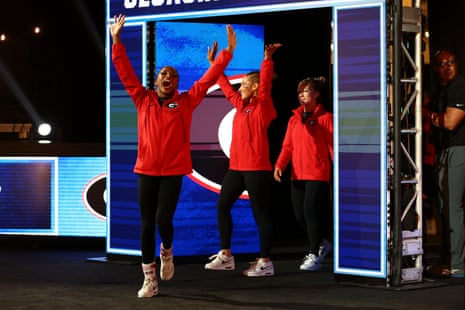
The Georgia Bulldogs are introduced before the NCAA championships in April. Photograph: Chris Swann/NCAA Photos/Getty Images
Out of bounds
For Aquino and Black athletes, visibility is power. So, what happens when they choose to withhold it? In May 2026, the NAACP’s “Out of Bounds” initiative called on Black student athletes across the SEC to do just that. Launched in response to April’s landmark gerrymandering ruling in Louisiana v. Callais, the organization called on Black athletes and their supporters to withhold athletic and financial support from public universities in states that suppressed Black voting representation.
The campaign’s message lands with particular weight this week: this piece runs on the 61st anniversary of the Voting Rights Act of 1965, the very law at the center of the NAACP’s argument.
The NAACP named eight priority states targeted in its initiative, directly calling out the state’s flagship public universities for their reliance on Black athletic talent. Among the schools listed were 11 SEC schools, including the University of Georgia and University of Texas.
The call urged Black athletes to “encourage” their institutions to “publicly oppose racial vote dilution and affirm that Black athletes’ civic power matters beyond their athletic performance.” It also urged them to reconsider attending the “priority” schools, offering HBCU alternatives.
In addition to calling on Black athletes to act, the NAACP demanded the states adopt a state Voting Rights Act, repeal maps that dilute Black voting power, restore districts reflecting Black population strength and commit to transparent redistricting. “Let’s let them know, you can’t have one without the other. Profiting off of Black athletes while suppressing their vote is out of bounds,” the organization wrote. The NAACP did not respond to a request for comment.
While the announcement generated headlines at a point of political tension, the message met mixed reviews from multiple parties, Dr Davis among them. Dr Davis’ conflict stems from the implication for young Black student athletes.
“I don’t fundamentally disagree with looking for leverage points at a time of crisis,” Dr Davis says. Understanding that Black athletic labor sustains – and built – modern institutions, she says, “is a really apt observation.” Her hesitation lies elsewhere.
“As far as I can tell this is a call that has not [been] done with input or voices of athletes,” she says of the Out of Bounds movement. While the movement may have been well-intended, Dr Davis argues that the execution places more burden on vulnerable young adults.
At the time of the announcement, the transfer portals for men’s basketball and football – the campaign’s target revenue sports – had closed. With current SEC athletes largely unable to act, the announcement puts the onus of a life-changing decision on teenage recruits. For a Black gymnast with NCAA title ambitions, walking away from the SEC means walking away from more than half of the sport’s championship contenders.
“It’s laying the burden of saving this moment on the backs [of athletes],” Dr Davis adds. “It’s just exploiting labor in a different way.”
While she disagrees with the NAACP’s execution, as a Texas resident with deep roots in the Mississippi Delta, she understands the sentiment. “I personally don’t love when folks go to Ole Miss. I have walked that campus. I’ve given talks at that campus. I understand the ghost that exists on that campus,” she admits.
Some understandably run from the ghosts. Dr Davis wants to confront and build despite them. Though the past few years of legislation dismantled years of progress, she and her colleagues remain committed to rebuilding and sustaining support infrastructure.
She recognizes promise at Mizzou, where Black students and community members have been collectively mobilizing for over a year. “The conversations that ensued between organizers and athletes ensured a way to merge those movements,” she says. “This is the infrastructure we have built.”
Those in the hardest of spots are often the ones “who move the most ground in terms of building a better future,” she reflects.
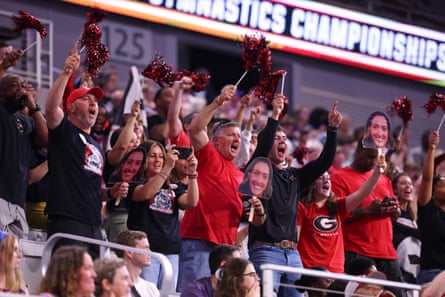
Georgia fans look on during last spring’s NCAA championships in Fort Worth, Texas. Photograph: C Morgan Engel/NCAA Photos/Getty Images
Structural v cosmetic
Though well-intentioned, the Out of Bounds announcement was flawed. As another academic semester approaches and fall sports begin to ramp up, gerrymandering efforts continue across the South and Black athletes, recruits and families face yet another wave of difficult decisions.
“I think this is a time where we have to be the most discerning about what’s structural change and what’s cosmetic,” Dr Davis advises. For Black athletes and their families in the college search, this means isolating the “bells and whistles” from concrete support systems.
Instead of focusing on the often-ephemeral NIL deals, brand partnerships and merchandise, ask structural questions. Ask about the process behind selecting those deals. Talk to current students. While it may no longer fall under the designation of a “DEI” issue, discuss specific concerns that your Black child might have.
For Dr Davis, this advice hits home. Her daughter – a talented musical theatre performer – recently concluded her own search. Much to her family’s initial concern, many of the nation’s top theatre programs sit within the sprawling cornfields of staunchly conservative states.
While their first visits to the campuses were jarring, Dr Davis vowed not to dismiss her daughter’s opportunity. Like NIL deals, the cornfields are cosmetic. Before ruling out the institution, she and her daughter asked structural questions.
Are you going to be isolated from family – or does the area simply look isolating? Are you going to be the first or one of the few Black women on the team, or is there already a cohort of folks there? If the infrastructure doesn’t exist, what is the institution doing to circumvent any bottlenecks?
Attention to detail can make all the difference, Dr Davis says. Back in the ‘70s, Penn State University’s predominantly white ‘Happy Valley’ had no salons that could provide haircuts for Black student athletes. Hoping to attract more Black recruits, Penn State athletic recruiters located the nearest suitable salons and began organizing regular bus trips for student athletes.
It went unnamed at the time, but this was DEI. “That was somebody realizing we don’t have the infrastructure here... so we’re going to organize a bus ride. That is diversity, equity, inclusion, whether or not you give it that label,” she says.
Looking ahead
“We don’t need a task force…we don’t need a meeting to form a panel to think about a task force. We need boots-on-the-ground conversations,” Dr Davis concludes. These conversations are exactly the kind Aquino intends to keep having long after her floor music ends. The SEC just means more, but for Aquino and fellow Black athletes, that meaning continues to take shape.
As Aquino enters her junior year, she comes off a historic season. With Simone Biles’ former coaches Cécile Canqueteau-Landi and Laurent Landi at the helm and recruits flocking to Athens in droves, Georgia is widely considered a top contender for the 2027 NCAA title.
Already a two-time All-American and NCAA Regional Champion, Aquino is expected to be a massive part of the program’s push for its first crown since 2009. Her floor routine will remain one to watch – and rest assured: she’s not dialing it back for anyone.
And while she’s ready to battle, that fight carries her far beyond the walls of Stegeman Coliseum. After getting her undergraduate degrees in Sociology and Criminal Justice, she has her sights set on law school.
“If I can help a young Black child who has a court case and is being tried as an adult, I’m doing that. If I can help juveniles [by] understanding their social behavior and getting them the resources and advocating for them… I’m going to do that.”
The SEC just means more. For Black athletes like Nyla Aquino, that couldn’t be more true. “No matter what I do and where I do it, it has to mean more.”
Source note
First published by The Guardian US
This article was supplied by The Guardian US through its RSS feed and formatted for Crooli Signal. The reporting remains with the original publisher.
Read the original at The Guardian US

