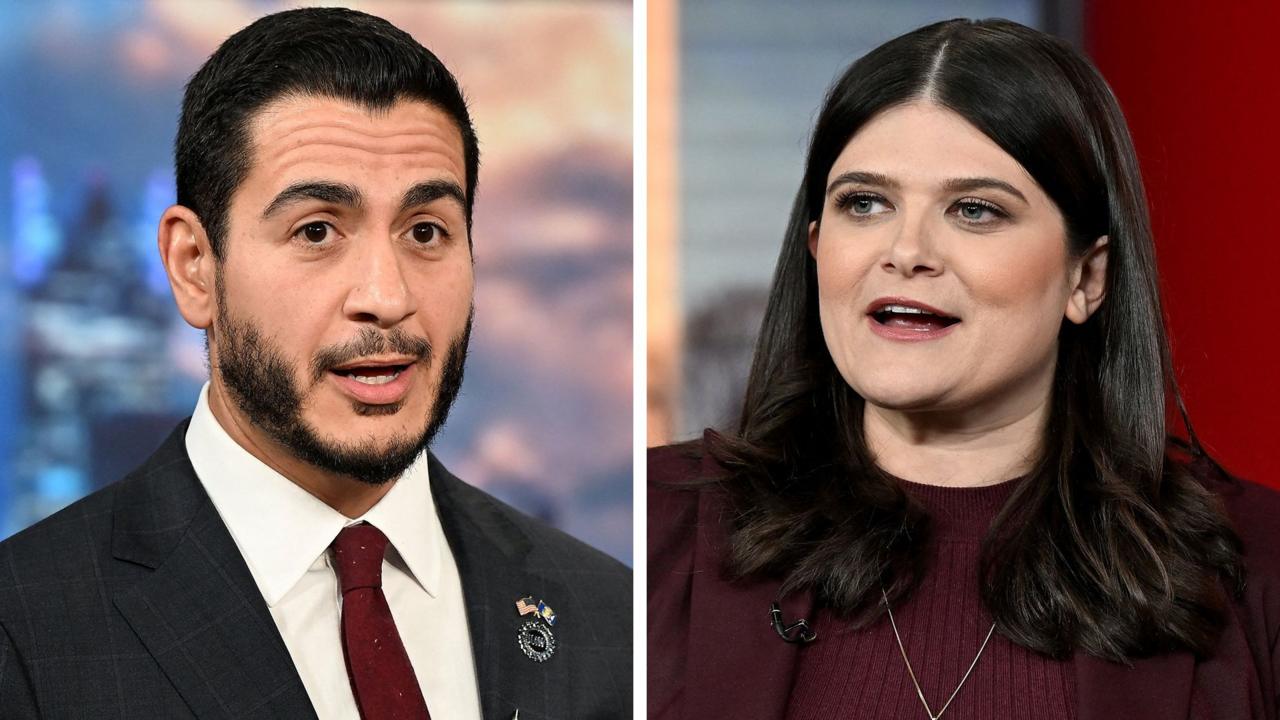
Left-wing political outsider Abdul El-Sayed is projected to win Michigan's Democratic Senate primary, a race that exposed bitter divisions within the party over its future direction.
The former public health official is on track to narrowly beat moderate Democratic congresswoman Haley Stevens, according to CBS News, the BBC's US partner.
"In the words of Mohammad Ali, 'We shook up the world,'" El-Sayed said, quoting the famed boxer's declaration after his underdog defeat of Sonny Liston in 1964.
He will face Republican and Trump ally Mike Rogers, in November's midterm elections. If elected, El-Sayed would become the first Muslim to serve in the US senate.
The final result was much closer than El-Sayed's camp had expected, with fewer than 15,000 votes - a margin of just under 1 percentage point out of more than 1.5 million ballots counted - separating him from Stevens as of late Wednesday morning.
"The movement to get money out of politics, put money in your pocket, and pass Medicare for All is a big movement," El-Sayed said on Wednesday, echoing a familiar refrain he had used on the campaign trail.
"I want to congratulate Abdul El-Sayed on winning the Democratic nomination for US Senate," Stevens said in a statement. "He is a doctor, a community health official, a Rhodes Scholar, and a dedicated Michigander. I am proud to offer my support as he takes on Mike Rogers in the general election."
The November midterm elections will determine the balance of power in Washington for the last two years of President Donald Trump's time in office.
Trump declared the Michigan Senate result "Great news for the Republican Party".
In his post on Truth Social, Trump referred to the Democratic Party as the "Dumocrats", and claimed their "crazy policies will only get worse!"
After a bruising and sometimes bitter campaign, El-Sayed hinted at bridge-building when he addressed supporters on Tuesday night, before the outcome was known.
"Whatever happens tonight, we have a responsibility to ensure that we unite, unite to make sure that [Republican] Mike Rogers never sees the inside of the US Senate."
El-Sayed, who was endorsed by left-wing politicians including Vermont Senator Bernie Sanders and New York City congresswoman Alexandria Ocasio-Cortez, has voiced support for progressive causes like universal healthcare and abolishing US Immigration and Customs Enforcement.
Stevens, 43, took a more moderate approach, pitching herself as the middle-of-the-road candidate who would appeal to voters unsure of which party to back in November. She made a promise to save manufacturing jobs in Michigan, should she be elected.
Stevens earned the endorsement of Michigan Governor Gretchen Whitmer, as well as outgoing Senator Gary Peters.
One of the biggest areas where the candidates disagreed was their stance on Israel.
El-Sayed spoke out against US involvement in the Middle East, including aid to Israel. Stevens, meanwhile, is staunchly pro-Israel and has said she supports upholding US aid to Israel without conditions.
El-Sayed's candidacy drew both support and opposition from Michigan's Jewish community due to his stance on the US-Israel relationship.
He has rejected allegations of anti-Semitism, which Trump renewed in his Truth Social post on Wednesday.
"I stand in solidarity with my Jewish sisters and brothers," El-Sayed said on Wednesday. "We can condemn anti-Semitism and at the same time, we can be talking about how we bring people together, and we can be talking about everybody's pain."
The Senate seat is currently held by a retiring Democrat. The last time the Midwestern state elected a Republican senator was in 1994.
In presidential elections Michigan is one of the crucial swing states. It voted for Democrat Joe Biden in 2020 but went for Trump in 2024.
A handful of other US states too held their primaries for statewide and national offices on Tuesday night, setting up partisan battles in November.
In Kansas, Democratic State Senator Cindy Holsher and Trump-backed Republican legislator Ty Masterson advanced in the governor's race.
In Ohio, Congressman Wesley Bell defeated former Congresswoman Cory Bush in a Democratic primary defined by the candidates' diverging stances on the US-Israel relationship.
Missouri voters also rejected a Republican-backed amendment that would have made it significantly harder to change the state's constitution, by raising the bar for passing citizen-led ballot initiatives.
Source note
First published by BBC World
This article was supplied by BBC World through its RSS feed and formatted for Crooli Signal. The reporting remains with the original publisher.
Read the original at BBC World