From
Lithuanian minister warns against Russia's 'false flag' strike on the Baltics
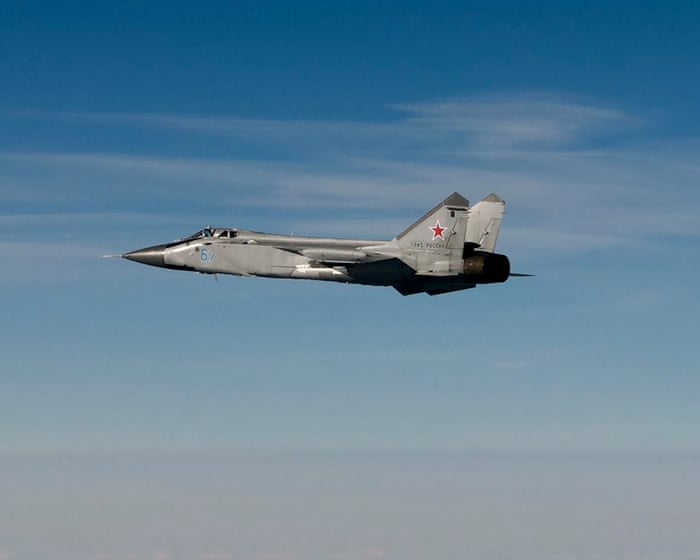
Lithuania’s defence minister Robertas Kaunas warned that Russia could be considering possible “false flag” provocations against Nato countries in the Baltic region.
A “false flag” is a term for an event or attack which would later be blamed on someone other than the actual perpetrator.
Kaunas said there was no specific date for any potential Russian actions, but authorities were closely monitoring Russia’s plans and exchanging information with Poland and other Nato allies.
“We are assessing and monitoring the threat level,” he said, quoted by LRT.
BNS news agency reported that one scenario believed to be considered by Moscow included a “false flag” strike using intercepted Ukrainian-made drones on the region’s critical infrastructure. Such possibility was also reported by Lithuanian media outlet 15min.
The minister suggested that a potential Russian attack – which could be carried using an intercepted or a reconstructed drone that would look like it is of Ukrainian-origin – would be used to test Nato’s resolve to support Ukraine.
He stressed that the risk of a conventional attack on Lithuania remained low, LRT said.
Kaunas’s latest comments come after months of warnings from senior regional leaders from Poland, Latvia and Lithuania about the risk of escalation by Russia.
Lithuania repeatedly experienced air drone alerts in the last few months.
In other news, Hungary has switched off decorative and non-essential lighting at all state institutions, including its parliament, most of the Buda Castle and Chain Bridge, at night to save energy as the country battles another heatwave putting strain on its energy system, AP reported.
Record-low water levels on the Danube have forced the country to largely shut down its sole nuclear plant, which uses the river for cooling, stretching power supply capacity to its limits.
Back to the drone incident in Leipzig, German newspaper Süddeutsche Zeitung is reporting that one of the planes near where the drone was spotted was carrying “military ammunition” transported from France and “likely intended for onward transport.”
The paper says the revelation comes from a confidential police report, but it has not been confirmed by the authorities at this stage.
Oh, that’s interesting.
Talking about energy security in the EU during the continuing heatwaves and droughts affecting multiple countries, an EU spokesperson pointed to another phenomenon likely to have an impact: next week’s solar eclipse.
\n “I can point you to the solar eclipse next week on the 12th, which will have an impact on energy production. \n We have established a operational group that is dedicated to the preparation of this and … my understanding is that they have a meeting tomorrow, Friday, where they are preparing for possible impacts. \n But given the fact that it should be taking place, the solar eclipse, towards afternoon, its impacts is not expected to be huge, but this is just to show you that we are really looking very holistically… at the situation and, and any possible, factors that might [have an] impact.”\n
Over in Brussels, the European Commission is giving its regular midday briefing, with reporters’ questions focusing on Ukraine at the moment.
The EU has already disbursed €8.5bn out of its €90bn loan for Ukraine, focusing on financing Ukraine’s defence needs, including fighter jets, missiles, drones.
Asked if Ukraine could use the money to spend on missile interceptors for its air defence, an EU spokesperson confirmed that’s the case.
\n “Ukraine defines the needs: Ukraine looks at the situation on the battlefield, identifies the needs, submits what we call a product schedule. We examine the project schedule and we proceed on that basis. So, it is very much a possibility for Ukraine to request, for example, interceptors or related equipment, and then we can look at it.”\n
A 25-year-old Afghan man who last year drove into the a trade union march in Munich killing two and injuring over 40 people has been sentenced to life imprisonment.
A Munich court ruled that the crime carried “particular gravity”, a designation that will make it much harder for the 25-year-old man, named only as Farhad N., to ever win release from prison, AFP noted.
Lithuania’s defence minister Robertas Kaunas warned that Russia could be considering possible “false flag” provocations against Nato countries in the Baltic region.
A “false flag” is a term for an event or attack which would later be blamed on someone other than the actual perpetrator.
Kaunas said there was no specific date for any potential Russian actions, but authorities were closely monitoring Russia’s plans and exchanging information with Poland and other Nato allies.
“We are assessing and monitoring the threat level,” he said, quoted by LRT.
BNS news agency reported that one scenario believed to be considered by Moscow included a “false flag” strike using intercepted Ukrainian-made drones on the region’s critical infrastructure. Such possibility was also reported by Lithuanian media outlet 15min.
The minister suggested that a potential Russian attack – which could be carried using an intercepted or a reconstructed drone that would look like it is of Ukrainian-origin – would be used to test Nato’s resolve to support Ukraine.
He stressed that the risk of a conventional attack on Lithuania remained low, LRT said.
Kaunas’s latest comments come after months of warnings from senior regional leaders from Poland, Latvia and Lithuania about the risk of escalation by Russia.
Lithuania repeatedly experienced air drone alerts in the last few months.
Ukraine could benefit from a Lockheed Martin project to build a new, lower-cost Patriot interceptor, the PAC-3 Adapted Capability Effector (ACE) missile, Reuters has reported.
The news agency, citing defence and US government sources, said that despite Donald Trump casting doubt on a deal for Ukraine to build desperately needed Patriots, “no order was given to halt the discussions”, and talks continued with US arms makers, military officials and others.
Ukraine has proven adept at producing large volumes of dramatically cheaper yet equally or more effective missiles and drones compared with those made by western allies.
The UK has added 13 new designations and six new specifications to its Russia sanctions regime.
The new entries include asset freezes, director disqualifications and transport sanctions, and shipping and trade sanctions, among others.
The new listings include banks, companies involved in natural resources exploration, tankers and companies responsible for selling them into Russian ownership, and engineering companies working on maintenance of airplanes, the government’s website showed.
The head of a leading Russian drone manufacturer has been critically injured in a car bomb near Ekaterinburg, in what appears to be the latest in a series of assassination attempts targeting figures linked to the country’s war in Ukraine.
Vladimir Tkachuk, the founder of the private drone manufacturer Uraldronzavod, was rushed to intensive care on Wednesday after a bomb planted beneath his Mercedes exploded, according to Russian state media, citing emergency services. His bodyguard was killed in the explosion.
The Russian news agency Tass reported that Tkachuk was in a critical condition and doctors were “fighting [to save] his life”.
Images circulating on social media showed the charred wreckage of a Mercedes, with blood stains visible on the pavement nearby.
Uraldronzavod is one of several private drone manufacturers that sprang up in Russia after the full-scale invasion of Ukraine. The company is best known for producing the Upyr (Ghoul), a low-cost first-person-view (FPV) kamikaze drone manufactured using 3D-printing technology at its facility in Ekaterinburg and widely used by Russian forces in Ukraine.
In 2024, Vladimir Putin visited the factory, where he was given a tour by Tkachuk.
Uraldronzavod and Tkachuk have been hit with sanctions by western governments for their role in supporting Russia’s war.
Tkachuk is also the founder of the popular pro-war Telegram channel Obsessed with War, which has more than 500,000 followers and has been used to raise funds and procure military equipment for Russian soldiers fighting on the frontline.
Russia is likely to blame Ukraine for the bombing, which comes just days after an explosion outside an upmarket restaurant in central Moscow that killed five people.
At least six people were killed and 36 injured in another round of Russian overnight attacks on Ukraine, targeting the eastern city of Balakliia and the northern region of Sumy.
But the Ukrainian president, Volodymyr Zelenskyy, noted that Ukraine’s military managed to hit two Russian refineries in targeted attacks, hitting “Russia’s oil revenues, which it uses to finance the war and the killing of Ukrainians.”
“Ukraine’s Defence Forces struck the aggressor’s facilities more than 1,300 kilometres from the frontline. The Bashneft-Novoil refinery was hit in Bashkortostan. In the Yaroslavl region, nearly 700 kilometres from our border, the Slavneft-YANOS refinery was hit,” he said.
“Russia must choose peace,” he added.
The attacks come at a particularly sensitive moment as Ukraine is growing concerned about the lack of air defence missiles to protect its skies. Nato secretary general Mark Rutte pledged to “urgently” look into this after speaking to Zelenskyy last night.
Later this month, US negotiators Steve Witkoff and Jared Kushner are expected to make their first visit to Kyiv for direct talks with Zelenskyy, with the issue of US licensing the manufacturing of Patriot missiles to Ukraine is likely to be discussed.
Elsewhere, I will be keeping an eye on the latest from Leipzig after last night’s press conference by Germany’s interior minister Alexander Dobrindt, hinting at the possible involvement of “foreign powers” remaining in “competition” with Europe on hybrid threats.
Who could he possibly be thinking about?
I will also follow the latest from central and south eastern Europe as several countries remain on red alert due to extreme temperatures. Austria and Slovakia broke their all-time high temperature records on Wednesday, with more extreme heat expected today, including also in Italy.
It’s Thursday, 6 August 2026, it’s Jakub Krupa here, and this is Europe Live.
Good morning.
Key events
- 18m agoHungary turns off decorative, non-essential lighting amid drought-related energy crunch
- 1h agoUkrainian plane next to drone at Leipzig was carrying ammunition for 'onward transport' - reports
- 1h agoEU preparing for solar eclipse impact on energy production next week
- 1h agoEU disbursed €8.5bn of its €90bn loan for Ukraine's defence
- 2h agoAfghan man given life sentence for deadly Munich car-ramming attack
- 2h agoLithuanian minister warns against Russia's 'false flag' strike on the Baltics
- 3h agoUkraine looking at cut-price Patriot missiles as it looks for missile defence options
- 3h agoUK expands designations under Russia sanctions regime
- 3h agoHead of drone manufacturer critically injured in car bomb in Russia
- 4h agoMorning opening: Ukraine hits Russia's oil refineries as Russian strikes on Ukrainian cities continue
Hungary turns off decorative, non-essential lighting amid drought-related energy crunch
In other news, Hungary has switched off decorative and non-essential lighting at all state institutions, including its parliament, most of the Buda Castle and Chain Bridge, at night to save energy as the country battles another heatwave putting strain on its energy system, AP reported.
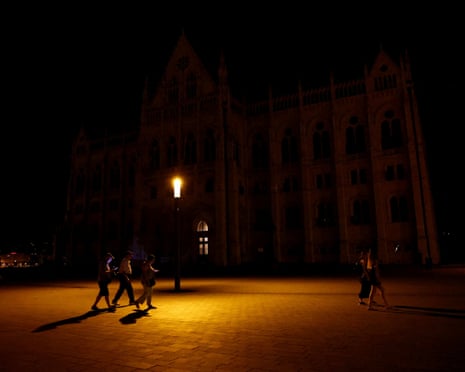
People walk next to the parliament building as lights are turned off at Budapest landmarks to reduce energy due to a power crisis in Budapest, Hungary. Photograph: Bernadett Szabó/Reuters
Record-low water levels on the Danube have forced the country to largely shut down its sole nuclear plant, which uses the river for cooling, stretching power supply capacity to its limits.
Jakub Krupa
I appreciate that’s not the main point here, but German authorities will hardly be thrilled that another confidential report on the Leipzig incident has leaked to the media.
This could put more pressure on them to explain what they know in a bit more detail than during Dobrindt’s briefing last night.
Ukrainian plane next to drone at Leipzig was carrying ammunition for 'onward transport' - reports
Back to the drone incident in Leipzig, German newspaper Süddeutsche Zeitung is reporting that one of the planes near where the drone was spotted was carrying “military ammunition” transported from France and “likely intended for onward transport.”
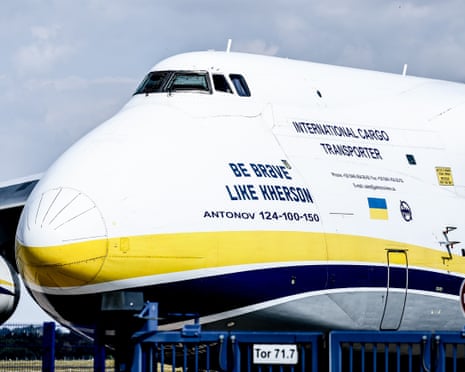
A Ukrainian 'Antonov' cargo plane at the Airport Leipzig-Halle, in Schkeuditz, Germany. Photograph: Filip Singer/EPA
The paper says the revelation comes from a confidential police report, but it has not been confirmed by the authorities at this stage.
The commission also got repeatedly asked about last week’s events in Ceuta and media reports that social media accounts seen calls for another attempt to overwhelm the border on 15 August.
A spokesperson said the commission was aware of various threats to the EU’s external border, and “that’s why we need to step up our work.”
The commission also said it was aware of reports that Russian-related channels joined in to “amplify” disinformation about the events in Ceuta, but it’s the Spanish national authorities that lead on this issue.
Answering some concerns, the commission also said that “illegal movement onwards to mainland Spain and Europe has so far been successfully prevented.”
EU preparing for solar eclipse impact on energy production next week
Oh, that’s interesting.
Talking about energy security in the EU during the continuing heatwaves and droughts affecting multiple countries, an EU spokesperson pointed to another phenomenon likely to have an impact: next week’s solar eclipse.
“I can point you to the solar eclipse next week on the 12th, which will have an impact on energy production. We have established a operational group that is dedicated to the preparation of this and … my understanding is that they have a meeting tomorrow, Friday, where they are preparing for possible impacts. But given the fact that it should be taking place, the solar eclipse, towards afternoon, its impacts is not expected to be huge, but this is just to show you that we are really looking very holistically… at the situation and, and any possible, factors that might [have an] impact.”
The EU also got asked about yesterday’s Leipzig drone incident over in Germany.
But a transport spokesperson declined to speculate on what happened, pointing strongly towards the German authorities instead.
“It’s for the national authorities to investigate. We do have aviation safety legislation in place … Before making any assessments or any kind of statement … we need to first let the national authorities look into this. And obviously we are closely, closely in contact or in close contact with them on this.”
EU disbursed €8.5bn of its €90bn loan for Ukraine's defence
Over in Brussels, the European Commission is giving its regular midday briefing, with reporters’ questions focusing on Ukraine at the moment.
The EU has already disbursed €8.5bn out of its €90bn loan for Ukraine, focusing on financing Ukraine’s defence needs, including fighter jets, missiles, drones.
Asked if Ukraine could use the money to spend on missile interceptors for its air defence, an EU spokesperson confirmed that’s the case.
“Ukraine defines the needs: Ukraine looks at the situation on the battlefield, identifies the needs, submits what we call a product schedule. We examine the project schedule and we proceed on that basis. So, it is very much a possibility for Ukraine to request, for example, interceptors or related equipment, and then we can look at it.”
Afghan man given life sentence for deadly Munich car-ramming attack
A 25-year-old Afghan man who last year drove into the a trade union march in Munich killing two and injuring over 40 people has been sentenced to life imprisonment.
A Munich court ruled that the crime carried “particular gravity”, a designation that will make it much harder for the 25-year-old man, named only as Farhad N., to ever win release from prison, AFP noted.
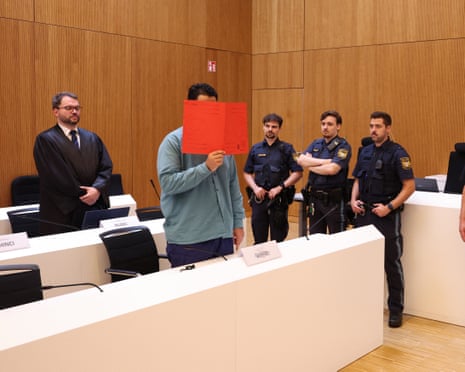
Afghan defendant identified as Farhad N accused of deliberately steering a car into a 1,400-strong trade union march in February 2025. Photograph: Karl-Josef Hildenbrand/AFP/Getty Images
Lithuanian minister warns against Russia's 'false flag' strike on the Baltics
Lithuania’s defence minister Robertas Kaunas warned that Russia could be considering possible “false flag” provocations against Nato countries in the Baltic region.
A “false flag” is a term for an event or attack which would later be blamed on someone other than the actual perpetrator.
Kaunas said there was no specific date for any potential Russian actions, but authorities were closely monitoring Russia’s plans and exchanging information with Poland and other Nato allies.
“We are assessing and monitoring the threat level,” he said, quoted by LRT.
BNS news agency reported that one scenario believed to be considered by Moscow included a “false flag” strike using intercepted Ukrainian-made drones on the region’s critical infrastructure. Such possibility was also reported by Lithuanian media outlet 15min.
The minister suggested that a potential Russian attack – which could be carried using an intercepted or a reconstructed drone that would look like it is of Ukrainian-origin – would be used to test Nato’s resolve to support Ukraine.
He stressed that the risk of a conventional attack on Lithuania remained low, LRT said.
Kaunas’s latest comments come after months of warnings from senior regional leaders from Poland, Latvia and Lithuania about the risk of escalation by Russia.
Lithuania repeatedly experienced air drone alerts in the last few months.
Ukraine looking at cut-price Patriot missiles as it looks for missile defence options
Ukraine could benefit from a Lockheed Martin project to build a new, lower-cost Patriot interceptor, the PAC-3 Adapted Capability Effector (ACE) missile, Reuters has reported.
The news agency, citing defence and US government sources, said that despite Donald Trump casting doubt on a deal for Ukraine to build desperately needed Patriots, “no order was given to halt the discussions”, and talks continued with US arms makers, military officials and others.
Ukraine has proven adept at producing large volumes of dramatically cheaper yet equally or more effective missiles and drones compared with those made by western allies.
UK expands designations under Russia sanctions regime
The UK has added 13 new designations and six new specifications to its Russia sanctions regime.
The new entries include asset freezes, director disqualifications and transport sanctions, and shipping and trade sanctions, among others.
The new listings include banks, companies involved in natural resources exploration, tankers and companies responsible for selling them into Russian ownership, and engineering companies working on maintenance of airplanes, the government’s website showed.
Head of drone manufacturer critically injured in car bomb in Russia
Pjotr Sauer
The head of a leading Russian drone manufacturer has been critically injured in a car bomb near Ekaterinburg, in what appears to be the latest in a series of assassination attempts targeting figures linked to the country’s war in Ukraine.
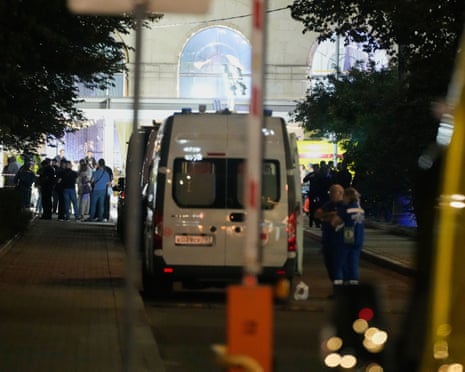
Russia is likely to blame Ukraine for the bombing, which comes just days after an explosion outside a restaurant in central Moscow. Photograph: Pavel Bednyakov/AP
Vladimir Tkachuk, the founder of the private drone manufacturer Uraldronzavod, was rushed to intensive care on Wednesday after a bomb planted beneath his Mercedes exploded, according to Russian state media, citing emergency services. His bodyguard was killed in the explosion.
The Russian news agency Tass reported that Tkachuk was in a critical condition and doctors were “fighting [to save] his life”.
Images circulating on social media showed the charred wreckage of a Mercedes, with blood stains visible on the pavement nearby.
Uraldronzavod is one of several private drone manufacturers that sprang up in Russia after the full-scale invasion of Ukraine. The company is best known for producing the Upyr (Ghoul), a low-cost first-person-view (FPV) kamikaze drone manufactured using 3D-printing technology at its facility in Ekaterinburg and widely used by Russian forces in Ukraine.
In 2024, Vladimir Putin visited the factory, where he was given a tour by Tkachuk.
Uraldronzavod and Tkachuk have been hit with sanctions by western governments for their role in supporting Russia’s war.
Tkachuk is also the founder of the popular pro-war Telegram channel Obsessed with War, which has more than 500,000 followers and has been used to raise funds and procure military equipment for Russian soldiers fighting on the frontline.
Russia is likely to blame Ukraine for the bombing, which comes just days after an explosion outside an upmarket restaurant in central Moscow that killed five people.
Morning opening: Ukraine hits Russia's oil refineries as Russian strikes on Ukrainian cities continue
Jakub Krupa
At least six people were killed and 36 injured in another round of Russian overnight attacks on Ukraine, targeting the eastern city of Balakliia and the northern region of Sumy.
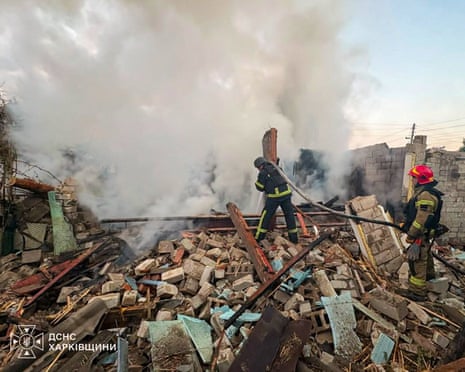
Firefighters work at the site of a private house destroyed during overnight Russian drone strikes, amid Russia's attack on Ukraine, in the town of Balakliia, in Kharkiv region, Ukraine. Photograph: State Emergency Service Of Ukraine/Reuters
But the Ukrainian president, Volodymyr Zelenskyy, noted that Ukraine’s military managed to hit two Russian refineries in targeted attacks, hitting “Russia’s oil revenues, which it uses to finance the war and the killing of Ukrainians.”
“Ukraine’s Defence Forces struck the aggressor’s facilities more than 1,300 kilometres from the frontline. The Bashneft-Novoil refinery was hit in Bashkortostan. In the Yaroslavl region, nearly 700 kilometres from our border, the Slavneft-YANOS refinery was hit,” he said.
“Russia must choose peace,” he added.
The attacks come at a particularly sensitive moment as Ukraine is growing concerned about the lack of air defence missiles to protect its skies. Nato secretary general Mark Rutte pledged to “urgently” look into this after speaking to Zelenskyy last night.
Later this month, US negotiators Steve Witkoff and Jared Kushner are expected to make their first visit to Kyiv for direct talks with Zelenskyy, with the issue of US licensing the manufacturing of Patriot missiles to Ukraine is likely to be discussed.
Elsewhere, I will be keeping an eye on the latest from Leipzig after last night’s press conference by Germany’s interior minister Alexander Dobrindt, hinting at the possible involvement of “foreign powers” remaining in “competition” with Europe on hybrid threats.
Who could he possibly be thinking about?
I will also follow the latest from central and south eastern Europe as several countries remain on red alert due to extreme temperatures. Austria and Slovakia broke their all-time high temperature records on Wednesday, with more extreme heat expected today, including also in Italy.
It’s Thursday, 6 August 2026, it’s Jakub Krupa here, and this is Europe Live.
Good morning.
Source note
First published by The Guardian World
This article was supplied by The Guardian World through its RSS feed and formatted for Crooli Signal. The reporting remains with the original publisher.
Read the original at The Guardian World