
From
Michigan Senate primary still too close to call with just over 60% of votes counted
With a little more than 60% of the vote counted in Michigan’s marquee Senate primary race, the insurgent Democratic candidate Abdul El‑Sayed, an epidemiologist and former public health official, is just three points ahead of establishment‑backed Haley Stevens, a US congresswoman.
According to the Associated Press, El‑Sayed is posting strong numbers in Washtenaw county, home to Ann Arbor and the University of Michigan, and in Kent county, which includes Grand Rapids.
Stevens, meanwhile, is ahead in Oakland county, which covers many of Detroit’s northern suburbs.
Only 48% of the vote has been counted in Wayne county, Michigan’s largest. At this stage, Stevens is up there by roughly eight points.
With a little more than 60% of the vote counted in Michigan’s marquee Senate primary race, the insurgent Democratic candidate Abdul El‑Sayed, an epidemiologist and former public health official, is just three points ahead of establishment‑backed Haley Stevens, a US congresswoman.
According to the Associated Press, El‑Sayed is posting strong numbers in Washtenaw county, home to Ann Arbor and the University of Michigan, and in Kent county, which includes Grand Rapids.
Stevens, meanwhile, is ahead in Oakland county, which covers many of Detroit’s northern suburbs.
Only 48% of the vote has been counted in Wayne county, Michigan’s largest. At this stage, Stevens is up there by roughly eight points.
Marie Gluesenkamp Perez, the two-term centrist Democrat, has advanced to the general election for a competitive US House seat in Washington state.
She’ll face the Republican candidate and state senator, John Braun, who is backed by Trump.
The state votes on single ballots – meaning the top two finishers, regardless of party, advance to November’s contest.
Highly contested seats such as Gluesenkamp Perez’s will be crucial for Democrats to secure a majority in the House, and expand the margin.
Trump has carried the district in all three of his presidential runs, most recently by about three points, and yet in 2024 Gluesenkamp Perez ran roughly seven points ahead of her party’s presidential nominee.
As my colleague Lok Darjee reports, logging, mills, agriculture, shipping and manufacturing still shape daily life in much of her district and Gluesenkamp Perez’s success has stemmed from her appeal to moderates and rural voters. An auto repair shop owner, she won over many in south-west Washington, including Republicans who considered Kent too extreme.
William Lawrence, a community organizer who co-founded the Sunrise Movement, won a competitive three-way Democratic primary race in Michigan’s seventh congressional district. He beat Bridget Brink, the former US ambassador to Ukraine and former US Navy Seal Matt Maasdam.
Lawrence will now face Republican incumbent Tom Barrett, who has bucked his own party while in office, after he flipped the district red in 2024.
The seat’s former representative, Senator Elissa Slotkin, had backed Massdam, while independent Senator Bernie Sanders endorsed Lawrence.
Here’s more on Lawrence from my colleague Dharna Noor:
Congressman John James has won the Republican nomination in the Michigan governor’s race.
James, who represents the state’s 10th congressional district, beat Perry Johnson – a businessman who ran against Donald Trump in the 2024 presidential election but withdrew before the primaries.
James will now face Jocelyn Benson, Michigan’s secretary of state, in November’s general election.
Voters in Missouri overwhelmingly rejected an amendment that would make it harder to amend the state constitution. Almost 80% voted “no” on the ballot measure in Tuesday’s primary election.
It would have required citizen initiatives to pass in all congressional districts rather than by a simple statewide majority.
Cindy Holscher, a state senator, won the Democratic nomination in Kansas’ gubernatorial race. She beat two other Sunflower state politicians to advance to the general election.
It’s set to be a fierce competition as Republicans are angling to retake the governor’s mansion following eight years under Laura Kelly, the term-limited Democratic incumbent.
Ty Masterson, the Trump-backed Kansas state senate president, clinched the GOP nomination in a crowded race.
Mallory McMorrow, the Michigan state lawmaker, who suspended her campaign for the Democratic nomination for US Senate earlier this year, said that it was vital for Democrats to “come together tonight” regardless of which candidate wins the race in an interview with CNN.
However, McMorrow did not reveal who she voted for in Tuesday’s primary.
“I voted for great Democrats up and down the ballot, and I made a commitment that whoever wins the Senate race tonight, I will be endorsing as soon as that race is called,” she said. “I will be headed to their election night party to show we all come together after whatever happens tonight, so that we can be a team as we head in November.”
Only 28% of the votes in the Michigan Senate Democratic primary have been counted so far. And in the state’s largest county – Wayne county – only 7% of the votes have been counted.
Jocelyn Benson, Michigan’s secretary of state, clinched the Democratic nomination in the governor’s race, beating Chris Swanson – the Genesee county sheriff.
The Republican contest has yet to be called by the Associated Press. The winner will face-off against Benson to replace the term-limited governor Gretchen Whitmer.
A quick note that the remaining counties in Michigan that keep central time have now closed their polls.
In the first round of results that the Associated Press have called in the state, Michael Bouchard won the Republican primary in Michigan’s 10th congressional district. This is a GOP stronghold that the party is hoping to hold on to this year as the incumbent, John James, vies for the Republican nomination for governor.
In Michigan’s 11th district, state senator Jeremy Moss won the Democratic primary to face Ethan Baker, the Republican running unopposed, in November. This is the seat currently held by Democratic Senate candidate Haley Stevens, who flipped the district blue in 2018.
The Democratic congressman Wesley Bell won his primary in the St Louis area on Tuesday, ending the progressive former representative Cori Bush’s bid for a comeback and blunting the momentum pro-Palestinian candidates have shown in recent elections.
Bell unseated Bush, a democratic socialist who opposes aid to the US ally and accuses it of committing a genocide in Gaza, in the Democratic congressional primary two years ago with the help of millions of dollars in spending from pro-Israel groups.
Their rematch this year came amid a spate of primary defeats of Democratic incumbents at the hands of progressive outsiders.
Shortly after polls closed, the Associated Press declared that Bell had prevailed. The first district’s heavily Democratic lean makes Bell the favorite to win a second term in the November election.
The Associated Press has called the first batch of results for three House primaries in Virginia.
- \n First congressional district: Shannon Taylor, a longtime prosecutor, has won the Democratic primary in Virginia’s first congressional district. Backed by establishment Democrats who hope she can flip the seat – which includes the Richmond suburbs – after voters there supported Democratic governor Abigail Spanberger last year, Taylor will challenge Republican incumbent Robb Wittman, who ran uncontested, in November.
- \n Second congressional district: Elaine Luria, a former congresswoman, has clinched the Democratic nomination in Virginia’s second district. Luria, who served two terms before losing to Republican Jennifer Kiggans in 2022, will now face the incumbent again in a rematch for the battleground district that includes Virginia Beach.
- \n Seventh congressional district: Meanwhile, in Virginia’s seventh district, Republican voters chose Doug Ollivant, an army veteran, to take on freshman Democrat Eugene Vindman, also a former service member, in the general election. The seat – formerly held by Spanberger – is one of the state’s most competitive. It was in GOP hands from 2000 until 2018, when Spanberger flipped it blue.
Polls have closed in Missouri, and we will be bringing you the results as they come through. We’ll be keeping an eye out on the Democratic primary in the state’s deep-blue first congressional district – where the pro-Israel incumbent, Wesley Bell, is facing a challenge from Cori Bush, a former progressive congresswoman who accuses Israel of perpetrating genocide in Gaza.
Along with a heated Senate primary in Michigan, the Missouri contest has become a proxy battle over the Democratic party’s role in supporting Israel’s military before the November midterm elections.
Almost all of the polls have closed in Michigan. We’ll bring you the results as they come in, particularly in the most closely watched race of the night – the Democratic primary for US Senate.
There are four counties in Michigan that keep central time, which means that they will close their polls an hour later than the rest of the state.
While Michigan’s Democratic Senate contest is the night’s marquee race, two House primaries also capture the fight over the party’s future.
In the Great Lake state’s seventh congressional district – which flipped red in 2024 and is now held by Republican congressman Tom Barrett – a three-way race has emerged between progressive William Lawrence, a community organizer who co-founded the Sunrise Movement, Bridget Brink, the former US ambassador to Ukraine and former US Navy Seal Matt Maasdam. While the seat’s former representative, Senator Elissa Slotkin, has backed Massdam, independent Senator Bernie Sanders has endorsed Lawrence.
Meanwhile, in the 13th district, which encompasses the Detroit area, Sanders also backed the state representative Donavan McKinney, another progressive running with the aim to oust the establishment-backed Democratic incumbent, representative Shri Thanedar.
Polls have closed in Virginia, where voters weighed in on primaries for all 11 US House seats and the Republican primary to pick a nominee to run against Democratic senator Mark Warner.
A reminder, Democrats are hoping to flip as many of the five GOP‑held House districts as possible this year – even after the state supreme court struck down their redistricting plan that would have netted them 10 of the 11 seats.
Meanwhile, Republicans are also voting on a challenger in a long-shot effort to take on Warner – a powerful Democrat who has served nearly 18 years in the Senate, and is running unopposed. This is also the incumbent’s final re-election bid, which Democrats are hoping will lift many of the down-ballot races going into November.
Abdul El-Sayed spends a fair amount of his day not taking himself so seriously. He jokes about his haircut, films selfie videos with supporters and has taken – more than once – to cringey dancing and lip-syncing on camera.
But ask him after a long day on the campaign trail to explain the difference between a virus and a bacterium, and the epidemiologist takes over from the entertainer.
El-Sayed, running in Michigan to be the Democratic candidate for US Senate this November, is trying to strike a delicate balance between policy wonk and performer – capable of detailing the mechanics of the proposed Medicare for All system of universal healthcare one minute and delivering a punchline the next.
At a moment when American politics has become conspicuously humorless, he is an unusual political persona. And in a matter of days, on 4 August, Michigan Democrats will decide whether he’s their type to send him to the United States Senate.
El-Sayed faces the more moderate representative Haley Stevens, who has the backing of the Democratic party establishment. The duo are virtually neck-and-neck at the polls – raising the prospect of the party’s grassroots voters again defying the wishes of its leaders.
While a string of socialist victories across Democratic primaries in recent months has boosted the left of the party, El-Sayed rejects the label. He just wants capitalism that works.
In Tuesday’s Democratic congressional primary, voters in Missouri’s deep-blue first congressional district will decide whether to give pro-Israel incumbent Wesley Bell a second term, or replace him with Cori Bush, a former progressive congresswoman who accuses Israel of perpetrating genocide in Gaza.
Along with a heated primary in Michigan, the contest has become a proxy battle over the Democratic party’s role in supporting Israel’s military before the November midterm elections, which will determine which party holds the majority in both chambers of Congress.
After losing to Bell two years ago, Bush, a member of the Democratic Socialists of America, is vying for her seat back, and a Super Pac linked to the American Israel Public Affairs Committee (Aipac) has so far spent more than $3m to try to keep her out.
In recent weeks, Democratic voters in New York City and Denver ousted incumbents in favor of candidates who promised they would take a hard line against support for Israel. In Congress, large shares of Democrats have voted for unsuccessful efforts to block arms sales to the country’s security forces, and progressives hope that a win by Bush will underscore their movement’s momentum.
The Michigan Democratic Senate primary is, perhaps, the most contentious Democratic primary this year – and a test for the party’s future.
Voters are weighing the policies and personalities of the candidates as they once again consider the thorny question of electability: who can win this purple state in November, and potentially push the party towards a majority in the Senate?
Recent surveys have shown Abdul El-Sayed pulling ahead. A non-partisan Emerson poll this week of likely Democratic voters found 54% intended to vote for El-Sayed compared with 39% for Haley Stevens, with a stark age divide. Voters under 50 broke for El-Sayed by 42 percentage points, while voters over 60 preferred Stevens by a 14-point margin, it showed. Independents were siding with El-Sayed by a 27-point margin.
Stevens, 43, has represented Michigan’s 11th House district since 2019, after flipping the seat. She has been endorsed by the Senate minority leader, Chuck Schumer, the Michigan governor, Gretchen Whitmer, and Gary Peters, the retiring senator who holds the seat she and El-Sayed, 41, are now running for.
El-Sayed, an epidemiologist who served in health director roles in Detroit and its county, counts leading progressive officials among his supporters, including the US senators Elizabeth Warren and Chris Van Hollen, who rallied with him in Michigan last weekend alongside a host of representatives and former elected officials.
The winner of Tuesday’s Democratic primary will face Mike Rogers, a former congressman from the state who was also the Republican nominee for US Senate in 2024, when he lost to Elissa Slotkin.
Good evening. In Michigan, voters are casting ballots in a Democratic primary that has become a high-stakes test of the party’s future. Polls close at 8 p.m. local time.
Michigan is one of five states holding primary elections today, along with Kansas, Virginia, Washington and Missouri.
Voters in Michigan are choosing between Abdul El-Sayed, a progressive former public health official, and representative Haley Stevens, a centrist backed by Democratic leaders.
The race has become the Democratic party’s most expensive and contentious Senate primary, with Stevens benefiting from more than $60m in outside spending from super PACs backing her campaign. Still, recent polls gave El-Sayed a slight lead as voting got under way today.
Lawmakers are laser-focused on the race’s outcome as it serves as a gauge of whether Democratic voters favor a more progressive, anti-establishment vision or a centrist path heading into the November midterm elections.
In Kansas, the race is on to replace governor Laura Kelly as she leaves office due to term limits. Three Democrats are pitted against each other for the role of Kansas governor, while Republican candidates include current secretary of state Scott Schwab, senate president and Trump-endorsed Ty Masterson and insurance commissioner Vicki Schmidt.
In Missouri, voters are deciding a slate of high-profile primary races and constitutional ballot measures. The most closely watched contest is a Democratic House primary rematch between incumbent Wesley Bell and progressive former representative Cori Bush, while voters are also considering multiple statewide amendments, including one that would phase out the income tax.
Virginians are choosing nominees, in a delayed manner, for a US Senate race and several congressional districts after redistricting pushed back the election schedule. Democrats see two House seats as their best opportunities to help flip in November as they try to regain control of the US House. Republicans, meanwhile, are choosing their nominee to challenge Democratic senator Mark Warner.
Moving on to Washington state, Democratic representative Marie Gluesenkamp Perez is seeking a third term to represent the third congressional district, where she faces several challengers in the primary, including Republican state Senate minority leader John Braun, who has received President Trump’s endorsement. Washington state has a top-two primary system in which all candidates compete on the same ballot and the two highest vote-getters, regardless of party, advance to the general election.
Key events
- 15m agoMichigan Senate primary still too close to call with just over 60% of votes counted
- 46m agoMarie Gluesenkamp Perez advances to general election in closely watched Washington state House race
- 50m agoWilliam Lawrence secures Democratic nomination in Michigan's seventh congressional district
- 1h agoJohn James wins Republican nomination in Michigan governor's race
- 1h agoMissouri voters reject amendment to make it harder to amend the state constitution
- 2h agoCindy Holscher wins Democratic nomination for Kansas governor
- 2h agoMcMorrow says it is vital for Democrats to 'come together tonight' regardless of Michigan Senate primary result
- 2h agoJocelyn Benson clinches Democratic nomination in Michigan governor's race
- 3h agoFirst round of Michigan primary races called
- 3h agoCongressman Wesley Bell wins Missouri primary against Cori Bush for US House seat
- 3h agoFirst batch of Virginia US House primary results
- 4h agoPolls close in Missouri
- 4h agoMost polls close in Michigan as all eyes remain on competitive Democratic Senate primary
- 4h agoMichigan down-ballot primaries also show a fight over the changing identity of the Democratic party
- 5h agoPolls close in Virginia
- 6h agoAbdul El-Sayed: will he win a key Senate race in Michigan?
- 6h agoWill Missouri be the next primary win for a democratic socialist challenger?
- 6h agoDemocrats face most contentious – and crucial – test yet with Michigan primary
- 7h agoFive states hold primary elections with all eyes on high-stakes Michigan Senate race
The Michigan Democratic party said that William Lawrence was a “clear choice” for the state’s seventh congressional district – a battleground seat that swung red in 2024.
“Will has spent his career in the fight for working people, and he’s not stopping now – he’s taking that fight to Congress,” said party chair Curtis Hertel, who unsuccessfully ran to fill the seat in the last election, losing to Republican Tom Barrett.
Marie Gluesenkamp Perez advances to general election in closely watched Washington state House race
Marie Gluesenkamp Perez, the two-term centrist Democrat, has advanced to the general election for a competitive US House seat in Washington state.
She’ll face the Republican candidate and state senator, John Braun, who is backed by Trump.
The state votes on single ballots – meaning the top two finishers, regardless of party, advance to November’s contest.
Highly contested seats such as Gluesenkamp Perez’s will be crucial for Democrats to secure a majority in the House, and expand the margin.
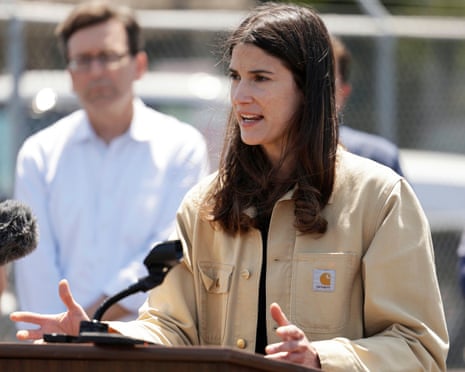
Marie Gluesenkamp Perez speaks during a news conference in May 2026. Photograph: Karen Ducey/The Seattle Times/AP
Trump has carried the district in all three of his presidential runs, most recently by about three points, and yet in 2024 Gluesenkamp Perez ran roughly seven points ahead of her party’s presidential nominee.
As my colleague Lok Darjee reports, logging, mills, agriculture, shipping and manufacturing still shape daily life in much of her district and Gluesenkamp Perez’s success has stemmed from her appeal to moderates and rural voters. An auto repair shop owner, she won over many in south-west Washington, including Republicans who considered Kent too extreme.
William Lawrence secures Democratic nomination in Michigan's seventh congressional district
William Lawrence, a community organizer who co-founded the Sunrise Movement, won a competitive three-way Democratic primary race in Michigan’s seventh congressional district. He beat Bridget Brink, the former US ambassador to Ukraine and former US Navy Seal Matt Maasdam.
Lawrence will now face Republican incumbent Tom Barrett, who has bucked his own party while in office, after he flipped the district red in 2024.
The seat’s former representative, Senator Elissa Slotkin, had backed Massdam, while independent Senator Bernie Sanders endorsed Lawrence.
Here’s more on Lawrence from my colleague Dharna Noor:
James is, notably, a fervent election denier who has repeated Donald Trump’s claims that the 2020 race was “rigged”.
The GOP nominee, an army veteran, received Trump’s endorsement in the governor’s race, after having launched two failed US Senate bids in 2018 and 2020. He won the US House seat he now holds in 2022.
While the Republican Governors Association heralded James’s win, Michigan Democrats called him a “failed politician” who voters “have already rejected” twice. “That’s exactly what we’re going to make sure happens for a third time this November,” they said in a statement.
John James wins Republican nomination in Michigan governor's race
Congressman John James has won the Republican nomination in the Michigan governor’s race.
James, who represents the state’s 10th congressional district, beat Perry Johnson – a businessman who ran against Donald Trump in the 2024 presidential election but withdrew before the primaries.
James will now face Jocelyn Benson, Michigan’s secretary of state, in November’s general election.
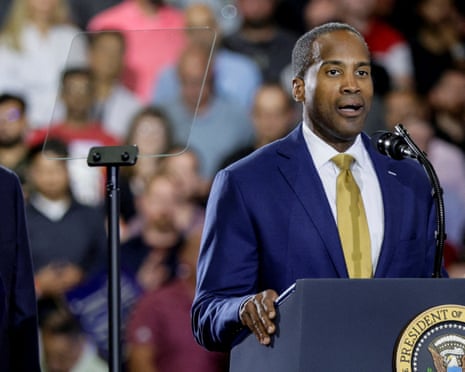
Michigan gubernatorial candidate John James delivers remarks in Milford, Michigan on 27 July. Photograph: Evan Vucci/Reuters
Missouri voters reject amendment to make it harder to amend the state constitution
Voters in Missouri overwhelmingly rejected an amendment that would make it harder to amend the state constitution. Almost 80% voted “no” on the ballot measure in Tuesday’s primary election.
It would have required citizen initiatives to pass in all congressional districts rather than by a simple statewide majority.
Cindy Holscher wins Democratic nomination for Kansas governor
Cindy Holscher, a state senator, won the Democratic nomination in Kansas’ gubernatorial race. She beat two other Sunflower state politicians to advance to the general election.
It’s set to be a fierce competition as Republicans are angling to retake the governor’s mansion following eight years under Laura Kelly, the term-limited Democratic incumbent.
Ty Masterson, the Trump-backed Kansas state senate president, clinched the GOP nomination in a crowded race.
McMorrow says it is vital for Democrats to 'come together tonight' regardless of Michigan Senate primary result
Mallory McMorrow, the Michigan state lawmaker, who suspended her campaign for the Democratic nomination for US Senate earlier this year, said that it was vital for Democrats to “come together tonight” regardless of which candidate wins the race in an interview with CNN.
However, McMorrow did not reveal who she voted for in Tuesday’s primary.
“I voted for great Democrats up and down the ballot, and I made a commitment that whoever wins the Senate race tonight, I will be endorsing as soon as that race is called,” she said. “I will be headed to their election night party to show we all come together after whatever happens tonight, so that we can be a team as we head in November.”
Only 28% of the votes in the Michigan Senate Democratic primary have been counted so far. And in the state’s largest county – Wayne county – only 7% of the votes have been counted.
Jocelyn Benson clinches Democratic nomination in Michigan governor's race
Jocelyn Benson, Michigan’s secretary of state, clinched the Democratic nomination in the governor’s race, beating Chris Swanson – the Genesee county sheriff.
The Republican contest has yet to be called by the Associated Press. The winner will face-off against Benson to replace the term-limited governor Gretchen Whitmer.
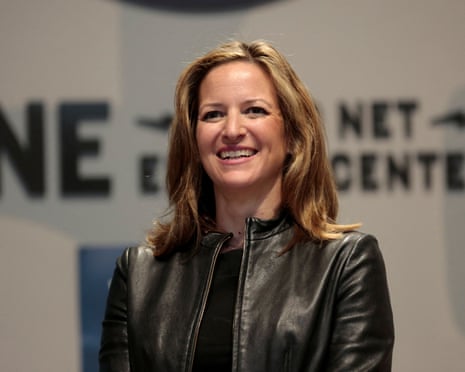
Jocelyn Benson, Michigan’s secretary of state, in November 2022. Photograph: Rebecca Cook/Reuters
Joseph Gedeon
Reporting from Detroit
The pro-Palestine IMEU Policy Project placed the biggest bet in the group’s short history on Michigan’s Democratic midterm race.
Formed in 2024, the organization has spent $1.5m on independent expenditures so far, and $400,000 of that, its largest single investment, went to Abdul El-Sayed.
“When he wins the primary tonight, it will send an undeniable message that support for Palestinian rights is an asset for Democratic voters,” Margaret DeReus, the group’s executive director and a Pal Pac co-founder, said at the sidelines of his watch party downtown Detroit. “Supporting Israel today is a big risk, and that is true no matter how much money Aipac puts into a race – they have a deeply unpopular agenda.”
First round of Michigan primary races called
A quick note that the remaining counties in Michigan that keep central time have now closed their polls.
In the first round of results that the Associated Press have called in the state, Michael Bouchard won the Republican primary in Michigan’s 10th congressional district. This is a GOP stronghold that the party is hoping to hold on to this year as the incumbent, John James, vies for the Republican nomination for governor.
In Michigan’s 11th district, state senator Jeremy Moss won the Democratic primary to face Ethan Baker, the Republican running unopposed, in November. This is the seat currently held by Democratic Senate candidate Haley Stevens, who flipped the district blue in 2018.
Congressman Wesley Bell wins Missouri primary against Cori Bush for US House seat
Chris Stein
The Democratic congressman Wesley Bell won his primary in the St Louis area on Tuesday, ending the progressive former representative Cori Bush’s bid for a comeback and blunting the momentum pro-Palestinian candidates have shown in recent elections.
Bell unseated Bush, a democratic socialist who opposes aid to the US ally and accuses it of committing a genocide in Gaza, in the Democratic congressional primary two years ago with the help of millions of dollars in spending from pro-Israel groups.
Their rematch this year came amid a spate of primary defeats of Democratic incumbents at the hands of progressive outsiders.
Shortly after polls closed, the Associated Press declared that Bell had prevailed. The first district’s heavily Democratic lean makes Bell the favorite to win a second term in the November election.
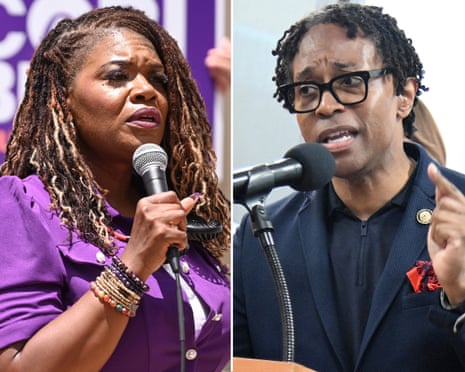
Cori Bush and Wesley Bell. Composite: AP
Joseph Gedeon
Reporting from Detroit
Chris Rabb, the Democratic nominee from Philadelphia’s third district, while at the watch party in Michigan, sees proof of a national realignment.
Pointing to fellow winners like mayor Zohran Mamdani in New York and Adam Hamawy in New Jersey’s 12th congressional district, he argues the same economic-populist, inclusive message is now winning across urban and rural ground alike, not just in deep blue enclaves.
“This is not just among coastal elites,” Rabb said at El-Sayed’s watch party. “That’s something that could benefit Democrats: if they have the collective wisdom to move us forward, not left or right. Because if they don’t learn this lesson, it’ll be through all of our defeats.”
First batch of Virginia US House primary results
The Associated Press has called the first batch of results for three House primaries in Virginia.
- First congressional district: Shannon Taylor, a longtime prosecutor, has won the Democratic primary in Virginia’s first congressional district. Backed by establishment Democrats who hope she can flip the seat – which includes the Richmond suburbs – after voters there supported Democratic governor Abigail Spanberger last year, Taylor will challenge Republican incumbent Robb Wittman, who ran uncontested, in November.
- Second congressional district: Elaine Luria, a former congresswoman, has clinched the Democratic nomination in Virginia’s second district. Luria, who served two terms before losing to Republican Jennifer Kiggans in 2022, will now face the incumbent again in a rematch for the battleground district that includes Virginia Beach.
- Seventh congressional district: Meanwhile, in Virginia’s seventh district, Republican voters chose Doug Ollivant, an army veteran, to take on freshman Democrat Eugene Vindman, also a former service member, in the general election. The seat – formerly held by Spanberger – is one of the state’s most competitive. It was in GOP hands from 2000 until 2018, when Spanberger flipped it blue.
Ahead of polls closing, my colleague Joseph Gedeon has been speaking with voters in Detroit today.
For David Sernick and Bonnie White, who live in Roseville Park, one race on the ballot mattered the most – the Democratic Senate primary. Sernick backed Abdul El-Sayed again, the same candidate he supported for governor in 2018. Sernick said he was drawn to a politician willing to be self-critical. “He’s comfortable criticizing ourselves as liberals, and we’ve got to do that,” Sernick said. White also backed El-Sayed, but for a different reason. “I’m thinking about Israel and Palestine because that’s been a hot topic in the news recently,” she said. “I’ve been hearing a lot of noise around that.”
Others noted that no matter who goes on to clinch the Democratic nomination, the party needs to band together and support them moving forward. “We’re really on the same team. How we go about it is the only difference,” said Roy Harris.
For Mike Shane, a retired, self-described socialist stumping for Rashida Tlaib, this primary is a reckoning bigger than one Senate seat. He watched pro-Israel outsider groups, led by Aipac, blitz Haley Stevens’ campaign with $60m in ad buys trying to beat El-Sayed, and he thinks the fight is only getting harder from here – including for rural conservatives losing hospitals, Medicaid, and food stamps. “This could be the Democratic party’s Whig moment,” he mused, describing the party’s collapse and elimination in the 19th century. “We have similar questions right now with the rise of white supremacy, and we need to deal with it once and for all.”
Polls close in Missouri
Polls have closed in Missouri, and we will be bringing you the results as they come through. We’ll be keeping an eye out on the Democratic primary in the state’s deep-blue first congressional district – where the pro-Israel incumbent, Wesley Bell, is facing a challenge from Cori Bush, a former progressive congresswoman who accuses Israel of perpetrating genocide in Gaza.
Along with a heated Senate primary in Michigan, the Missouri contest has become a proxy battle over the Democratic party’s role in supporting Israel’s military before the November midterm elections.
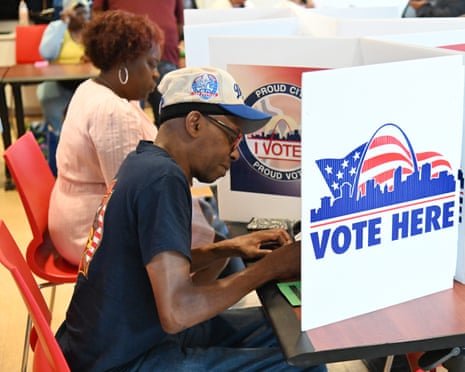
Voters cast their ballots on the 4 August primary election in St. Louis. Photograph: Michael Thomas/AP
Source note
First published by The Guardian US
This article was supplied by The Guardian US through its RSS feed and formatted for Crooli Signal. The reporting remains with the original publisher.
Read the original at The Guardian US