From
Trump calls Iran 'unbelievably duplicitous' as says US blockade will continue until 'deal, or total surrender'
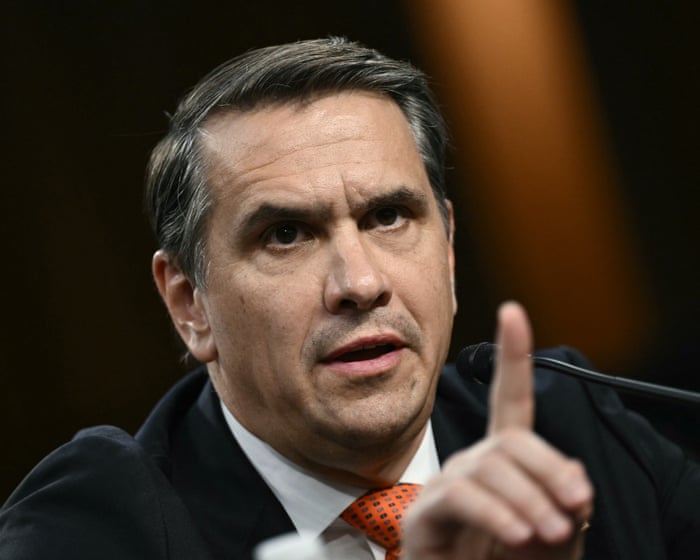
Donald Trump has lashed out after Iran denied it was in negotiations with the United States, declaring in an angry social media post that a US military blockade will continue until there is a “Deal, or Total surrender.”
Calling Iranian leaders “duplicitous” for “openly and proudly” saying Iran was not negotiating, Trump wrote: “Whether Iran wants to admit it or not, we are, in fact, talking of a solution to a problem that they have caused, for decades.”
The US president wrote on his Truth Social platform:
double quotation markIranian Leadership is unbelievably duplicitous! They ask for a meeting, some would say “beg,” talks begin, with more scheduled in the immediate future, and they say, openly and proudly, that they’re not having any discussions, that nothing is being talked about, and they’re only dealing with “Oman.” They then go on to give their usual blather in saying, the Strait of Hormuz will be operated powerfully by them, when it is already completely controlled by the United States Navy and our “Blockade” or, as some say, “The United States Wall of Steel!” Nothing gets through to Iran, unless we want it to, and nothing will get through, unless a Deal, or Total Surrender, is accomplished. Whether Iran wants to admit it or not, we are, in fact, talking of a solution to a problem that they have caused, for decades. It is very simple, IRAN WILL NEVER HAVE A NUCLEAR WEAPON!
Donald Trump is speaking at an executive order signing at the White House, where he was asked where direct talks with Iran would take place.
“You’ll find out today or tomorrow,” he said. “They’re going to go quickly one way or the other. It’s not very complex.”
Trump said the strait of Hormuz could be open “literally by tomorrow”.
“The first phase is the opening of the straits. The second phase will be the denuclearisation,” he said. “That’ll take a little while, but … we’re very strong on it.”
Staying in Islamabad, Pakistani government sources have told Turkish news agency AA that intermediaries were yet to confirm a date or venue for the resumption of stalled negotiations between the US and Iran.
No direct talks were scheduled in Pakistan’s capital in the next 24 hours, the agency reported.
Donald Trump earlier insisted direct negotiations with Iran would begin on Monday afternoon.
Mediators from Pakistan and Qatar are in contact with both Washington and Tehran, AA reported, with Islamabad and Doha likely venues for the proposed talks.
Donald Trump has lashed out after Iran denied it was in negotiations with the United States, declaring in an angry social media post that a US military blockade will continue until there is a “Deal, or Total surrender.”
Calling Iranian leaders “duplicitous” for “openly and proudly” saying Iran was not negotiating, Trump wrote: “Whether Iran wants to admit it or not, we are, in fact, talking of a solution to a problem that they have caused, for decades.”
The US president wrote on his Truth Social platform:
\n Iranian Leadership is unbelievably duplicitous! They ask for a meeting, some would say “beg,” talks begin, with more scheduled in the immediate future, and they say, openly and proudly, that they’re not having any discussions, that nothing is being talked about, and they’re only dealing with “Oman.” They then go on to give their usual blather in saying, the Strait of Hormuz will be operated powerfully by them, when it is already completely controlled by the United States Navy and our “Blockade” or, as some say, “The United States Wall of Steel!” Nothing gets through to Iran, unless we want it to, and nothing will get through, unless a Deal, or Total Surrender, is accomplished. Whether Iran wants to admit it or not, we are, in fact, talking of a solution to a problem that they have caused, for decades. It is very simple, IRAN WILL NEVER HAVE A NUCLEAR WEAPON!\n
CNN reports that an officer in the intelligence branch of the US Central Command sent a message to a broad group of military analysts “looking for new creative and unconventional ways to pressure and punish Iran”.
The email went out on Wednesday, before Donald Trump threatened to launch new strikes against Iran and then backed down after speaking on the phone to the Saudi crown prince Mohammed bin Salman.
Iranian state media is reporting that Iran executed two people on Monday on charges of espionage and cooperation with Israel, according to Reuters.
Omid Behzad and Pouria Safvat were accused of sending Israel the coordinates of military and security sites in addition to images and information in the latest conflict that began 28 February as well as during the brief war last summer, judiciary news outlet Mizan reported.
A source briefed on Israel’s military strategy told Reuters in March that Israel targeted checkpoints manned by the Islamic Revolutionary Guard Corps during the current conflict based on intelligence from informants on the ground.
Iran has executed at least 50 p[eople in the past four months on vague national security charges, including several 18- and 19-year-olds, Human Rights Watch reported last month. In January, Iranian authorities quelled a period of nationwide unrest by killing thousands of protesters.
Lebanon’s state-run National News Agency reports that Israeli forces dropped phosphorus shells overnight in the towns of Yaroun and Haroun and the city of Bint Jbeil, sparking fires in olive and pine groves.
International humanitarian law currently restricts the usage of white phosphorus, given its incendiary nature, according to Amnesty International. Though it can be used lawfully, it must never be fired at, or in close proximity to, a populated civilian area or civilian infrastructure.
The IDF did not immediately respond to a request for comment.
In addition to the phosphorus shells, Israeli forces also conducted an airstrike just after 1 a.m. local time Monday on the outskirts of Nabatieh al-Fawqa, according to the National News agency.
An Israeli drone also dropped a sound bomb on Bouyout al-Sayyad, the news agency reported.
Two tankers laden with Saudi oil crossed the Bab el-Mandeb strait over the weekend, data collected by Reuters showed on Monday, despite the maritime embargo against Saudi Arabia declared by the Iran-aligned Houthis at the end of last month.
Kpler data showed that 18 commodity vessels total passed the Bab el-Mandeb strait on Sunday, down from the 27 that passed on Saturday and the 28 on Friday.
Two tankers – the Suezmax tanker Lesvos, carrying 1 million barrels of Saudi crude. and Very Large Crude Carrier Desh Vaibhav, 1 million barrels of Saudi crude – exited the Red Sea with their automatic identification systems (AIS) transponders switched off, the data showed.
The Houthis of Yemen, who control the capital Sana’a and much of its Red Sea coastline, announced on 20 July that they were implementing a blockade against Saudi ships, opening a new front against the US and its allies in the war on Iran. They have since claimed to have been behind a number of strikes on Saudi tankers.
Hello and welcome to our live coverage of the Middle East.
Esmaeil Baghaei, Iran’s foreign ministry spokesperson, told reporters at a weekly press briefing on Monday that Iran is not currently holding any talks with the US, Reuters reports – contradicting claims made by Donald Trump on Sunday night that talks with Iran would happen the next day.
Baghaei said that there were no plans to receive a delegation or send an Iranian one, and that Iran’s current focus was on negotiations with Oman over the strait of Hormuz.
“We are now going to reach an understanding on a route acceptable to both sides – neither the northern route nor the southern route – but one that respects the sovereign rights of both sides and safeguards our national interests and security,” he said in an interview with Iranian state television.
On Sunday, Trump told reporters on Air Force One that he decided to hold off on ordering American forces to carry out new strikes against Iran at the urging of Gulf allies Qatar, the United Arab Emirates and Saudi Arabia, including a phone call with Crown Prince Mohammed bin Salman.
“I said to the crown prince, ‘What would you rather do? Would you rather us do this or not?’” Trump said. “They said we would much prefer a deal as opposed to an attack, because you don’t know where these attacks lead.”
Key events
- 6m agoStrait of Hormuz could open 'by tomorrow': Trump
- 10m agoIntermediaries yet to confirm date or venue for resumption of stalled negotiations between US and Iran, Pakistani government sources say
- 3h agoTrump calls Iran 'unbelievably duplicitous' as says US blockade will continue until 'deal, or total surrender'
- 8h agoReport: US military crowdsourcing tactics to 'punish Iran'
- 8h agoIran executes two people, accusing them of spying for Israel
- 9h agoReport: IDF dropped phosphorus bombs in southern Lebanon
- 9h agoTwo tankers with Saudi oil exit Red Sea over the weekend
- 10h agoIran foreign ministry says there are no talks with the US
Strait of Hormuz could open 'by tomorrow': Trump
Donald Trump is speaking at an executive order signing at the White House, where he was asked where direct talks with Iran would take place.
“You’ll find out today or tomorrow,” he said. “They’re going to go quickly one way or the other. It’s not very complex.”
Trump said the strait of Hormuz could be open “literally by tomorrow”.
“The first phase is the opening of the straits. The second phase will be the denuclearisation,” he said. “That’ll take a little while, but … we’re very strong on it.”
Intermediaries yet to confirm date or venue for resumption of stalled negotiations between US and Iran, Pakistani government sources say
Staying in Islamabad, Pakistani government sources have told Turkish news agency AA that intermediaries were yet to confirm a date or venue for the resumption of stalled negotiations between the US and Iran.
No direct talks were scheduled in Pakistan’s capital in the next 24 hours, the agency reported.
Donald Trump earlier insisted direct negotiations with Iran would begin on Monday afternoon.
Mediators from Pakistan and Qatar are in contact with both Washington and Tehran, AA reported, with Islamabad and Doha likely venues for the proposed talks.
Haroon Janjua
A senior Pakistani official with direct knowledge of contacts between Islamabad, Washington, and Tehran told the Guardian over a phone on Monday that despite the current impasse, Pakistan remains actively engaged in quiet diplomacy aimed at reducing tensions between the US and Iran, insisting that Islamabad’s offer to help facilitate dialogue between the two sides “is still intact”.
“We are actively involved in efforts to resolve US-Iran tensions,” the official said. “Our offer to facilitate contacts has not changed. The understanding reached earlier remains intact, and we continue to engage both sides.”
The official said Pakistan’s army chief, Field Marshal Asim Munir, has remained in close contact with senior US officials, including vice-president JD Vance and the US special envoy Steve Witkoff, as part of efforts to prevent further escalation in the region.
“Field Marshal Asim Munir has been in contact with JD Vance and Steve Witkoff,” the official said. “These have been substantive discussions focused on regional stability and de-escalation.”
At the same time, the official said Islamabad has maintained high-level communication with Tehran, including hours-long talks between Munir and Iran’s foreign minister, Abbas Araghchi.
“There have also been hours-long discussions with Foreign Minister Abbas Araghchi,” the official said. “Pakistan has channels open with both Washington and Tehran and believes dialogue remains the only viable path to avoid a wider regional conflict.”
The official declined to disclose details of the exchanges but said Pakistan sees itself as one of the few countries maintaining the confidence of both capitals, allowing it to quietly encourage diplomatic engagement at a time of heightened regional tensions.
Joseph Gedeon
Despite Trump insisting that talks with Iran began on Monday afternoon, officials tell CBS News there’s nothing new to announce after all, just the same negotiations, run through mediators by envoy Steve Witkoff and Jared Kushner.
Trump calls Iran 'unbelievably duplicitous' as says US blockade will continue until 'deal, or total surrender'
Donald Trump has lashed out after Iran denied it was in negotiations with the United States, declaring in an angry social media post that a US military blockade will continue until there is a “Deal, or Total surrender.”
Calling Iranian leaders “duplicitous” for “openly and proudly” saying Iran was not negotiating, Trump wrote: “Whether Iran wants to admit it or not, we are, in fact, talking of a solution to a problem that they have caused, for decades.”
The US president wrote on his Truth Social platform:
double quotation markIranian Leadership is unbelievably duplicitous! They ask for a meeting, some would say “beg,” talks begin, with more scheduled in the immediate future, and they say, openly and proudly, that they’re not having any discussions, that nothing is being talked about, and they’re only dealing with “Oman.” They then go on to give their usual blather in saying, the Strait of Hormuz will be operated powerfully by them, when it is already completely controlled by the United States Navy and our “Blockade” or, as some say, “The United States Wall of Steel!” Nothing gets through to Iran, unless we want it to, and nothing will get through, unless a Deal, or Total Surrender, is accomplished. Whether Iran wants to admit it or not, we are, in fact, talking of a solution to a problem that they have caused, for decades. It is very simple, IRAN WILL NEVER HAVE A NUCLEAR WEAPON!
People walk near a billboard depicting Iran’s late supreme leader Ayatollah Ali Khamenei, on a street in Tehran, Iran, earlier today.
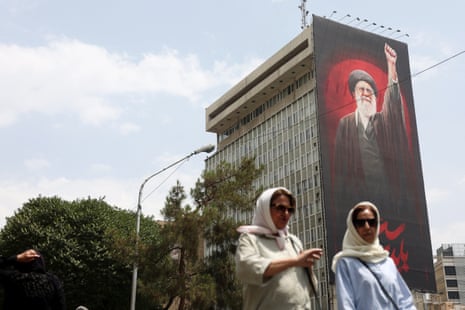
People walk near a billboard depicting Iran's late Supreme Leader Ayatollah Ali Khamenei, on a street in Tehran, Iran, August 3, 2026. Photograph: Majid Asgaripour/Reuters
Six Saudi-flagged supertankers have changed course in the Gulf of Aden in recent days amid threats from the Iran-aligned Houthis, Reuters reports.
The tankers, which were empty of cargo after returning from destinations in Asia, opted to avoid transit through the southern Red Sea and the Bab el-Mandeb chokepoint by sailing in formation toward southern Africa, according to automatic identification systems data collected by Reuters.
The Houthis of Yemen, who control the capital Sana’a and much of its Red Sea coastline, announced on 20 July that they were implementing a blockade against Saudi ships. They have since claimed to have been behind a number of strikes on Saudi tankers.
Earlier today, Esmail Baghaei, Tehran’s foreign ministry spokesperson, said that Iran was not reviving talks with the US – despite what Donald Trump told reporters on Sunday.
However, Iran is continuing talks with Oman over the strait of Hormuz.
The Guardian’s Patrick Wintour has the full story here:
Julia Kollewe
Crude oil prices fell sharply and European stock markets rallied on Monday after Donald Trump cancelled planned strikes on Iran to focus on negotiations for a peace deal.
Brent crude was trading 5% lower at $83.50 a barrel by mid-morning, after falling as low as $81.55 a barrel. US West Texas Intermediate dropped more than $5 to $79.47 a barrel.
Both global oil benchmarks jumped more than 20% in July after fighting between the US and Iran resumed, and as attacks on several tankers in the strait of Hormuz revived fears for the safety of vessels transiting the important shipping passage.
Michel Issa, the US ambassador to Lebanon, said on Monday that he was “encouraged” that the US-brokered peace talks between Israel and Lebanon are ongoing in Rome.
“A great deal of technical work remains to ensure civilian safety on the ground. There is a meaningful difference between drafting an agreement on paper and implementing it responsibly — moving too quickly risks jeopardizing the very civilians this process is meant to protect,” Issa said in a statement.
The ambassador continued: “We believe it is better to take the time needed to get this right the first time. Doing so will allow subsequent pilot zones to move forward more efficiently. Above all, both sides must agree on a clear, workable process before proceeding.”
Report: US military crowdsourcing tactics to 'punish Iran'
CNN reports that an officer in the intelligence branch of the US Central Command sent a message to a broad group of military analysts “looking for new creative and unconventional ways to pressure and punish Iran”.
The email went out on Wednesday, before Donald Trump threatened to launch new strikes against Iran and then backed down after speaking on the phone to the Saudi crown prince Mohammed bin Salman.
Iran executes two people, accusing them of spying for Israel
Iranian state media is reporting that Iran executed two people on Monday on charges of espionage and cooperation with Israel, according to Reuters.
Omid Behzad and Pouria Safvat were accused of sending Israel the coordinates of military and security sites in addition to images and information in the latest conflict that began 28 February as well as during the brief war last summer, judiciary news outlet Mizan reported.
A source briefed on Israel’s military strategy told Reuters in March that Israel targeted checkpoints manned by the Islamic Revolutionary Guard Corps during the current conflict based on intelligence from informants on the ground.
Iran has executed at least 50 p[eople in the past four months on vague national security charges, including several 18- and 19-year-olds, Human Rights Watch reported last month. In January, Iranian authorities quelled a period of nationwide unrest by killing thousands of protesters.
Report: IDF dropped phosphorus bombs in southern Lebanon
Lebanon’s state-run National News Agency reports that Israeli forces dropped phosphorus shells overnight in the towns of Yaroun and Haroun and the city of Bint Jbeil, sparking fires in olive and pine groves.
International humanitarian law currently restricts the usage of white phosphorus, given its incendiary nature, according to Amnesty International. Though it can be used lawfully, it must never be fired at, or in close proximity to, a populated civilian area or civilian infrastructure.
The IDF did not immediately respond to a request for comment.
In addition to the phosphorus shells, Israeli forces also conducted an airstrike just after 1 a.m. local time Monday on the outskirts of Nabatieh al-Fawqa, according to the National News agency.
An Israeli drone also dropped a sound bomb on Bouyout al-Sayyad, the news agency reported.
Two tankers with Saudi oil exit Red Sea over the weekend
Two tankers laden with Saudi oil crossed the Bab el-Mandeb strait over the weekend, data collected by Reuters showed on Monday, despite the maritime embargo against Saudi Arabia declared by the Iran-aligned Houthis at the end of last month.
Kpler data showed that 18 commodity vessels total passed the Bab el-Mandeb strait on Sunday, down from the 27 that passed on Saturday and the 28 on Friday.
Two tankers – the Suezmax tanker Lesvos, carrying 1 million barrels of Saudi crude. and Very Large Crude Carrier Desh Vaibhav, 1 million barrels of Saudi crude – exited the Red Sea with their automatic identification systems (AIS) transponders switched off, the data showed.
The Houthis of Yemen, who control the capital Sana’a and much of its Red Sea coastline, announced on 20 July that they were implementing a blockade against Saudi ships, opening a new front against the US and its allies in the war on Iran. They have since claimed to have been behind a number of strikes on Saudi tankers.
Iran foreign ministry says there are no talks with the US
Hello and welcome to our live coverage of the Middle East.
Esmaeil Baghaei, Iran’s foreign ministry spokesperson, told reporters at a weekly press briefing on Monday that Iran is not currently holding any talks with the US, Reuters reports – contradicting claims made by Donald Trump on Sunday night that talks with Iran would happen the next day.
Baghaei said that there were no plans to receive a delegation or send an Iranian one, and that Iran’s current focus was on negotiations with Oman over the strait of Hormuz.
“We are now going to reach an understanding on a route acceptable to both sides – neither the northern route nor the southern route – but one that respects the sovereign rights of both sides and safeguards our national interests and security,” he said in an interview with Iranian state television.
On Sunday, Trump told reporters on Air Force One that he decided to hold off on ordering American forces to carry out new strikes against Iran at the urging of Gulf allies Qatar, the United Arab Emirates and Saudi Arabia, including a phone call with Crown Prince Mohammed bin Salman.
“I said to the crown prince, ‘What would you rather do? Would you rather us do this or not?’” Trump said. “They said we would much prefer a deal as opposed to an attack, because you don’t know where these attacks lead.”
Source note
First published by The Guardian World
This article was supplied by The Guardian World through its RSS feed and formatted for Crooli Signal. The reporting remains with the original publisher.
Read the original at The Guardian World