HSBC has reported a 23% surge in pre-tax profit to $19.5bn for the first six months of this year, beating expectations of $18.9bn.
The London-based bank, which also has a strong presence in Hong Kong, said growth was particularly strong in its wealth management and insurance business.
It now expects to exceed $46bn in profit for the year, and announced a new share buyback of up to $1bn.
Kathleen Brooks, of the broker XTB, says that around $2bn of the increase in profits were down to one off items, “so investors may worry that this will not be repeated”.
\n However, profitability levels remain high, and the company expects its return on tangible equity, its main measure of profitability, to stay at 17% for this year.\n These results were also heavy on shareholder sweeteners, which may boost investor interest later today. HSBC announced a second dividend for this year and a share buyback of $1bn, to be completed in the next 3 months.\n The share price slipped in overnight trading in the US, and HSBC could be a victim of its own success. There is political pressure on PM Andy Burnham to tax banks more, and HSBC’s results and high profit levels could add to calls for a higher levy on the sector, which could act as a counterweight to banking stocks later on Tuesday.\n
Indeed the TUC is arguing this morning that there is “now a mountain of evidence” to suggest banks can afford to pay more tax.
The union body has proposed the government should use higher taxes on banks to pay for a social tariff that brings down energy bills.
TUC general secretary Paul Nowak said:
\n There is now a mountain of evidence to suggest that banks can easily afford to pay more tax.\n While higher interest rates have meant mortgage misery and bigger bills for the rest of us, the big banks have been rolling in it.\n Andy Burnham has rightly prioritised cost of living measures in his first days as prime minister, but as the war in Iran rumbles on energy prices will rise further – and the government will need to do more to protect households.\n That’s why it’s time to increase the tax on bank profits to cut bills. It’s common sense and it’s the right thing to do.\n
Surging profits across the oil industry, while Europe grapples with wildfires and drought, is prompting a strong backlash from environmental campaigners.
Angharad Hopkinson, a political campaigner at Greenpeace, says:
\n We’ve just experienced the driest July on record and BP has driven record-breaking droughts, unprecedented wildfires and extraordinary excess heatwave deaths. To cause this destruction while amassing $5.7bn in profits shows how corporate gains have become entirely divorced from the public good – ordinary people are feeling the heat when it should be the polluters paying the price.\n Prolonging this parasitic relationship by trying to squeeze the last few drops of expensive oil out of the North Sea is sheer folly – perhaps the one point on which we agree with BP.\n But it’s not just BP that needs to leave the North Sea, Shell and Equinor need to follow suit and give up the Jackdaw and Rosebank fields too. The government should hold fast on no new oil and gas. We need true investment in the clean energy industries of the future, which are our only dependable path to good jobs, lower bills, and long-term prosperity.”\n
Rosie Downes, head of campaigns at Friends of the Earth, argues that energy companies such as BP should be paying more tax:
\n Clearly not everyone is feeling the pain of the energy crisis. While BP banks another round of enormous profits, millions of households are paying the price through sky-high energy bills and a climate crisis accelerating rapidly out of control with increasingly severe heatwaves, wildfires and droughts.\n The only way to protect people from soaring bills and climate chaos is to break our dependence on costly and polluting oil and gas by investing in energy efficiency and homegrown renewable power. Andy Burnham must back measures that make companies like BP pay more for the damage they are causing and use that money to speed up the transition to a cleaner, fairer and more secure future.”\n
Profits are surging at oil companies on the back of the spike in energy prices triggered by the war in the Middle East.
BP is the latest to reveal its windfall earnings today: its second-quarter profit more than doubled in the second quarter of this year to $5.73bn compared with the same period a year argo, beating analyst expectations.
Meanwhile Saudi Aramco, the world’s biggest oil exporter, reported a 44% increase in net profit, rising to $32.69bn in the three months ended 30 June, compared with $22.67bn a year earlier.
The spike in profits across the industry is starting to attract criticism across the political spectrum – last night president Donald Trump openly criticised US oil giants ExxonMobil and Chevron, saying they had made “too much money” on rising crude oil prices.
He told reporters at the White House:
\n They’re making too much money based on a shortage. I don’t like it.\n
It comes after both companies reported windfall profits in their second quarters last week. Chevron’s earnings surged nearly 400% to $12bn compared with $2.5bn in the same period last year. Exxon’s profits more than doubled to $14.5bn compared with $7.1bn last year.
Trump said:
\n Chevron, too much money. ExxonMobil, too much money,. They’re going to give some of that back to the public and they better cut the retail price, the consumer price.”\n
The oil price is rising again this morning, with the international benchmark Brent crude now up 1.3% to $85.08 a barrel. Fuel prices in the US are much cheaper than prices we see here in the UK – but gasoline prices averaged $4.10 per gallon in the US on Monday, nearly 40% higher compared with the $2.98 per gallon before the war with Iran started, according to the AAA.
The agenda
- \n 7am BST: Flutter interim results, BP Q2, HSBC Q2, Metro Bank Q2
- \n 10am BST: Eurozone unemployment data
- \n 9pm BST: SpaceX Q2 first earnings report since its record-breaking IPO
Key events
- 2m agoHSBC profits surge as unions call for banks to pay more tax
- 36m agoBP's surge in profits 'divorced from the public good' amid wildfires and drought
- 42m agoIntroduction: Oil profits spike as Middle East war fuels energy prices
HSBC profits surge as unions call for banks to pay more tax
HSBC has reported a 23% surge in pre-tax profit to $19.5bn for the first six months of this year, beating expectations of $18.9bn.
The London-based bank, which also has a strong presence in Hong Kong, said growth was particularly strong in its wealth management and insurance business.
It now expects to exceed $46bn in profit for the year, and announced a new share buyback of up to $1bn.
Kathleen Brooks, of the broker XTB, says that around $2bn of the increase in profits were down to one off items, “so investors may worry that this will not be repeated”.
double quotation markHowever, profitability levels remain high, and the company expects its return on tangible equity, its main measure of profitability, to stay at 17% for this year. These results were also heavy on shareholder sweeteners, which may boost investor interest later today. HSBC announced a second dividend for this year and a share buyback of $1bn, to be completed in the next 3 months. The share price slipped in overnight trading in the US, and HSBC could be a victim of its own success. There is political pressure on PM Andy Burnham to tax banks more, and HSBC’s results and high profit levels could add to calls for a higher levy on the sector, which could act as a counterweight to banking stocks later on Tuesday.
Indeed the TUC is arguing this morning that there is “now a mountain of evidence” to suggest banks can afford to pay more tax.
The union body has proposed the government should use higher taxes on banks to pay for a social tariff that brings down energy bills.
TUC general secretary Paul Nowak said:
double quotation markThere is now a mountain of evidence to suggest that banks can easily afford to pay more tax. While higher interest rates have meant mortgage misery and bigger bills for the rest of us, the big banks have been rolling in it. Andy Burnham has rightly prioritised cost of living measures in his first days as prime minister, but as the war in Iran rumbles on energy prices will rise further – and the government will need to do more to protect households. That’s why it’s time to increase the tax on bank profits to cut bills. It’s common sense and it’s the right thing to do.
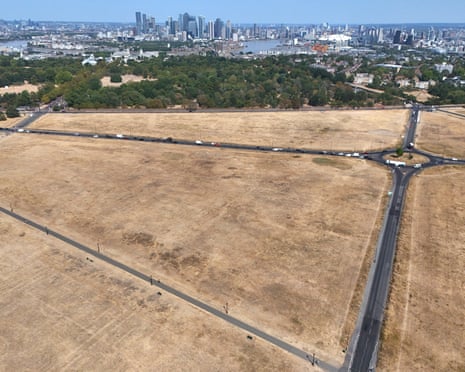
An image taken with a drone shows parched grassland at Blackheath Common in London, Britain, 03 August 2026 Photograph: Neil Hall/EPA
Burgeoning profits at big oil companies comes as the climate crisis grips the UK and Europe this summer.
Half of England and the whole of Wales are officially in drought and July is set to be the driest month on record, envrionmental agencies have warned.
It is the third such event over the past five years, and comes after four record-breaking heatwaves since May which have fuelled huge wildfires and left farmers, wildlife and protected habitats running out of water.
Meanwhile in Europe, severe wildfires have burned across Spain and France since early July, killing people, destroying thousands of homes, and forcing more than 300,000 people to flee.
BP’s new boss Meg O’Neill is defending its surge in profit, after Donald Trump blasted US oil companies ExxonMobil and Chevron for also reporting windfall earnings last week.
The president told reporters last night that the oil companies should “give some of that [profit] back to the public and they better cut the retail price, the consumer price.”
O’Neill told CNBC’s Squawk Box Europe this morning:
double quotation markI understand the pressure that the ordinary household feels when they pull into the service station to fill up and see and see the prices. The reality is, we produce a global commodity, and the product we sell hangs off the prices for the product we sell hangs off that global commodity price. What BP is doing is making sure that we are focused on the things we can do to try to help address the situation. We’re driving hard on reliability, both in our upstream assets where we produce those barrels and the refining assets where we refine them. …And by way of example, we’ve made some shifts to try to produce more jet and diesel because those are the commodities that are in even shorter supply than gasoline. So we are doing what we can. Our world-class trading organisation is also playing an important role to try to get products to customers as cost-efficiently as we can. You know, to play our role to try to tackle those prices at the pump.
BP's surge in profits 'divorced from the public good' amid wildfires and drought
Surging profits across the oil industry, while Europe grapples with wildfires and drought, is prompting a strong backlash from environmental campaigners.
Angharad Hopkinson, a political campaigner at Greenpeace, says:
double quotation markWe’ve just experienced the driest July on record and BP has driven record-breaking droughts, unprecedented wildfires and extraordinary excess heatwave deaths. To cause this destruction while amassing $5.7bn in profits shows how corporate gains have become entirely divorced from the public good – ordinary people are feeling the heat when it should be the polluters paying the price. Prolonging this parasitic relationship by trying to squeeze the last few drops of expensive oil out of the North Sea is sheer folly – perhaps the one point on which we agree with BP. But it’s not just BP that needs to leave the North Sea, Shell and Equinor need to follow suit and give up the Jackdaw and Rosebank fields too. The government should hold fast on no new oil and gas. We need true investment in the clean energy industries of the future, which are our only dependable path to good jobs, lower bills, and long-term prosperity.”
Rosie Downes, head of campaigns at Friends of the Earth, argues that energy companies such as BP should be paying more tax:
double quotation markClearly not everyone is feeling the pain of the energy crisis. While BP banks another round of enormous profits, millions of households are paying the price through sky-high energy bills and a climate crisis accelerating rapidly out of control with increasingly severe heatwaves, wildfires and droughts. The only way to protect people from soaring bills and climate chaos is to break our dependence on costly and polluting oil and gas by investing in energy efficiency and homegrown renewable power. Andy Burnham must back measures that make companies like BP pay more for the damage they are causing and use that money to speed up the transition to a cleaner, fairer and more secure future.”
Introduction: Oil profits spike as Middle East war fuels energy prices
Profits are surging at oil companies on the back of the spike in energy prices triggered by the war in the Middle East.
BP is the latest to reveal its windfall earnings today: its second-quarter profit more than doubled in the second quarter of this year to $5.73bn compared with the same period a year argo, beating analyst expectations.
Meanwhile Saudi Aramco, the world’s biggest oil exporter, reported a 44% increase in net profit, rising to $32.69bn in the three months ended 30 June, compared with $22.67bn a year earlier.
The spike in profits across the industry is starting to attract criticism across the political spectrum – last night president Donald Trump openly criticised US oil giants ExxonMobil and Chevron, saying they had made “too much money” on rising crude oil prices.
He told reporters at the White House:
double quotation markThey’re making too much money based on a shortage. I don’t like it.
It comes after both companies reported windfall profits in their second quarters last week. Chevron’s earnings surged nearly 400% to $12bn compared with $2.5bn in the same period last year. Exxon’s profits more than doubled to $14.5bn compared with $7.1bn last year.
Trump said:
double quotation markChevron, too much money. ExxonMobil, too much money,. They’re going to give some of that back to the public and they better cut the retail price, the consumer price.”
The oil price is rising again this morning, with the international benchmark Brent crude now up 1.3% to $85.08 a barrel. Fuel prices in the US are much cheaper than prices we see here in the UK – but gasoline prices averaged $4.10 per gallon in the US on Monday, nearly 40% higher compared with the $2.98 per gallon before the war with Iran started, according to the AAA.
The agenda
- 7am BST: Flutter interim results, BP Q2, HSBC Q2, Metro Bank Q2
- 10am BST: Eurozone unemployment data
- 9pm BST: SpaceX Q2 first earnings report since its record-breaking IPO
Source note
First published by The Guardian Business
This article was supplied by The Guardian Business through its RSS feed and formatted for Crooli Signal. The reporting remains with the original publisher.
Read the original at The Guardian Business