
From
Global food prices hit three-year high as conflict and heatwaves push up cereal costs
Newsflash: Global food commodity prics have hit a three-year high, as the Ukraine war, conflict in the Middle East and extremely hot weather push up crop prices.
The United Nations’ Food and Agriculture Organization’s Food Price Index, which tracks key food prices, has just risen to its highest since January 2023.
The FAO reports that prices for cereals, sugar and vegetable oils all rose in July, while meat and dairy product prices fell.
The report shows that global wheat prices surged by 5.8% in July, and were almost 10% higher than a year ago.
The FAO says this was due to “continued disruptions to Black Sea export flows and damage to export infrastructure, further compounded by the impact of recent heatwaves on crop yields in several key producing countries.”
There was a surge in attacks in the Black Sea last month, amid the renewed military escalation between Russia and Ukraine.
World maize prices rose by 3.6%, “supported by concerns over hot and dry weather in parts of the Corn Belt in the United States of America and spillover effects from firmer energy markets amid heightened geopolitical tensions.”
The FAO adds:
double quotation markInternational sorghum prices edged higher in line with the increases in maize prices in the United States of America. By contrast, barley prices fell by 1.9 percent, as favourable crop prospects in Australia and the Black Sea region more than offset heat-related yield losses in the European Union. On the other hand, the FAO All Rice Price Index held broadly steady in July 2026, as a mild increase in Indica quotations was offset by demand-driven price declines for all other major traded rice varieties.
This helped to push the FAO Food Price Index up to 131.1 points in July, a rise of up 0.7 points.
More details to follow…
Newsflash: Global food commodity prics have hit a three-year high, as the Ukraine war, conflict in the Middle East and extremely hot weather push up crop prices.
The United Nations’ Food and Agriculture Organization’s Food Price Index, which tracks key food prices, has just risen to its highest since January 2023.
The FAO reports that prices for cereals, sugar and vegetable oils all rose in July, while meat and dairy product prices fell.
The report shows that global wheat prices surged by 5.8% in July, and were almost 10% higher than a year ago.
The FAO says this was due to “continued disruptions to Black Sea export flows and damage to export infrastructure, further compounded by the impact of recent heatwaves on crop yields in several key producing countries.”
There was a surge in attacks in the Black Sea last month, amid the renewed military escalation between Russia and Ukraine.
World maize prices rose by 3.6%, “supported by concerns over hot and dry weather in parts of the Corn Belt in the United States of America and spillover effects from firmer energy markets amid heightened geopolitical tensions.”
The FAO adds:
\n International sorghum prices edged higher in line with the increases in maize prices in the United States of America. By contrast, barley prices fell by 1.9 percent, as favourable crop prospects in Australia and the Black Sea region more than offset heat-related yield losses in the European Union.\n On the other hand, the FAO All Rice Price Index held broadly steady in July 2026, as a mild increase in Indica quotations was offset by demand-driven price declines for all other major traded rice varieties.\n
This helped to push the FAO Food Price Index up to 131.1 points in July, a rise of up 0.7 points.
More details to follow…
Back in the UK housing markets, annual price inflation slowed to its lowest rate in more than two and a half years.
The 0.1% year-on-year rise in prices is the slowest since November 2023, Lloyds’ house price report shows.
Amanda Bryden, head of mortgages at Lloyds, says:
\n “More broadly, average house prices have remained relatively stable for almost two years, moving within a narrow range over that period and sitting just +0.5% higher than they were in November 2024.\n That trend has persisted even as buyers and sellers have faced a more uncertain economic backdrop this year. “Affordability remains a challenge for many would -be buyers and, following recent events in the Middle East, mortgage rates have edged higher again after easing earlier in the summer\".”\n
Disruption to rail services in the Greater Manchester area and the north west of England expected to continue until 12:00pm, according to Network Rail’s website.
The disruption between Newport and Cardiff is due to a fire next to the railway track last weekend.
Happily, Network Rail are reporting that “most train services across the North West are running this morning” after yesterday’s power cut – but there is still the risk of disruption.
Network Rail is warning that some TransPennine Express services continue to be affected as trains and crew return to their normal positions following yesterday’s disruption. That suggests there could be problems travelling between major cities in the region today.
Passengers planning to travel this morning are advised to check before they travel using National Rail Enquiries or their train operator’s website for the latest travel information, it says.
Chris Wright, Network Rail’s North West route director, explains:
\n “I’d like to thank passengers for their patience following yesterday’s power outage and the disruption it caused across the North West.\n “Our engineers worked through the night to restore signalling systems and recover the railway, and I’m pleased that most services are now running this morning. While some passengers may still experience disruption, we’re continuing to work closely with train operators to return services to normal as quickly as possible.\n “Anyone planning to travel this morning should continue to check before they travel for the latest information.”\n
Train passengers face across the Midlands and north-west England are facing the threat of further travel chaos today, after a power outage ground trains to a halt.
Network Rail has reported that further disruption is likely today because many trains and their crew “are not where they would normally be after this unexpected incident”.
The disruption means some trains will be delayed, cancelled, or sent on revised routes across the network.
Network Rail’s engineers have been working to fix signalling issues caused after electricity cut out in the main control hub for north-west England’s railways, the Manchester Rail Operating Centre, which led to widespread cancellations and delays to services.
Chris Wright, Network Rail’s North West route director, said yesterday:
\n “I’m extremely sorry for the disruption today and the very difficult journeys many people have experienced.\n Our engineers are working tirelessly to restore the signalling systems impacted by the power cut at lunchtime.”\n
Good morning, and welcome to our rolling coverage of business, the financial markets and the world economy.
The Iran war is continuing to have a dampening inpact on the UK’s property market, as persistently high borrowing costs restrain buyers.
Lloyds has reported this morning that average house prices were flat month-on-month in July, and only up by 0.1% compared with a year ago.
Emeritus professor Joe Nellis, head of economic research at MHA, points out that affordability is a ‘huge challenge’ facing potential busyers, explaining:
\n According to Lloyds Bank’s Affordability Review released late last year, the typical first-time buyer house costs nearly 6 times average annual earnings. For aspiring homeowners, the biggest hurdle is no longer simply finding the right property – it is raising a deposit and passing increasingly demanding mortgage affordability tests.\n
Although the Bank of England has left interest rates on hold so far this year, mortgage rates have fluctuated as the Middle East conflict has raged, with higher oil prices threatening an inflationary spike.
The agenda
- \n 7am BST: Lloyds house price index
- \n 9am BST: UN’s FAO Food Price Index
- \n 9.30am BST: Public service productivity, quarterly, UK: January to March 2026
- \n 1.30pm BST: US non-farm payroll jobs report for July
Key events
- 9m agoGlobal food prices hit three-year high as conflict and heatwaves push up cereal costs
- 31m agoUK house price inflation lowest since November 2023
- 1h agoDisruption in the Greater Manchester / north west of England expected until noon
- 2h agoNetwork Rail: Rail services largely restored across North West
- 2h agoRail passengers facing more disruption after power outage
- 2h agoIntroduction: UK house price stagnant
Vegetable oil prices rose by 2% in July, to their highest level since June 2022.
This was driven by higher palm and soy oil prices, the UN’s FAO reports, saying:
double quotation markInternational palm oil prices rose for the second consecutive month, following a brief decline in May, largely underpinned by firm demand from Indonesia’s biodiesel sector and higher crude oil prices, which outweighed downward pressure from seasonally higher production in Southeast Asia. Similarly, world soy oil prices increased, underpinned by persistently robust feedstock demand in the United States of America and stronger global import demand amid greater price competitiveness.
S unflower and rapeseed oil prices dropped, but the FAO adds that renewed tensions in the Black Sea region prevented them falling further.
Global food prices hit three-year high as conflict and heatwaves push up cereal costs
Newsflash: Global food commodity prics have hit a three-year high, as the Ukraine war, conflict in the Middle East and extremely hot weather push up crop prices.
The United Nations’ Food and Agriculture Organization’s Food Price Index, which tracks key food prices, has just risen to its highest since January 2023.
The FAO reports that prices for cereals, sugar and vegetable oils all rose in July, while meat and dairy product prices fell.
The report shows that global wheat prices surged by 5.8% in July, and were almost 10% higher than a year ago.
The FAO says this was due to “continued disruptions to Black Sea export flows and damage to export infrastructure, further compounded by the impact of recent heatwaves on crop yields in several key producing countries.”
There was a surge in attacks in the Black Sea last month, amid the renewed military escalation between Russia and Ukraine.
World maize prices rose by 3.6%, “supported by concerns over hot and dry weather in parts of the Corn Belt in the United States of America and spillover effects from firmer energy markets amid heightened geopolitical tensions.”
The FAO adds:
double quotation markInternational sorghum prices edged higher in line with the increases in maize prices in the United States of America. By contrast, barley prices fell by 1.9 percent, as favourable crop prospects in Australia and the Black Sea region more than offset heat-related yield losses in the European Union. On the other hand, the FAO All Rice Price Index held broadly steady in July 2026, as a mild increase in Indica quotations was offset by demand-driven price declines for all other major traded rice varieties.
This helped to push the FAO Food Price Index up to 131.1 points in July, a rise of up 0.7 points.
More details to follow…
UK house price inflation lowest since November 2023
Back in the UK housing markets, annual price inflation slowed to its lowest rate in more than two and a half years.
The 0.1% year-on-year rise in prices is the slowest since November 2023, Lloyds’ house price report shows.
Amanda Bryden, head of mortgages at Lloyds, says:
double quotation mark“More broadly, average house prices have remained relatively stable for almost two years, moving within a narrow range over that period and sitting just +0.5% higher than they were in November 2024. That trend has persisted even as buyers and sellers have faced a more uncertain economic backdrop this year. “Affordability remains a challenge for many would -be buyers and, following recent events in the Middle East, mortgage rates have edged higher again after easing earlier in the summer".”
TransPennine Express are urging passengers to “please check carefully before any travel on Friday morning”.
Various ticket restrictions have been eased to help passengers, with train tickets being accepted on Bee Network buses and Metrolink trams in Greater Manchester.
Railway operator Northern has said its “do not travel” alert first issued on Thursday afternoon would remain in place until 10am on Friday, as “some services will be amended and may not be able to run at all”.
Disruption in the Greater Manchester / north west of England expected until noon
Disruption to rail services in the Greater Manchester area and the north west of England expected to continue until 12:00pm, according to Network Rail’s website.
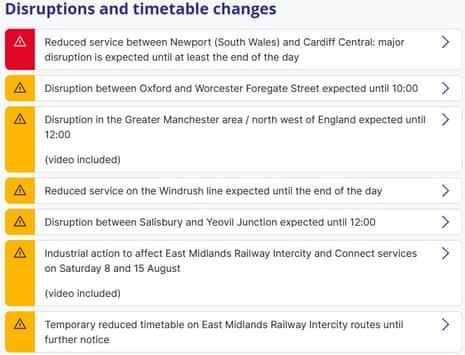
Network Rail’s service status page Photograph: Network Rail
The disruption between Newport and Cardiff is due to a fire next to the railway track last weekend.

Preston railway station Photograph: Christopher Thomond/The Guardian
Normal service was restored between Preston and Lancaster, on the West Coast mainline, shortly after midnight.
Network Rail: Rail services largely restored across North West
Happily, Network Rail are reporting that “most train services across the North West are running this morning” after yesterday’s power cut – but there is still the risk of disruption.
Network Rail is warning that some TransPennine Express services continue to be affected as trains and crew return to their normal positions following yesterday’s disruption. That suggests there could be problems travelling between major cities in the region today.
Passengers planning to travel this morning are advised to check before they travel using National Rail Enquiries or their train operator’s website for the latest travel information, it says.
Chris Wright, Network Rail’s North West route director, explains:
double quotation mark“I’d like to thank passengers for their patience following yesterday’s power outage and the disruption it caused across the North West. “Our engineers worked through the night to restore signalling systems and recover the railway, and I’m pleased that most services are now running this morning. While some passengers may still experience disruption, we’re continuing to work closely with train operators to return services to normal as quickly as possible. “Anyone planning to travel this morning should continue to check before they travel for the latest information.”
Avanti West Coast, CrossCountry, East Midlands Railway, London Northwestern, Northern, TransPennine Express, and Transport for Wales were all hit by yesterday’s power outage.
Rail passengers facing more disruption after power outage
Train passengers face across the Midlands and north-west England are facing the threat of further travel chaos today, after a power outage ground trains to a halt.
Network Rail has reported that further disruption is likely today because many trains and their crew “are not where they would normally be after this unexpected incident”.
The disruption means some trains will be delayed, cancelled, or sent on revised routes across the network.
Network Rail’s engineers have been working to fix signalling issues caused after electricity cut out in the main control hub for north-west England’s railways, the Manchester Rail Operating Centre, which led to widespread cancellations and delays to services.
Chris Wright, Network Rail’s North West route director, said yesterday:
double quotation mark“I’m extremely sorry for the disruption today and the very difficult journeys many people have experienced. Our engineers are working tirelessly to restore the signalling systems impacted by the power cut at lunchtime.”
Introduction: UK house price stagnant
Good morning, and welcome to our rolling coverage of business, the financial markets and the world economy.
The Iran war is continuing to have a dampening inpact on the UK’s property market, as persistently high borrowing costs restrain buyers.
Lloyds has reported this morning that average house prices were flat month-on-month in July, and only up by 0.1% compared with a year ago.
Emeritus professor Joe Nellis, head of economic research at MHA, points out that affordability is a ‘huge challenge’ facing potential busyers, explaining:
double quotation markAccording to Lloyds Bank’s Affordability Review released late last year, the typical first-time buyer house costs nearly 6 times average annual earnings. For aspiring homeowners, the biggest hurdle is no longer simply finding the right property – it is raising a deposit and passing increasingly demanding mortgage affordability tests.
Although the Bank of England has left interest rates on hold so far this year, mortgage rates have fluctuated as the Middle East conflict has raged, with higher oil prices threatening an inflationary spike.
The agenda
- 7am BST: Lloyds house price index
- 9am BST: UN’s FAO Food Price Index
- 9.30am BST: Public service productivity, quarterly, UK: January to March 2026
- 1.30pm BST: US non-farm payroll jobs report for July
Source note
First published by The Guardian Business
This article was supplied by The Guardian Business through its RSS feed and formatted for Crooli Signal. The reporting remains with the original publisher.
Read the original at The Guardian Business