Infravision
Wavelength and intensity in the infrared are translated into colors in the visible.
Human eyes don’t register the infrared portion of the light spectrum because infrared photons don’t carry enough energy to trigger the signaling pathway inside our light-sensing cells. But we’ve been able to make devices that give us a visual representation of what’s happening in the infrared.
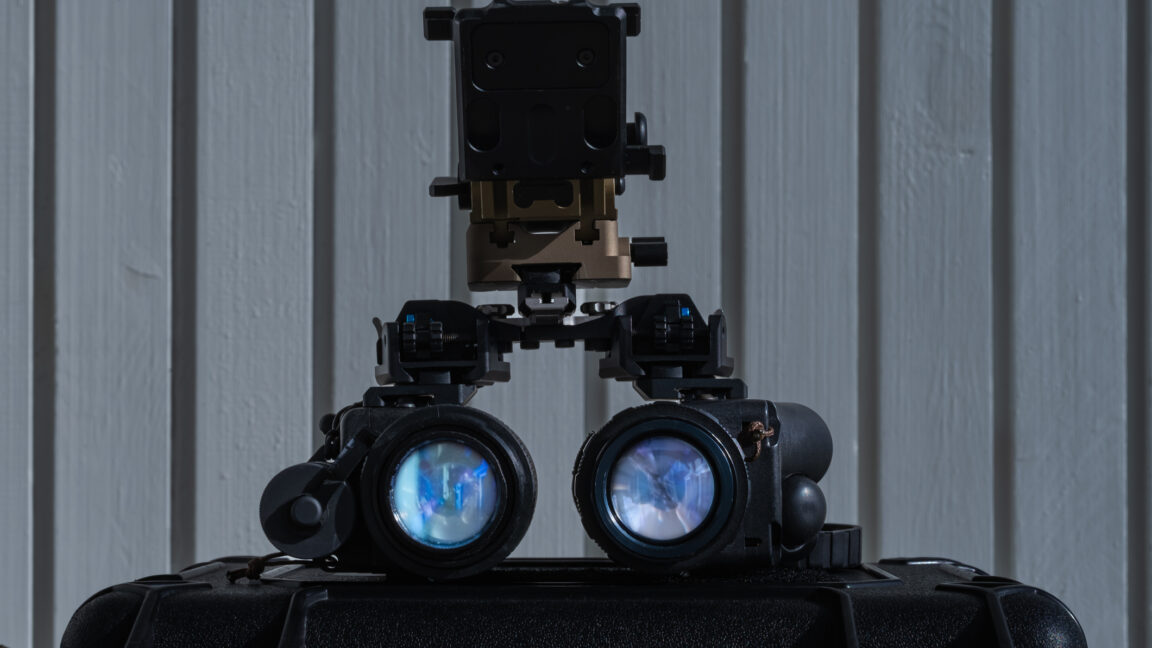
A team at the Beijing Institute of Technology, led by Xin Tang and Ge Mu, has now built a device that lets people see infrared in a new way. Instead of just translating it to visible shades of green as it’s done in standard night-vision goggles, it translates different infrared wavelengths into distinct parts of the visual spectrum, giving the eye something closer to natural vision.
Researchers achieved that by combining mercury telluride colloidal quantum dots, which absorb infrared light, and a dual-layer OLED, which converts that absorbed energy into visible color. Stacked together with the right internal wiring, they make incoming infrared radiation come out the other side as an ordinary-looking, full-color image.
Invisible light
Vision begins when a photon strikes a light-sensitive pigment in the retina and causes it to change shape. That alters a protein that the pigment is embedded in, starting a nerve impulse that eventually contributes to an image in the brain. The molecular shape change that starts it all needs a minimum amount of energy, roughly 1.6 electron volts; infrared photons with wavelengths longer than 700 nanometers don’t carry enough energy to do it. That leaves over half of the Sun’s radiant energy outside our visual reach, along with anything that emits or reflects heat rather than visible light.
Most existing devices that allow us to see infrared use IR photodetectors wired to visible-light LEDs. This approach makes infrared light visible, but only as brightness: A warmer object glows a bit more, a cooler one glows a bit less, and we represent them all in the same (usually greenish) color. One problem with this is that human eyes are far better at distinguishing subtle differences in hue than they are at picking out brightness differences, so a device that only modulates brightness is leaving most of the eye’s sensitivity unused.
The solution Tang’s team arrived at starts with the way infrared light is registered in the first place.
Selective quantum dots
Bulk semiconductors routinely used in IR detectors have continuous energy bands, which means they absorb a broad, undifferentiated swath of the infrared spectrum. This doesn’t preserve much information about which specific wavelength arrived. The mercury telluride colloidal quantum dots the Chinese team picked for their device behave differently. Due to their tiny size, roughly 4 nanometers across, quantum confinement breaks their energy levels into discrete steps rather than a continuous chunk. Photons of different infrared wavelengths and intensities excite different electronic transitions, moving an electron between discrete energy levels within the dot, rather than just producing more or less of a single signal.
At wavelengths of around 2 micrometers, the longest the team tested, incoming photons have just enough energy to bump an electron across the dot’s fundamental bandgap, producing a modest number of charge carriers, either negatively charged electrons or positively charged holes that move around the dot.
At shorter infrared wavelengths, photons carry more energy per particle, and they can access additional, higher-energy electronic transitions inside the dot. In some cases the excess energy in a carrier can be enough to kick loose more than one electron-hole pair per photon. These processes open extra channels for generating charge carriers. The effect is that shorter infrared wavelengths and more intense infrared light push more positively charged holes out of the quantum dot layer and toward the OLED side of the device.
But getting a variable number of holes dependent on the wavelength and intensity of infrared light out of the detector was only half the problem. The other half was translating this signal into a color image at the other side.
The barrier
The team achieved this by building the OLED with two separate emissive layers stacked on top of each other. One layer, closer to where the holes enter, was doped with a red-emitting phosphor. The other one, positioned farther away, was doped with phosphor-emitting cyan light. The key component that made full-color vision work was an energy barrier of about 0.82 electron volts between these two layers.
When only a small number of holes arrive from the infrared detector because of dim illumination or long-wavelength photons, they are all captured by the red layer, and the device emits a low-brightness red glow. As the number of incoming holes grows, whether because the infrared light is brighter or because it contains shorter wavelengths, additional carrier-generating pathways in the quantum dots are unlocked, and the barrier gets saturated. Holes start finding their way through it and into the cyan layer, and the device begins emitting a mixture of red and cyan simultaneously, shifting the overall color and increasing the luminance.
Because this color shift is tied to carrier number rather than a fixed lookup table, the resulting color space encodes both the wavelength and the intensity of the incoming infrared light. The team’s calculations presented in the study show the device should enable users to distinguish infrared power differences roughly 200 times smaller than they would be able to if using a single-color, brightness-only design.
To show how all this works, scientists built an IR-vision eyeglass using these quantum dots.
Glasses and implants
The eyeglass is semi-transparent and weighs only 23 grams, with an active viewing area of about 3.57 square centimeters. In the first test, aimed at objects illuminated with shortwave infrared light, the eyeglass projected sharp, color-coded images, including test patterns and moving objects that could be captured by a standard camera. It still let ordinary visible light pass through the semi-transparent structure, as well. In principle, the eyeglass could be switched between an augmented-reality mode that overlays infrared information on normal sight, and an immersive infrared-only mode with a simple filter.
The team also tested whether the upconverted IR light could drive a biological visual system, rather than just a camera. They bound the upconverters to cells that produce channelrhodopsin-2, a light-sensitive protein commonly used to make neurons responsive to blue light. Infrared illumination through the device indeed triggered photocurrents in those cells.
Moving up to whole organisms, having test subjects view the LED screen while it was illuminated by infrared pulses produced clear electroencephalogram responses in mice and clear electroretinogram responses in human volunteers. In both cases, the same infrared pulses alone, without the upconverter, produced no measurable response at all.
In the paper, the team says their work “redefined infrared vision” by “transcending the monochrome paradigm.” The authors claim that by “surpassing the evolutionary boundaries of biological photoreception,” their device paves the way to “next generation visual prosthetics.” But there are still plenty of details researchers need to figure out before full-color IR glasses or retinal implants are achievable with this technology.
Heavy metal vision
Every demonstration covered in the study happened under controlled conditions the real world rarely offers. The eyeglass was tested against a calibrated blackbody source and simple, high-contrast test patterns like letters and leaf shapes, not the multi-wavelength infrared clutter of an actual room or street. It’s unclear how readable the color-coding stays once real scenes are involved. The OLED side also needs an external power supply, which makes the eyeglass closer to a small powered display than a passive lens.
Finally, mercury telluride is a heavy-metal compound, and the paper says nothing about long-term skin contact or, for the more ambitious implantable version, biocompatibility or safety over time. The idea of an implantable retinal photoreceptor, so far, is supported only by isolated neurons in a dish, EEG traces from mice, and ERG readings from humans with light shone at the eye externally. All this serves as convincing evidence that the infrared light signal upconverted this way can reach the visual system. But the team is still several steps short of a device that could be implanted in an eye or even work in actual night-vision glasses.
Science Advances, 2026. DOI: 10.1126/sciadv.aed0245
Jacek Krywko is a freelance science and technology writer who covers space exploration, artificial intelligence research, computer science, and all sorts of engineering wizardry.
40 Comments
Source note
First published by Ars Technica
This article was supplied by Ars Technica through its RSS feed and formatted for Crooli Signal. The reporting remains with the original publisher.
Read the original at Ars Technica