From
What do we know so far on Ceuta migration crisis
Jakub Krupa
- Some 60,000 people are locally estimated to have crossed into the Spanish North African enclave of Ceuta from Morocco in the last 24 hours, as part of an attempt to overwhelm the Spanish border (13:46).
- At least 41 people reportedly died during the surge.
- The migrants in Ceuta have no onwards route to the EU given the territory’s special status under the Schengen rules (14:02, 15:04).
- Spanish prime minister Pedro Sánchez said the crossings violated Spain’s territorial integrity, as he blamed human trafficking gangs for wilfully misleading people about changes to Spain’s migration rules and triggering the border run (12:51, 12:54, 13:17).
- Some 25,000 people voluntarily returned to Morocco on Friday, the Spanish interior ministry said, as authorities pledged to crack down on illegal migration and expedite returns (12:57).
- The crisis prompted critical reactions from across the EU, with Italy leading the controversial calls to suspend Spain’s status in the Schengen area until the situation improves (9:42, 13:52).
- The EU has called the situation “unacceptable,” and insisted that “returns must be swift, as our rules allow,” pledging to help Spain deal with the crisis (13:25).
Meanwhile, the death toll from crossing has gone up to 43, the Spanish news agency EFE reported.
US president Donald Trump struck a similar tone, telling Fox News that the pictures coming from Spain were “terrible.”
“It’s terrible. Remember that picture. That’s going to be us in three years if the wrong side gets in,” he said, as reported by Fox News, referring to Democrats winning elections.
“If the Democrats get in, you will not live a very good life,” he told Fox News’s anchor Jacqui Heinrich who spoke with him earlier today.
US vice-president JD Vance responded to the crisis in Ceuta, saying the pictures coming from Spain were “an unfortunate reminder of the consequences of mass migration and the radical left-wing globalist policies.”
Here is what he said in full:
\n “Thank God POTUS was elected and our country’s border no longer looks like this. \n These images out of Spain are an unfortunate reminder of the consequences of mass migration and the radical left-wing globalist policies that have enabled the Invasion of the West.”\n
EU’s migration commissioner Magnus Brunner has just responded to the crisis situation in Ceuta.
In a post on X, he called the situation “unacceptable” and said he’s in close contact with the Spanish authorities.
But he also confirmed the point I made earlier about the fact that there is no onwards route from Ceuta (14:02) given the enclave’s unique status under the Schengen rules.
\n “I reiterate that there are no onward movements towards the European continent or other member states. The Schengen Borders Code provides for special rules that apply to Ceuta and Melilla. Border checks on persons departing from Ceuta and Melilla remain in force.”\n
He also “welcomes the close cooperation between Spain and Morocco to manage the situation and ensure swift returns.”
“The commission will continue to work with the Spanish authorities on the effective use of the instruments available under the new Migration and Asylum rules and to provide additional support at EU level, including through our agencies,” he says.
Denmark’s prime minister Mette Frederiksen is the latest EU leader to urge the bloc to consider whether Spain should be suspended from the Schengen cooperation.
In a written statement, quoted by Berlingske, TV2 and DR, Frederiksen said that “the EU must immediately take all necessary steps and consider all options, including a suspension of Schengen cooperation” to avoid repeating the 2015 migration crisis.
“Uncontrolled immigration is a threat to Europe and Denmark,” she was quoted as saying.
- \n Some 60,000 people are locally estimated to have crossed into the Spanish North African enclave of Ceuta from Morocco in the last 24 hours, as part of an attempt to overwhelm the Spanish border (13:46).
- \n At least 41 people reportedly died during the surge.
- \n The migrants in Ceuta have no onwards route to the EU given the territory’s special status under the Schengen rules (14:02, 15:04).
- \n Spanish prime minister Pedro Sánchez said the crossings violated Spain’s territorial integrity, as he blamed human trafficking gangs for wilfully misleading people about changes to Spain’s migration rules and triggering the border run (12:51, 12:54, 13:17).
- \n Some 25,000 people voluntarily returned to Morocco on Friday, the Spanish interior ministry said, as authorities pledged to crack down on illegal migration and expedite returns (12:57).
- \n The crisis prompted critical reactions from across the EU, with Italy leading the controversial calls to suspend Spain’s status in the Schengen area until the situation improves (9:42, 13:52).
- \n The EU has called the situation “unacceptable,” and insisted that “returns must be swift, as our rules allow,” pledging to help Spain deal with the crisis (13:25).
Some of the European reactions to this migration crisis in Ceuta – playing on voters’s concerns that the new arrivals would now be free to travel onwards within the EU – seem to ignore a fairly important caveat in Spain’s Schengen rules.
Under the 1990 deal on Spain joining the Schengen agreement, the two north African enclaves of Ceuta and Melilla are covered by a special regime, with Spain responsible for maintaining another round of border checks before travellers enter mainland Spain or any other EU country.
The relevant clauses say:
\n “Pursuant to its national law and in order to verify whether passengers still satisfy the conditions laid down in Article 5 of the 1990 Convention on the basis which they were authorised to enter national territory upon passport control at the external border, Spain shall maintain checks (on identity and documents) on sea and air connections departing from Ceuta and Melilla and having as their sole destination any other place on Spanish territory.\n To the same end, Spain shall maintain checks on internal flights and on regular ferry connections departing from the towns of Ceuta and Melilla to a destination in another State party to the Convention.”\n
This obviously does not lessen the legal, political and humanitarian challenges facing Spain. The government in Madrid will need to decide how to respond to the tens of thousands of new arrivals in Ceuta, and will probably seek to facilitate their return to Morocco – either voluntarily or through legal channels – as the sheer scale of the influx makes it nearly impossible for them to remain in the enclave.
But despite the tone coming from the likes of France and Italy, this also does not mean new arrivals automatically are already within the Schengen area in the way most people – and voters – understand it.
Or to put it simply: the new arrivals do not get the right to travel freely to the rest of the EU – say, France, Germany or Italy – and would still have to face another border check before they can leave Ceuta for mainland Spain or any other part of the EU.
This is presumably why we have seen some unusually strong language from Spain’s foreign minister earlier today, angrily accusing Italy of trying to score political points on the back of their problems (9:42).
With France, Italy and Spain all set to have closely contested elections in 2027 in which migration is likely to feature heavily, it’s perhaps not surprising to see politicians get involved in that sort of politicised commentary as they feel domestic political pressures and need to respond to their voters’s fears.
But it’s worth keeping in mind that the legal situation is (as often) a bit more complex.
Spain’s interior ministry said around 25,000 migrants are believed to have returned from Ceuta to Morocco today as part of a Spanish effort to reverse last night’s migratory flows across the border.
If confirmed, that would be almost half of all those believed to have crossed, given that the latest estimates from local authorities put the figure at about 60,000 people (13:46).
But there are some obvious problems with offering detailed estimates offered during an ongoing emergency, so it is probably worth treating all of these numbers with some caution.
The EU’s former foreign policy chief, Josep Borrell Fontelles, dismissed calls to suspend Spain’s Schengen status, saying it’s impossible under the EU law.
In very pointed criticism of Italy’s request for such a suspension (9:42), the Spanish politician and former senior EU official stressed:
\n “Under EU law, no Member State can unilaterally suspend another’s participation in Schengen.”\n
He added:
\n “This is worth unpacking as it is quite revealing of how EU governments are learning to understand, talk, use and abuse the EU’s legal order in manifest breach of the principle of loyal cooperation that binds them.”\n
Speaking shortly after Sánchez, Ceuta’s regional president Juan Jesús Vivas also offered his take on the events of the last 24 hours.
He said that the latest estimates show that “around 60,000 people have entered our city” as part of the influx.
That’s almost two-thirds of the city’s ordinary population.
“Clearly, this figure demonstrates the impossibility of absorbing such pressure,” he said.
Furthermore, at least 34 people are believed to have died trying to cross into Ceuta, he said.
He urged the government to act “decisively and immediately” to respond to the challenge.
The German chancellor, Friedrich Merz, also spoke about the situation in Ceuta.
In a statement, he said:
\n “Protecting the external borders of the European Union is crucial for combating illegal migration. I have a clear expectation that all EU member states will fulfil this obligation. We are in contact with the Spanish government on this matter. Spain wants and needs to get the situation in Ceuta under control as quickly as possible. I therefore welcome Spain’s intention not to allow illegal migrants onto the European continent. \n We expect Morocco to take back the illegal migrants immediately. I\n t is good that the European Commission and Commissioner Magnus Brunner have pledged their support for this. The return regulation adopted in June must now be implemented immediately and fully.”\n
Meanwhile, the European Commission president Ursula von der Leyen also responded to the crisis, saying “the images coming from Ceuta are unacceptable.”
\n “We cannot allow anyone to come to our Union without abiding by our rules. Dangerous crossings must stop immediately. Smuggling networks must be dismantled. \n And returns must be swift, as our rules allow. I tasked two Commissioners to support to control the situation. \n @magnusbrunner is already working closely with Spain and is ready to travel to critical points. He will work on additional operational support to Spain, including through Frontex. \n @dubravkasuica is in contact with her Moroccan counterpart. \n I am confident that our close partnership with Morocco will help deliver concrete results.”\n
There is also a further diplomatic angle to the current crisis.
Morocco’s authorities have not yet issued an official statement on the flow of migrants, and it is not yet clear what prompted the surge in crossings or how hard authorities on the Moroccan side tried to prevent it.
However, it could be linked to the rivalry between Morocco and Algeria, and a recent trip by the Spanish prime minister to Algiers.
The last mass border crossing, in May 2021, took place after Morocco loosened border controls during a diplomatic row with Spain over Spain’s decision to allow the leader of the Western Sahara independence movement, the Polisario Front, to be treated for Covid-19 in Spain.
Morocco and the Polisario Front both lay claim to Western Sahara, which was under Spanish rule until 1975, when colonial authorities handed over the territory to Morocco and Mauritania.
That diplomatic crisis ended in 2022 when Madrid reversed its longstanding policy of neutrality and backed Morocco’s plan for Western Sahara – a move that had caused a diplomatic rift between Madrid and Algiers, which had supported the Polisario group.
The Spanish prime minister Pedro Sánchez visited Algiers on 20 July – the first such visit by a Spanish head of government in four years – marking a thaw in relations with Algeria.
Sánchez’s line is clear: the migration crisis in Ceuta is a violation of Spain’s territorial sovereignty, driven by human traffickers wilfully misleading migrants about the legal situation following a recent ruling by the Spanish supreme court.
He says human traffickers are spreading a “self-serving” and misleading interpretation of the Spanish supreme court’s recent ruling on push backs to drive migratory flows.
The court said earlier this month that immediate returns of migrants crossing the border illegally did not apply to those arriving by sea – but with some important caveats that say they cannot “overcome the established border containment elements.”
Sánchez’s fully intends to confront the gangs over that and protect Spain’s internal security, just as the government would over in Madrid, he says.
The authorities will further adapt the border – for example, introducing more visible barriers to mark the border; a point specifically mentioned in the court’s ruling – to further tighten their case vis a vis the court’s ruling and thus enable repatriations.
Making the most of Ceuta’s unique geographical position – or to put it bluntly, that they have nowhere further to go – the migrants will be told to return across the border or face formal proceedings.
The government will also look at whether it needs to change some laws to guarantee the repatriation of those involved.
Sánchez says a temporary reception centre will be established to facilitate documentation, registration, triage and “expedited” expulsion of people with no legal claim to be in Spain.
He says the government will also add a visible barrier – a line of buoys – near the breakwater to make it clear where the border is to legally comply with the court’s ruling.
He says this will help with border repatriations while fully complying with the court’s decision – as he notes that many of them are already voluntarily leaving.
He says Spain will work closely with Morocco on this.
Spanish prime minister Pedro Sánchez calls last night’s escalation “an attack and a violation of Spain’s territorial sovereignty.”
He calls it “deplorable,” and says it deserves “our strongest possible condemnation.”
He says the government will use “all the mechanisms and resources available to the state” to resolve the situation.
Sánchez is speaking now.
I will bring you the key lines here.
Swedish prime minister Ulf Kristersson is the latest European leader to respond to the events unfolding in Ceuta.
In a post on X, he urged Spain to “act swiftly to regain control of the situation and fulfil its commitments within Schengen cooperation.”
“If the developments were to risk affecting Sweden’s security or migration situation, the government is prepared to take the measures required to safeguard order and control,” he added.
Finnish interior minister Mari Rantanen said that as “Spain has completely failed to protect the Schengen Area’s external border,” all EU countries should support Italy’s proposal to suspend its Schengen status.
“Countries that do not fulfil their obligation to protect the external border cannot be members of Schengen,” she said.
Dutch interior minister Tom Berendsen called the events in Cueta “concerning.”
“We are counting on Spain to do what is necessary to protect the EU’s external borders and on Morocco also taking the necessary steps,” he added.
And France’s interior minister Laurent Nuñez has just said the government will do exactly that.
In a post on X, he said:
\n “In response to the situation observed in the Ceuta enclave, I gave instructions as of last night to immediately strengthen the controls at the Spanish border. Furthermore, I am activating the Rapid Intervention Border Force for in-depth checks.”\n
The crisis also prompted some strong reactions in France.
Far-right presidential candidate Marine Le Pen said:
\n “Faced with the massive and coordinated influx of migrants into Spain, encouraged by the Spanish government, France must without delay strengthen controls at its borders. And in 2027, we will put an end to this madness by reserving Schengen free movement for EU nationals.”\n
Former prime minister Michel Barnier struck a fairly similar tone:
\n “The European Union now has an essential tool thanks to the advances achieved by the @EPP & @fxbellamy in the European Parliament with the new return directive. \n It is time to move from texts to action: every person in an irregular situation who is not meant to stay must be effectively returned. \n France cannot suffer the consequences of its neighbours’ migration choices. If a Member State makes decisions that create a pull factor for migration, we must be able to immediately protect our borders, particularly with Spain.\n Mastering immigration is a condition of sovereignty, security, and trust between European states. The rules exist: they must be applied firmly, in the interest of France and Europe.”\n
in Madrid
The opposition People’s party (PP) is calling on Sánchez to produce a swift and tough response, saying the small military and police reinforcements announced last night are insufficient.
The PP’s leader, Alberto Núñez Feijóo, is not dialling down his language.
“People have continued to arrive in Ceuta throughout the night, and those on the ground describe an occupied city, with nothing sufficient being done to prevent it,” he’s just posted on X.
\n “In Melilla, too, around 400 irregulars have entered. I insist that Sánchez must defend our national security, our territorial integrity, and our coexistence.\n As prime minister, he has instruments and means at his disposal, and all that remains is for him to give the orders.\n As serious as what is happening is the fact that the Government is reacting with this weakness. All of Spain stands with Ceuta and Melilla.”\n
The far-right Vox party, meanwhile, is calling the influx “an invasion”.
in Madrid
The Spanish interior ministry has just said that more than 49,000 people are believed to have swum or walked into Ceuta over the past 24 hours.
That, obviously is a huge number, and dwarves the 10,000 people who entered the territory during the border crisis in 2021.
That mass crossing came amid heightened tensions between Madrid and Rabat over Spain’s decision to allow a western Sahara independence leader to be treated for Covid-19 in Spain.
To give some perspective, the population of Ceuta is around 85,000.
The Spanish prime minister, Pedro Sánchez, is en route to Ceuta, where he is expected to visit the Tarajal border and speak to the media some time after midday local time.
At least 18 people died as thousands of migrants breached the Spanish-Moroccan border in Ceuta yesterday, prompting concerns about a fresh migration crisis and questions over the implications for the European Union.
A spokesperson for the Guardia Civil force, which polices Spain’s borders, said the migrants were “massively entering from the sea” through the Tarajal breakwater, but could not provide an estimate of the numbers.
Spain’s interior minister said on Friday that it estimated some 49,000 migrants crossed into Ceuta over the past 24 hours.
More people were reported crossing into the enclave over night, with Spanish media reporting “passivity” from the Moroccan police.
In response, the Spanish government is deploying extra troops and police officers to protect the border between the tiny African enclave and neighbouring Morocco. Spanish prime minister Pedro Sánchez is expected to visit the territory later today.
But the fresh migration crisis sparked also a conflict within the European Union as Italian authorities demanded Spain to be suspended from open border Schengen area until they restore control.
In a rare direct clash between two EU countries, Italy’s far-right prime minister Giorgia Meloni angrily said that pictures coming from Ceuta demonstrated that “uncontrolled illegal immigration poses a concrete threat to the security of Europe’s borders.”
“Italy will not stand by and watch. … We are prepared to intervene with extraordinary measures to defend the borders and the safety of citizens, including the suspension of the Schengen Area with Spain,” she said.
Italian foreign minister Antonio Tajani backed her calls, saying he was in favour of Spain’s suspension, and linking the migration crisis with a recent decision with the Spanish government’s decision to regularise over 500,000 undocumented migrants resident in Spain.
In response, Spanish foreign minister José Manuel Albares said the Italian comments were “unbecoming of a foreign minister of a partner and friendly country” dismissing them as “partisan demagoguery,” and said he would summon the Italian ambassador to Madrid on Friday.
Instead, he linked the influx of migrants with a recent decision by Spain’s supreme court saying that migrants intercepted at sea while attempting to reach Ceuta or Melilla could not be summarily returned under the enclaves’ special border rejection regime.
I will bring you all the updates as the day progresses.
It’s Friday, 31 July 2026, it’s Jakub Krupa here, and this is Europe Live.
Good morning.
Key events
- nowSituation in Ceuta - in pictures
- 43m agoAt least 43 people died during Ceuta crossings
- 1h ago'That's going to be us in three years if the wrong side gets in,' Trump responds to Ceuta crisis
- 1h agoCeuta 'an unfortunate reminder of the consequences of mass migration,' JD Vance says
- 1h ago'Unacceptable' situation in Ceuta, but 'no onward movements' to Europe, EU commissioner says
- 2h agoDenmark's Frederiksen urges EU to 'consider all options' including Spain's Schengen suspension
- 2h agoWhat do we know so far on Ceuta migration crisis
- 2h agoMigration is where political narratives often clash with legal reality - snap analysis
- 3h agoSpain says 25,000 migrants returned from Ceuta to Morocco today
- 3h agoFormer Spanish senior EU official dismisses Italy's call to suspend Spain's Schengen status
- 3h agoWhere is Ceuta? - locator map
- 3h agoEstimated 60,000 migrants crossed into Spain's Ceuta, with at least 34 dead, local leader says
- 3h ago'Protecting borders crucial for combating illegal migration,' Germany's Merz says
- 3h ago'Images coming from Ceuta are unacceptable,' EU's von der Leyen says
- 3h agoCeuta crisis may be linked to diplomatic issues between Spain and Morocco - snap analysis
- 3h agoSánchez blames human trafficking gangs for 'violations' in Ceuta
- 4h agoSpain to set up temporary centre in Ceuta to send back migrants with no legal claim, says Sánchez
- 4h agoMigration crisis in Ceuta 'a violation of Spanish territorial sovereignty'
- 4h agoSpain's Sánchez address media on migration crisis in Ceuta
- 4h agoSpain needs to 'act swiftly to regain control of the situation,' Swedish PM says
- 6h agoFrance to strengthen controls at French-Spanish border in response to Ceuta crossings, minister says
- 6h agoLe Pen, Barnier call for France to strengthen border controls in response to Spain migration crisis
- 7h agoSpanish opposition calls on Sánchez to 'defend our national security'
- 7h ago49,000 people believed to cross into Ceuta, more than half of its population
- 7h agoMorning opening: Spain faces migration crisis in north African enclave of Ceuta
Situation in Ceuta - in pictures
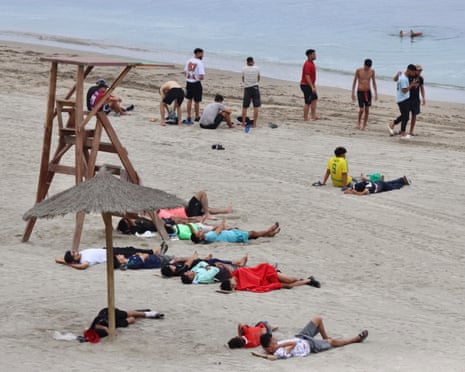
A group of migrants rests on a beach near the Tarajal border crossing in Ceuta, Spain. Photograph: Reduan Dris/EPA
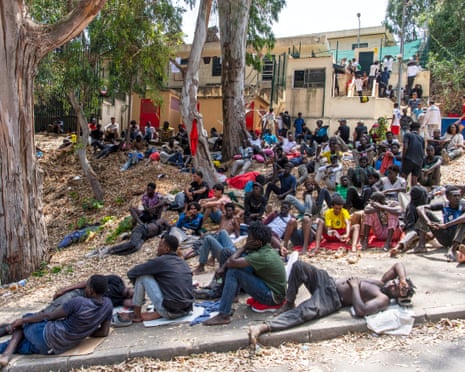
Migrants rest outside the Temporary Center for Immigrants (CETI) after crossing from Morocco into the Spanish enclave of Ceuta, Friday. Photograph: Antonio Sempere/AP
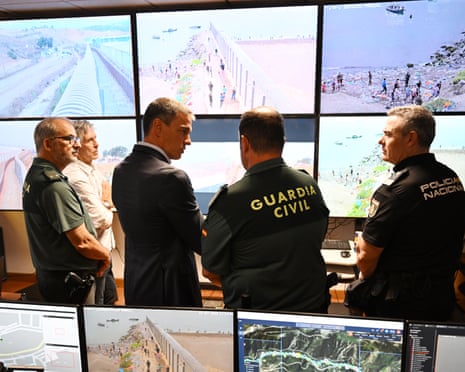
Spain's prime minister Pedro Sánchez and Minister of Interior Fernando Grande Marlaska visit the Spanish city of Ceuta. Photograph: Anadolu/Getty Images
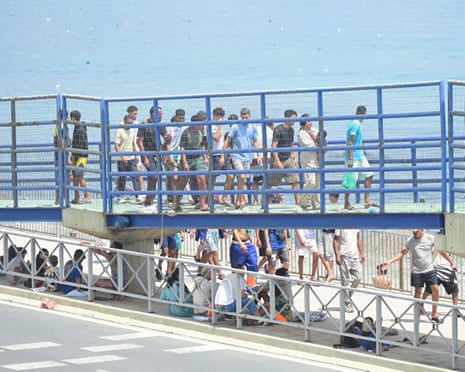
Migrants walk towards the border with Morocco to leave Spain, in Ceuta, Spain. Photograph: Fabian Bimmer/Reuters
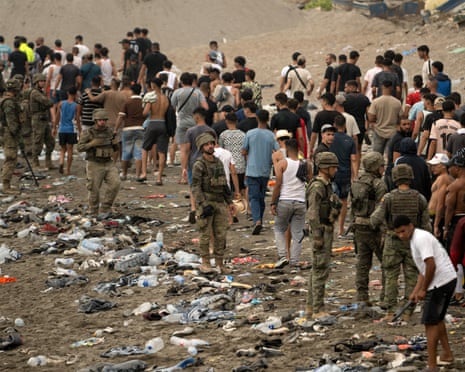
Spanish soldiers control as migrants cross back to Morocco after they crossed the border to enter Spain's north Africa's Ceuta enclave. Photograph: Jorge Guerrero/AFP/Getty Images
There is one other part of EU’s migration commissioner Brunner’s statement (15:04) that is worth highlighting.
He goes out of his way there to point out that “Morocco is included on the EU list of safe countries of origin.”
What it means is that, technically, any Moroccan nationals who crossed the border to Ceuta are unlikely to qualify for international protection given Morroco’s status, as also picked up by Euronews’s Jorge Liboreiro.
“They have to be quickly processed and returned,” Liboreiro quotes a senior EU official as saying.
At least 43 people died during Ceuta crossings
Meanwhile, the death toll from crossing has gone up to 43, the Spanish news agency EFE reported.
Jakub Krupa
Reading the US comments to the events in Ceuta, it’s worth keeping in mind that Spain’s Pedro Sánchez has long been the main target of Trump’s criticism in Europe.
The pair repeatedly clashed on a number of issues, including Israel/Palestine, Iran, Nato, and (obviously) migration, with the US president regularly threatening with all sorts of trade and other sanctions against Madrid.
Some examples:
Local police sources in Ceuta told the El País newspaper that the death toll has gone up to 41.
'That's going to be us in three years if the wrong side gets in,' Trump responds to Ceuta crisis
US president Donald Trump struck a similar tone, telling Fox News that the pictures coming from Spain were “terrible.”
“It’s terrible. Remember that picture. That’s going to be us in three years if the wrong side gets in,” he said, as reported by Fox News, referring to Democrats winning elections.
“If the Democrats get in, you will not live a very good life,” he told Fox News’s anchor Jacqui Heinrich who spoke with him earlier today.
Ceuta 'an unfortunate reminder of the consequences of mass migration,' JD Vance says
US vice-president JD Vance responded to the crisis in Ceuta, saying the pictures coming from Spain were “an unfortunate reminder of the consequences of mass migration and the radical left-wing globalist policies.”
Here is what he said in full:
“Thank God POTUS was elected and our country’s border no longer looks like this. These images out of Spain are an unfortunate reminder of the consequences of mass migration and the radical left-wing globalist policies that have enabled the Invasion of the West.”
'Unacceptable' situation in Ceuta, but 'no onward movements' to Europe, EU commissioner says
EU’s migration commissioner Magnus Brunner has just responded to the crisis situation in Ceuta.
In a post on X, he called the situation “unacceptable” and said he’s in close contact with the Spanish authorities.
But he also confirmed the point I made earlier about the fact that there is no onwards route from Ceuta (14:02) given the enclave’s unique status under the Schengen rules.
“I reiterate that there are no onward movements towards the European continent or other member states. The Schengen Borders Code provides for special rules that apply to Ceuta and Melilla. Border checks on persons departing from Ceuta and Melilla remain in force.”
He also “welcomes the close cooperation between Spain and Morocco to manage the situation and ensure swift returns.”
“The commission will continue to work with the Spanish authorities on the effective use of the instruments available under the new Migration and Asylum rules and to provide additional support at EU level, including through our agencies,” he says.
Denmark's Frederiksen urges EU to 'consider all options' including Spain's Schengen suspension
Denmark’s prime minister Mette Frederiksen is the latest EU leader to urge the bloc to consider whether Spain should be suspended from the Schengen cooperation.
In a written statement, quoted by Berlingske, TV2 and DR, Frederiksen said that “the EU must immediately take all necessary steps and consider all options, including a suspension of Schengen cooperation” to avoid repeating the 2015 migration crisis.
“Uncontrolled immigration is a threat to Europe and Denmark,” she was quoted as saying.
What do we know so far on Ceuta migration crisis
Jakub Krupa
- Some 60,000 people are locally estimated to have crossed into the Spanish North African enclave of Ceuta from Morocco in the last 24 hours, as part of an attempt to overwhelm the Spanish border (13:46).
- At least 41 people reportedly died during the surge.
- The migrants in Ceuta have no onwards route to the EU given the territory’s special status under the Schengen rules (14:02, 15:04).
- Spanish prime minister Pedro Sánchez said the crossings violated Spain’s territorial integrity, as he blamed human trafficking gangs for wilfully misleading people about changes to Spain’s migration rules and triggering the border run (12:51, 12:54, 13:17).
- Some 25,000 people voluntarily returned to Morocco on Friday, the Spanish interior ministry said, as authorities pledged to crack down on illegal migration and expedite returns (12:57).
- The crisis prompted critical reactions from across the EU, with Italy leading the controversial calls to suspend Spain’s status in the Schengen area until the situation improves (9:42, 13:52).
- The EU has called the situation “unacceptable,” and insisted that “returns must be swift, as our rules allow,” pledging to help Spain deal with the crisis (13:25).
Belgium’s deputy prime minister and foreign minister Maxime Prévot is one of the European leaders trying to strike a rather more helpful tone as he says that “when a member state … comes under pressure, it’s a European issue.”
In a post on X, he says:
“Belgium is monitoring the situation in Ceuta closely. When a Member State situated at the external border comes under such pressure, it is a European issue, not purely a Spanish one. At times like these, Spain must ensure that its borders are protected and be able to count on the involvement of both the European authorities and those of Morocco. The protection of Europe’s external borders remains a priority for the Belgian government. Controlling the borders, taking a firmer stance towards illegal migrants and dismantling the business model of people-smugglers is not at odds with a humane approach: it is a prerequisite for it. The Spanish authorities, with whom I have been in contact this morning, and the European Commission are taking the necessary measures to manage the situation, in coordination with Morocco, including return mechanisms for those who have crossed the border illegally, in addition to voluntary returns to Morocco, which appear to be already taking place.”
Migration is where political narratives often clash with legal reality - snap analysis
Jakub Krupa
Some of the European reactions to this migration crisis in Ceuta – playing on voters’s concerns that the new arrivals would now be free to travel onwards within the EU – seem to ignore a fairly important caveat in Spain’s Schengen rules.
Under the 1990 deal on Spain joining the Schengen agreement, the two north African enclaves of Ceuta and Melilla are covered by a special regime, with Spain responsible for maintaining another round of border checks before travellers enter mainland Spain or any other EU country.
The relevant clauses say:
“Pursuant to its national law and in order to verify whether passengers still satisfy the conditions laid down in Article 5 of the 1990 Convention on the basis which they were authorised to enter national territory upon passport control at the external border, Spain shall maintain checks (on identity and documents) on sea and air connections departing from Ceuta and Melilla and having as their sole destination any other place on Spanish territory. To the same end, Spain shall maintain checks on internal flights and on regular ferry connections departing from the towns of Ceuta and Melilla to a destination in another State party to the Convention.”
This obviously does not lessen the legal, political and humanitarian challenges facing Spain. The government in Madrid will need to decide how to respond to the tens of thousands of new arrivals in Ceuta, and will probably seek to facilitate their return to Morocco – either voluntarily or through legal channels – as the sheer scale of the influx makes it nearly impossible for them to remain in the enclave.
But despite the tone coming from the likes of France and Italy, this also does not mean new arrivals automatically are already within the Schengen area in the way most people – and voters – understand it.
Or to put it simply: the new arrivals do not get the right to travel freely to the rest of the EU – say, France, Germany or Italy – and would still have to face another border check before they can leave Ceuta for mainland Spain or any other part of the EU.
This is presumably why we have seen some unusually strong language from Spain’s foreign minister earlier today, angrily accusing Italy of trying to score political points on the back of their problems (9:42).
With France, Italy and Spain all set to have closely contested elections in 2027 in which migration is likely to feature heavily, it’s perhaps not surprising to see politicians get involved in that sort of politicised commentary as they feel domestic political pressures and need to respond to their voters’s fears.
But it’s worth keeping in mind that the legal situation is (as often) a bit more complex.
Spain says 25,000 migrants returned from Ceuta to Morocco today
Spain’s interior ministry said around 25,000 migrants are believed to have returned from Ceuta to Morocco today as part of a Spanish effort to reverse last night’s migratory flows across the border.
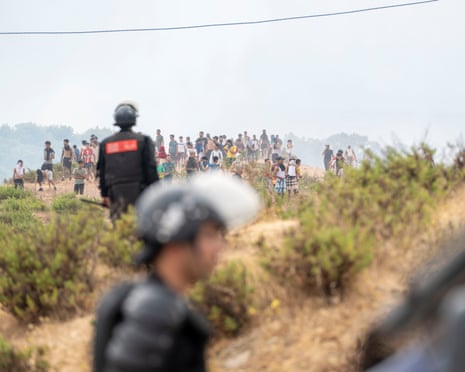
Members of the Moroccan security forces and civilians who returned from Spain gather at the site of clashes at the Bab Sebta border crossing near Fnideq, Morocco across from Ceuta, Spain. Photograph: Jalal Morchidi/EPA
If confirmed, that would be almost half of all those believed to have crossed, given that the latest estimates from local authorities put the figure at about 60,000 people (13:46).
But there are some obvious problems with offering detailed estimates offered during an ongoing emergency, so it is probably worth treating all of these numbers with some caution.
Former Spanish senior EU official dismisses Italy's call to suspend Spain's Schengen status
The EU’s former foreign policy chief, Josep Borrell Fontelles, dismissed calls to suspend Spain’s Schengen status, saying it’s impossible under the EU law.
In very pointed criticism of Italy’s request for such a suspension (9:42), the Spanish politician and former senior EU official stressed:
“Under EU law, no Member State can unilaterally suspend another’s participation in Schengen.”
He added:
“This is worth unpacking as it is quite revealing of how EU governments are learning to understand, talk, use and abuse the EU’s legal order in manifest breach of the principle of loyal cooperation that binds them.”
Where is Ceuta? - locator map
Estimated 60,000 migrants crossed into Spain's Ceuta, with at least 34 dead, local leader says
Speaking shortly after Sánchez, Ceuta’s regional president Juan Jesús Vivas also offered his take on the events of the last 24 hours.
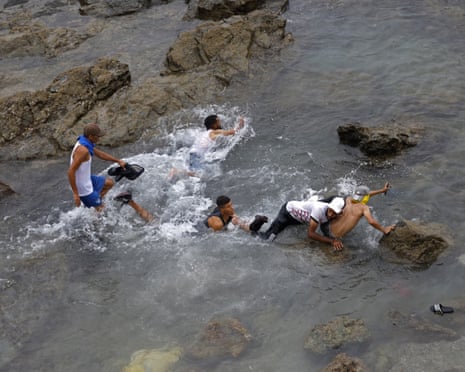
People try to swim through the waters close to the fence near Fnideq, on the Morocco-Spain border. Photograph: Abdel Majid Bziouat/AFP/Getty Images
He said that the latest estimates show that “around 60,000 people have entered our city” as part of the influx.
That’s almost two-thirds of the city’s ordinary population.
“Clearly, this figure demonstrates the impossibility of absorbing such pressure,” he said.
Furthermore, at least 34 people are believed to have died trying to cross into Ceuta, he said.
He urged the government to act “decisively and immediately” to respond to the challenge.
Source note
First published by The Guardian World
This article was supplied by The Guardian World through its RSS feed and formatted for Crooli Signal. The reporting remains with the original publisher.
Read the original at The Guardian World