From
70,000 out of 72,000 migrants in Ceuta returned to Morocco, Spanish minister says
Spain’s interior minister Fernando Grande-Marlaska is also briefing the press right now.
He says all countries were “constructive” and acknowledged Spain’s immediate response.
He tells reporters that 70,000 of the estimated 72,000 that crossed in Cueta have now returned to Morocco.
Spain is “in the process of resolving” the status of the remaining individuals, and those who do not have the right to remain in the country will be returned to Morocco, he says.
But he goes out of his way to make it very clear that the EU’s Schengen area “was in no way compromised” by the crisis, with “no secondary movement, nor even the possibility of any.”
As we explained on Europe Live on Friday, Ceuta has a special status under the Schengen rules, meaning that all entries and exits to mainland Spain or the EU still require full border and document checks.
He says today’s meeting was “satisfactory” in recognising Spain’s work on irregular migration.
EU’s migration commissioner Brunner is also speaking now.
You can follow along live here:
Spain’s Grande-Marlaska also rejected suggestions that Spain was specifically warned about a potential surge at the Ceuta border, as sort of implied by a senior Moroccan official earlier today (11:31).
He says that if there had been any warning or signal of a similar surge, there would have been a much closer communication at the highest levels of the Spanish government.
He also says the plans to extend the maritime border infrastructure were already in place before last week’s crisis.
Grande-Marlaska also insisted that Spain will respect all fundamental rights of minors in Ceuta, but insisted there were no reason to suggest otherwise.
Spain’s interior minister Fernando Grande-Marlaska is also briefing the press right now.
He says all countries were “constructive” and acknowledged Spain’s immediate response.
He tells reporters that 70,000 of the estimated 72,000 that crossed in Cueta have now returned to Morocco.
Spain is “in the process of resolving” the status of the remaining individuals, and those who do not have the right to remain in the country will be returned to Morocco, he says.
But he goes out of his way to make it very clear that the EU’s Schengen area “was in no way compromised” by the crisis, with “no secondary movement, nor even the possibility of any.”
As we explained on Europe Live on Friday, Ceuta has a special status under the Schengen rules, meaning that all entries and exits to mainland Spain or the EU still require full border and document checks.
He says today’s meeting was “satisfactory” in recognising Spain’s work on irregular migration.
Meanwhile, French interior minister Laurent Nuñez is currently on French TV, speaking after today’s meeting of the bloc’s ministers to discuss the latest on Ceuta.
He says that during the three-hour meeting, the ministers expressed their “solidarity” with Spain and praised how Madrid handled the crisis last week. (Erm, did not sound like it last week!)
He says the Spanish minister, Fernando Grande-Marlaska, told colleagues that some 70,000 crossed the border and were returned to Morocco.
75 dead bodies have been recovered so far, Grande-Malaska told ministers, stressing that this figure was “preliminary” and could rise further.
The ministers also discussed the measures taken by Spain to strengthen its border, including a new floating barrier.
(This may not sound like a lot, but it’s a legally critical point as it will clearly classify any attempt to cross the border as falling under one of the exceptions to the recent Supreme Court restrictive ruling on pushbacks, allowing authorities for speedier processing of repatriation.)
Nuñez also said the ministers were concerned by attempts to sow disinformation about the crisis and “interference” by foreign states in a bid to criticise the bloc and “sow division” among the member states.
He says France remains available to help Spain in whatever way possible. In this context, he mentions France’s decision to strengthen its checks on borders with Spain to prevent “secondary movements,” including towards France and the UK.
The minister also stresses the need to fight against human smuggling gangs, including the work “upstream” in the countries of origin.
He also says all countries strongly backed the EU’s Asylum and Migration Pact, which he called “indispensable” in fight against irregular migration.
Well, turns out you don’t quite need to be a fly on the wall to know what the EU ministers are talking about in the context of last week’s events in Ceuta, as some of them are actually quite keen to make their remarks public.
Italy is understood to have called for EU-funded migrant processing centres and return hubs in third countries, with interior minister Matteo Piantedosi telling ministers that they “must act as a united, cohesive bloc to stop departures at their source and return those who have no right to remain on EU territory,” a copy of his speech released by his office showed.
“Now the time has come to put into practice new hub models for the external processing of asylum procedures and for returns in safe third countries,” he was quoted by Reuters as saying.
But as we extensively covered in the Guardian, the apparent model for this solution – Italy’s controversial deal with Albania – has faced numerous legal challenges.
The Council of Europe’s commissioner for human rights Michael O’Flaherty wrote for us last month saying that “without iron-clad legal safeguards, offshore migration centres can only repeat the worst mistakes of the recent past.”
Other countries in central and eastern Europe are also reporting disruptions caused by the extreme weather conditions.
The Czech Republic has recorded the highest nighttime temperature since records began, with 27.9 C in Bystřice pod Hostýnem, ČT24 reported.
Similar record was broken across the border, in Slovakia, with 27.5 C overnight in Plavecký Peter, surpassing the previous record from 2013, Pravda reported.
Temperatures are expected to rise up to 39C later today.
Meanwhile, the European Commission said it was “monitoring very closely” the situation in Bulgaria, Hungary and Romania as the region faces an energy crunch caused by the ongoing heatwave and drought.
Energy spokesperson Anna-Kaisa Itkonen said “the low Danube levels will clearly have an impact on nuclear generation along the route,” and this “concerns several member states.”
The commission was ready to “convene an electricity coordination group as soon as there is a need for that.”
“Generally speaking, climate risks, extreme weather events, have already been embedded in many of our policies related to energy transport already for some time, so we will obviously include, include these aspects in any of our future work as well,” she said.
Back to discussions on Ceuta, now under way in Brussels (10:08), a senior Moroccan official claimed that Morocco had warned Spain that a recent Spanish court ruling that migrants arriving by sea would not face immediate removal was going to create “a problem,” AFP reported.
Spain’s Supreme Court ruled on 8 July that migrants arriving by sea should not be returned as quickly as others and Madrid has blamed criminal gangs for spreading misinformation about the ruling.
“We started engaging with the Spanish side around 22-23 July, when the networks began talking about this,” the Moroccan senior official, speaking on condition of anonymity, said on Monday night.
“We discussed this ruling and its impact. We explained that this ruling was going to create a problem. And it did create a problem,” he said.
The official also rejected any suggestion that Morocco was to be blamed for the crisis, saying “at a certain point, the Moroccan law enforcement forces could no longer confront the migrants because the numbers were very large,” and because “the pull effect was very strong,” he said.
“Today, it is up to Spain to find answers to the challenges posed by this ruling,” he said.
For what it’s worth, Spain responded to the ruling in recent days, installing new border containment structures that would provide them a legal claim to use an exemption provided in the court’s ruling and allow to send migrants back across the border.
Meanwhile, Hungary’s prime minister Péter Magyar praised the solidarity of Hungarians after the country faced “the most difficult and critical night” amid a heatwave energy crunch.
In a video on Facebook, Magyar repeated that the Paks power plant was just “millimetres away” from being shut down overnight, but the water levels started rising again as of this morning.
He praised the “solidarity” shown by Hungarians when reducing their energy consumption, and thanked people working to stabilise the country’s energy grid in these challenging circumstances.
“Tonight’s turn of events gives us cause for optimism, but the hardest days are still ahead of us,” he warned, as Hungary faces a few more days of extreme temperatures.
“Scorching heat of over 40C, drought, and further hardships await, but light now can be seen at the end of the tunnel as cooler weather arrives from Friday, and hopefully much-needed rain in the upper areas of the Danube,” he said.
Temperatures in Budapest are expected to get close to 40C later today.
Meanwhile, a 4.3 magnitude earthquake was reported in the Italian city of Pisa, which was also felt in Livorno, Lucca and Massa Carrara in northern Tuscany, Italian media reported.
The National Institute of Geophysics and Volcanology reported the earthquake had its epicentre 7km west of Pisa.
Tuscan president Eugenio Giani said the authorities were checking across the region to see if there’s any damage. He later added that while “hundreds” of calls to emergency services were made, there are currently no reports of injuries.
Last Thursday, a 4.7 quake was also reported in the Campi Flegrei caldera, west of Naples.
Ashifa Kassam in Madrid, Okba Mohammad in Ceuta and Lisa O’Carroll in London
A growing chorus of voices has accused Morocco of helping to fuel the crisis in Ceuta, with the leader of the Spanish enclave describing last week’s border crossings as an attack on Spain’s territorial integrity that was seen as being “if not orchestrated, at least encouraged or permitted by Morocco”.
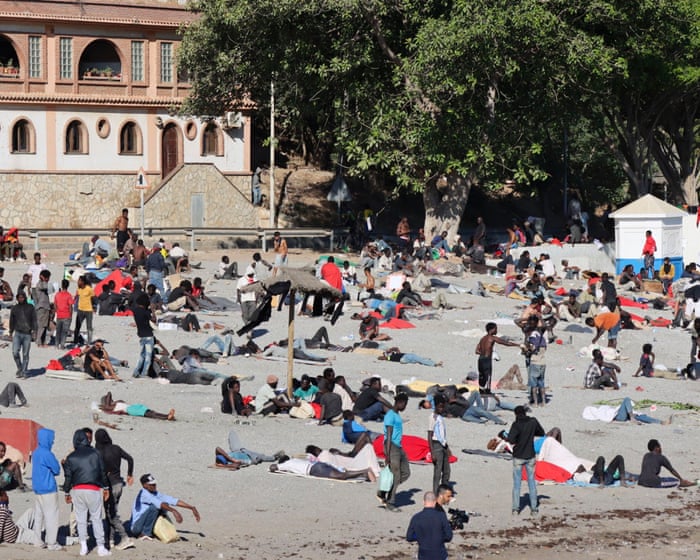
Spanish officials said on Monday that an estimated 69,500 people who had arrived late last week in Ceuta, a tiny Spanish territory in north Africa, had returned to Morocco in recent days. About 2,500 people who had made the crossing were believed to still be in Ceuta.
The extraordinary influx had overwhelmed the city of 84,000 people and set off a political crisis across the EU as some member states laid blame on Spain.
In Ceuta, leaders pointed to the broader picture of what had transpired. “It’s an atrocity,” said Juan Jesús Vivas, the long-serving conservative leader of the territory.
\n “There are 88 bodies in the morgue, and there are more on the other side of the border.”\n
He said local people watched the events play out with a mix of sadness, worry and anguish.
“People see this not as a migration crisis; it was fundamentally an attack, a violation of Spain’s territorial integrity,” Vivas told El País newspaper. “People felt that this, if not orchestrated, was at least encouraged or permitted by Morocco.”
He drew a parallel with May 2021, when Rabat loosened border controls, allowing 10,000 people to cross into Ceuta over the course of two days, during a diplomatic standoff over Madrid’s decision to allow a Western Sahara independence leader to be treated for Covid-19 in Spain.
This time around, analysts have suggested that Spain’s recent rapprochement with Rabat’s arch-enemy Algeria could have triggered a response from Morocco.
in Brussels
Over in Brussels, after a weekend of backbiting over the response to the mass border crossings in the Spanish enclave of Ceuta, EU ministers will seek to present a more unified front – and signal tougher security at Europe’s frontiers.
EU home affairs ministers are meeting at 10.30 CET via video conference to assess the bloc’s response to the arrival – and quick departure – of tens of thousands of people at the Spanish territory in north Africa. Around 100 people are estimated to have died on both sides of the Spanish-Moroccan border.
Ministers are not expected to take decisions, but EU sources think they will give a broad endorsement to the measures outlined by the European Commission president, Ursula von der Leyen on Monday, intended to ensure stronger border protection “at critical points” of the EU’s external border.
Von der Leyen wants to double down on five areas: strengthening cooperation with non-EU countries to prevent migration; stronger external borders; implementing early warning systems; dismantling smuggling networks; and boosting returns of people with no right to stay.
At a meeting of senior EU diplomats on Monday, several countries stressed the importance of preventing sudden movements of people, calling for greater use of intelligence and monitoring of disinformation and misinformation.
While Madrid’s envoy voiced his government’s frustration with the response from some member states, others rejected suggestions that they had failed to show solidarity over the sudden influx of arrivals.
A number of member states said they were ready to help and reflected on their own experience: Poland and Lithuania referred to the instrumentalisation of people on the move by the Belarusian dictatorship, while Italy and Greece spoke of their dealings with sudden arrivals of large numbers of people. But despite the warm words, many governments remain critical of Spain’s plan to regularise 500,000 undocumented migrants, which has triggered nearly 1.2m applications.
One EU diplomat said:
\n “There is some concern that the regularisation of 1.2m people can be used to paint a picture that the door is open.” \n
This issue is set to run. And EU migration policy in general, including controversial plans for return hubs, will be high on the agenda in the autumn, including at the EU’s next scheduled summit in October.
Hungary has come “within millimetres” of having to shut down its nuclear power plant overnight, prime minister Péter Magyar said, as low water levels in the Danube continue to pose challenges for countries in south-eastern Europe.
“Around 1:30 a.m. we were a few millimetres away from completely shutting down the Paks Power Plant, but then the water level stopped falling and by morning it had risen 1.5 centimetres. The last turbine is currently operating safely,” Magyar said on social media.
The plant already operates at a reduced capacity of just over 10% after the Danube fell to a record low, making it impossible to cool it properly.
Energy minister István Kapitány said on Tuesday that a number of energy saving measures succeeded in lowering energy consumption to keep the grid secure.
A number of businesses have made significant adjustments to their normal ways of working to save energy consumption during the peak hours. For example, a grocery chain Lidl changed its baking shifts, and turned off its drink fridges – despite temperatures expected to get close to 40C. Electric car chargers in their parkings can only be used until 5pm, HVG reported.
Over in Romania, the government celebrated that a two-centimetre rise in water levels after yesterday’s spectacular controlled explosion, intended to divert the flow of the Danube to help cool its Cernavodă nuclear plant.
The plant manager told local media that it should help keep the plant running during the next few days, but more interventions are planned today, with plans to sink old barges to further divert the flow of water.
Temperatures are set to surpass 40C in large parts of Romania today, again.
Elsewhere, I will keep an eye on the much-awaited meeting of EU interior ministers who will discuss last week’s migration crisis in Ceuta amid questions about the EU’s relationship with Morocco and the steps needed to secure the bloc’s external borders.
They are meeting at 10am Brussels time, and we should hear from the EU’s migration commissioner, Magnus Brunner, in the early afternoon.
I will bring you all the latest lines here.
It’s Tuesday, 4 August 2026, it’s Jakub Krupa here, and this is Europe Live.
Good morning.
Key events
- 8m agoEU's migration commissioner briefing press on Ceuta border crisis
- 9m agoNo advance warning about possible migrant surge, Spanish minister says
- 21m ago70,000 out of 72,000 migrants in Ceuta returned to Morocco, Spanish minister says
- 34m agoAt least 75 people died in Ceuta border crisis, EU ministers told by Spain
- 1h agoItaly pushes for EU-funded overseas migrant processing centres modelled on controversial Albania deal
- 2h agoCzechia, Slovakia report record-breaking nighttime temperatures
- 2h agoEU 'monitoring very closely' energy crunch in Bulgaria, Hungary and Romania
- 3h agoMorocco says it warned Spain about 'a problem' with Spain's top court ruling on migration
- 3h agoMagyar praises people's solidarity amid energy crunch, but warns of 'hardest days ahead'
- 4h ago4.3 magnitude earthquake reported in Pisa, Italy
- 4h agoCeuta leader accuses Morocco over ‘atrocity’ of mass border crossing
- 4h agoEU ministers to discuss bloc's response to Ceuta migration crisis today
- 5h agoDanube drought - in pictures
- 5h agoMorning opening: Hungary 'within millimetres' of shutting down its nuclear plant as region fights extreme weather and droughts
EU’s Brunner opens by acknowledging the Ceuta incident was a “test” of the EU’s resilience and the security of its external border, which he says the bloc “passed.”
He says ministers expressed “full solidarity with Spain.”
He says the Spanish government had a chance to “clarify” the situation and confirm that the situation has been contained and no onwards movement towards the EU or the Schengen area was recorded.
He sides with Spain on their interpretation that the border crisis was fueled by criminal smuggling networks and disinformation on social media, as he promised the bloc’s support to Ceuta and Spain to strengthen the border further.
EU's migration commissioner briefing press on Ceuta border crisis
EU’s migration commissioner Brunner is also speaking now.
You can follow along live here:
EU ministers discuss Ceuta migrant crossings at press conference – watch live
No advance warning about possible migrant surge, Spanish minister says
Spain’s Grande-Marlaska also rejected suggestions that Spain was specifically warned about a potential surge at the Ceuta border, as sort of implied by a senior Moroccan official earlier today (11:31).
He says that if there had been any warning or signal of a similar surge, there would have been a much closer communication at the highest levels of the Spanish government.
He also says the plans to extend the maritime border infrastructure were already in place before last week’s crisis.
Grande-Marlaska also insisted that Spain will respect all fundamental rights of minors in Ceuta, but insisted there were no reason to suggest otherwise.
Ireland’s home affairs minister Jim O’Callaghan also offered his take on today’s meeting.
Ireland hosts the EU’s rotating presidency of the Council of the European Union, meaning it chairs the key meetings during this period.
In a diplomatically worded statement, O’Callaghan said:
“The EU is united and stands ready to support Spain and protect our external borders from illegal migration. We commend Spain for their swift response to the situation in Ceuta and extend our deepest condolences for the tragic loss of life. The EU’s external borders are our shared responsibility, and migration requires a united European response. Today’s meeting which I convened provided an important opportunity for member states to assess the tools already at our disposal, identify where further cooperation is needed, and advance our collective preparations ahead of the next ministerial meeting and the European Council in October.”
The EU’s readout also added that there was “a common understanding on the need to continue relentlessly fighting migrant smuggling networks” and to “improve situational awareness” to prevent similar crises.
70,000 out of 72,000 migrants in Ceuta returned to Morocco, Spanish minister says
Spain’s interior minister Fernando Grande-Marlaska is also briefing the press right now.
He says all countries were “constructive” and acknowledged Spain’s immediate response.
He tells reporters that 70,000 of the estimated 72,000 that crossed in Cueta have now returned to Morocco.
Spain is “in the process of resolving” the status of the remaining individuals, and those who do not have the right to remain in the country will be returned to Morocco, he says.
But he goes out of his way to make it very clear that the EU’s Schengen area “was in no way compromised” by the crisis, with “no secondary movement, nor even the possibility of any.”
As we explained on Europe Live on Friday, Ceuta has a special status under the Schengen rules, meaning that all entries and exits to mainland Spain or the EU still require full border and document checks.
He says today’s meeting was “satisfactory” in recognising Spain’s work on irregular migration.
At least 75 people died in Ceuta border crisis, EU ministers told by Spain
Meanwhile, French interior minister Laurent Nuñez is currently on French TV, speaking after today’s meeting of the bloc’s ministers to discuss the latest on Ceuta.
He says that during the three-hour meeting, the ministers expressed their “solidarity” with Spain and praised how Madrid handled the crisis last week. (Erm, did not sound like it last week!)
He says the Spanish minister, Fernando Grande-Marlaska, told colleagues that some 70,000 crossed the border and were returned to Morocco.
75 dead bodies have been recovered so far, Grande-Malaska told ministers, stressing that this figure was “preliminary” and could rise further.
The ministers also discussed the measures taken by Spain to strengthen its border, including a new floating barrier.
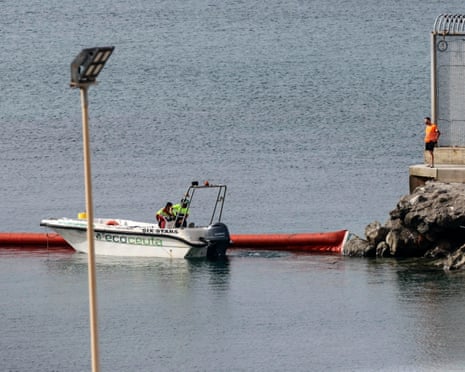
Work continues on the installation of a floating buoy marking the jurisdictional waters off Tarajal Beach in Ceuta, Spain. Photograph: REDUAN/EPA
(This may not sound like a lot, but it’s a legally critical point as it will clearly classify any attempt to cross the border as falling under one of the exceptions to the recent Supreme Court restrictive ruling on pushbacks, allowing authorities for speedier processing of repatriation.)
Nuñez also said the ministers were concerned by attempts to sow disinformation about the crisis and “interference” by foreign states in a bid to criticise the bloc and “sow division” among the member states.
He says France remains available to help Spain in whatever way possible. In this context, he mentions France’s decision to strengthen its checks on borders with Spain to prevent “secondary movements,” including towards France and the UK.
The minister also stresses the need to fight against human smuggling gangs, including the work “upstream” in the countries of origin.
He also says all countries strongly backed the EU’s Asylum and Migration Pact, which he called “indispensable” in fight against irregular migration.
Jakub Krupa
We will no doubt hear more about this proposal – and the EU’s initial response – from the bloc’s migration commissioner Brunner during his press conference in the next hour.
I will bring you the key lines here when it happens.
Italy pushes for EU-funded overseas migrant processing centres modelled on controversial Albania deal
Well, turns out you don’t quite need to be a fly on the wall to know what the EU ministers are talking about in the context of last week’s events in Ceuta, as some of them are actually quite keen to make their remarks public.
Italy is understood to have called for EU-funded migrant processing centres and return hubs in third countries, with interior minister Matteo Piantedosi telling ministers that they “must act as a united, cohesive bloc to stop departures at their source and return those who have no right to remain on EU territory,” a copy of his speech released by his office showed.
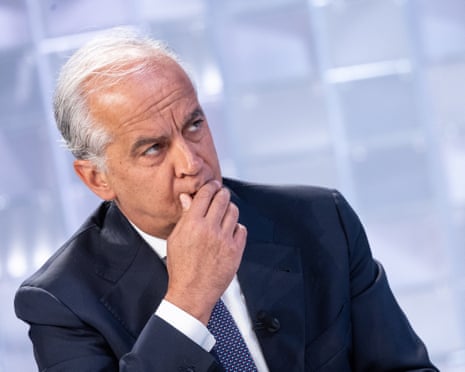
Italian interior minister Matteo Piantedosi speaking during a TV interview last month. Photograph: Mauro Scrobogna/LaPresse/Shutterstock
“Now the time has come to put into practice new hub models for the external processing of asylum procedures and for returns in safe third countries,” he was quoted by Reuters as saying.
But as we extensively covered in the Guardian, the apparent model for this solution – Italy’s controversial deal with Albania – has faced numerous legal challenges.
The Council of Europe’s commissioner for human rights Michael O’Flaherty wrote for us last month saying that “without iron-clad legal safeguards, offshore migration centres can only repeat the worst mistakes of the recent past.”
Czechia, Slovakia report record-breaking nighttime temperatures
Other countries in central and eastern Europe are also reporting disruptions caused by the extreme weather conditions.
The Czech Republic has recorded the highest nighttime temperature since records began, with 27.9 C in Bystřice pod Hostýnem, ČT24 reported.
Similar record was broken across the border, in Slovakia, with 27.5 C overnight in Plavecký Peter, surpassing the previous record from 2013, Pravda reported.
Temperatures are expected to rise up to 39C later today.

A woman pours a cup of cold water on her face as she cools of in the Tisza River near the village of Male Trakany, eastern Slovakia Photograph: Anadolu/Getty Images
Jakub Krupa
Oh, interesting: the EU migration commissioner Brunner’s press conference has just been pushed back by about an hour as the meeting is still ongoing.
It’s now expected not before 2pm local time (1pm UK).
Oh, to be a fly on the wall on that call.
Source note
First published by The Guardian World
This article was supplied by The Guardian World through its RSS feed and formatted for Crooli Signal. The reporting remains with the original publisher.
Read the original at The Guardian World