The president of the European Commission has called for action to strengthen Europe’s borders after tens of thousands of people arrived and quickly left the Spanish territory of Ceuta, triggering a furious row between Madrid and other European countries.
In a letter to Spain’s prime minister, Pedro Sánchez, on Monday, Ursula von der Leyen said: “From this incident, it is clear that we must do more to further strengthen our borders at critical points, including vigilant monitoring and the use of physical barriers where needed.”
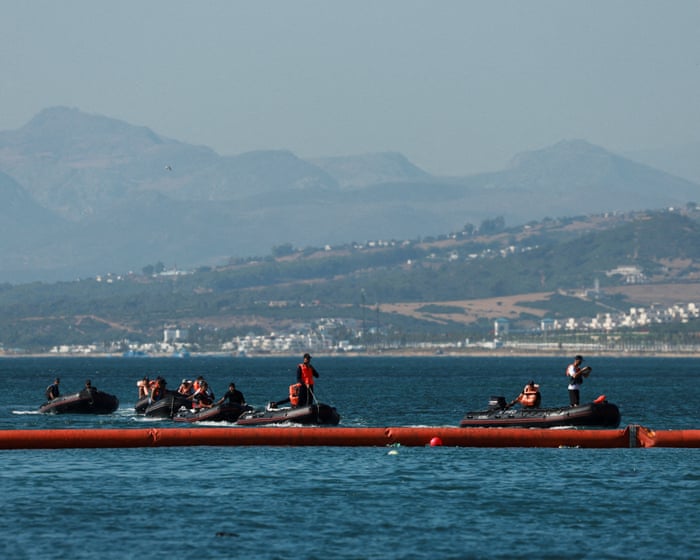
She praised the Spanish socialist leader’s swift handling of the crisis, after the vast majority of migrants left Ceuta and Spanish officials began installing a 500-metre (1,640ft) floating barrier at the border with Morocco. “Order has been restored and the returns system in place worked,” she wrote in the letter.
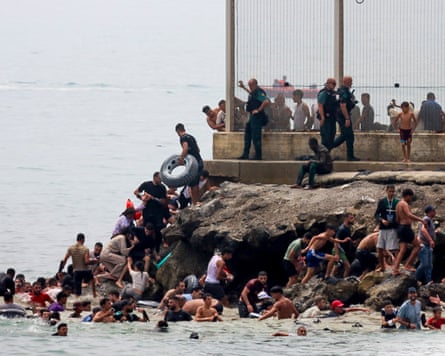
People arriving in Ceuta from Morocco last week. Photograph: Reduan Dris/EPA
Spain estimates that about 69,500 migrants have returned to Morocco over the past four days, exceeding initial estimates of 50,000 having arrived in the enclave on north African territory on Thursday. Authorities in Ceuta reported that 88 people died trying to reach the territory, while at least 11 deaths have been recorded in Morocco.
Ceuta and Melilla, another Spanish enclave, have the EU’s only land border with Africa. There are periodic surges in attempted crossings to both cities, although neither permits onward free movement to the EU as they are outside the border-free Schengen zone.
EU interior ministers will hold emergency talks on Tuesday, which von der Leyen said would be a chance to draw lessons from the crossings.
The EU, she said, should double down on five areas: strengthening cooperation with non-EU countries to prevent migration; stronger external borders; implementing early warning systems; dismantling smuggling networks; and boosting returns of people with no right to stay.
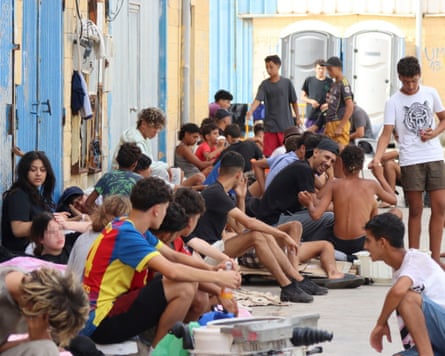
People who arrived in Ceuta from Morocco sitting on the street. Photograph: Reduan/EPA
Italian media reported that Giorgia Meloni’s government wanted to accelerate the opening of offshore migration centres, which Europe’s top human rights expert recently said risk becoming “human rights black holes”.
The EU opened the door to offshore detention centres in June in an unprecedented departure from legal norms as part of a law aiming to increase the deportations of people with no legal right to stay.
Amid heavy criticism of the EU’s divided response to the Ceuta border crossings, von der Leyen stressed that Spain could access EU funds as well as support from the Frontex border agency. So far Madrid has not requested the assistance of Frontex.
The crossings – seized on by far-right politicians across Europe – have exposed deep divisions over migration that have left Spain’s socialist leader isolated.
Over the weekend, Sánchez criticised other governments for failing to support Spain, after Italy and Denmark led calls for its temporary exclusion from the Schengen zone. Sánchez said such an attitude was “driven by prejudice, fake news, ignorance or political interest”, contrary to European and humanitarian law “and the principles of solidarity that bind us together”.
Italy and Denmark also organised a letter signed by 20 other EU member states that appeared to blame the crisis on Sánchez’s decision to regularise the status of 500,000 migrants without documents. “We have a duty to effectively deter and relentlessly combat illegal migration,” the 22 leaders wrote, arguing for the need to address “all policies that can serve as pull factors, such as the regularisation of [a] very large number of irregular migrants”.
after newsletter promotion
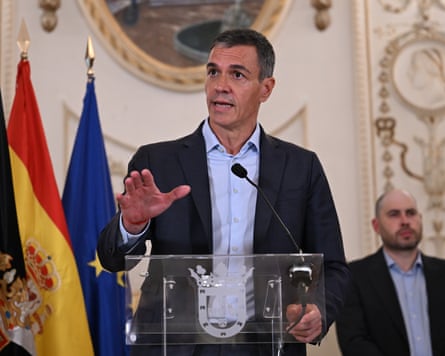
Pedro Sánchez has criticised other governments for failing to support Spain. Photograph: Borja Puig de la Bellacasa/Moncloa Handout/EPA
EU member states favouring a tough approach to migration are expected to raise the issue of “pull factors” on Tuesday. “There is some concern that the regularisation of 1.2 million people can be used to paint a picture that the door is open,” an EU diplomat said, referring to the approximate number of people who applied for regularisation under the 2026 Spanish government programme.
Academic research has found no evidence of a pull effect from regularisation programmes on arrivals of irregular migrants.
Michele LeVoy, the director of Picum, an umbrella group that campaigns for the rights of undocumented migrants, said regularisation programmes had been criticised by EU governments for the last two decades. “If an EU country offers regularisation possibilities, other member states believe that it may invite secondary movement [onward movement to other EU member states] – that is what EU member states don’t want and that explains most likely the harsh response.”
Amid widespread suspicion that Morocco helped fuel the crisis, von der Leyen described the country as “an important strategic partner”, especially in combating “illegal migration”.
Officials said that before the Ceuta crossings, the European Commission was looking to upgrade the EU’s diplomatic relationship with Morocco to a “strategic and comprehensive partnership”. The EU already has similar wide-ranging agreements with Egypt and Tunisia, which include pledges to stem migration, but have been heavily criticised by rights groups.
Von der Leyen wrote: “On anything related to Ceuta and Melilla, we could enhance border management early-warning systems and improve our technical and financial support to Morocco.”
Rights groups said people seeking work or fleeing persecution needed routes to move safely. LeVoy said: “On Ceuta, political games are being played over the lives of people on both sides of the border – those who hope for a better life, and those who are made to fear a so-called ‘invasion’. But what happened in and around Ceuta is fundamentally the result of Europe’s inaction on decent work permits and other regular pathways and the dismantling of its asylum systems.”
Source note
First published by The Guardian World
This article was supplied by The Guardian World through its RSS feed and formatted for Crooli Signal. The reporting remains with the original publisher.
Read the original at The Guardian World