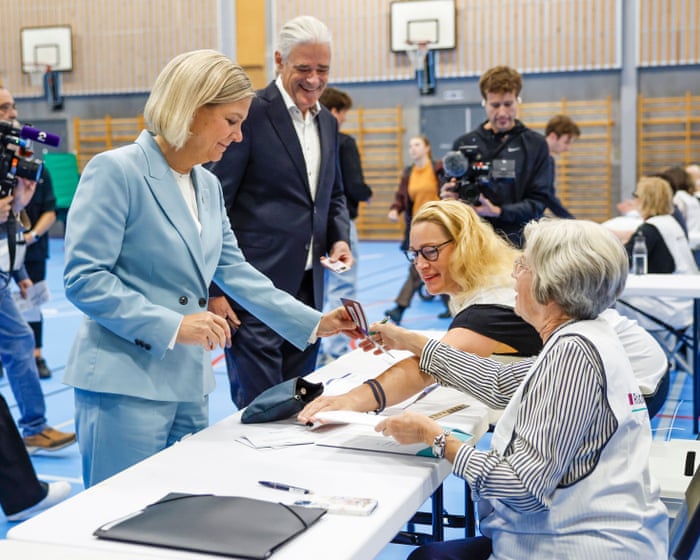
Nordic correspondent
Voting is under way in Sweden in a high-stakes election that could lead to the far-right Sweden Democrats (SD) entering government for the first time.
It comes after an unusually heated and polarised campaign punctuated by personal attacks between leaders, accusations of misinformation and Maga-inspired ads.
Polls suggest an extremely tight race, with one showing just 0.3 percentage points between the left and right blocs.
The right-leaning bloc, made up of what are known as the Tidö parties, has been in power for four years. It is formed of the Moderates, the Christian Democrats and the Liberals with a supporting role for SD, Sweden’s second biggest party.
The opposition left-leaning bloc is formed of Sweden’s biggest party, the Social Democrats, the Centre party, the Green party and the Left party.
The rightwing coalition broke a longstanding taboo in 2022 by going into partnership with SD, which has neo-Nazi roots.
SD has attempted to make itself more palatable to the mainstream by toning down its overtly racist rhetoric, while arguing that immigration is responsible for Sweden’s crime problems.
After four years in a supporting role for the Moderates-run coalition government, however, during which it has shifted much of the Swedish establishment to the right, SD’s approach to the election has been more brazen. If the right-leaning coalition wins, the party has been promised a prominent role in the government, including key ministerial positions.
The prime minister and leader of the Moderates, Ulf Kristersson, has put considerable focus in the final days of campaigning on the penalty discount applied to criminals convicted of various offences. He accused opposition leader Magdalena Andersson of not standing up for female rape victims. In response, she accused him of weaponising men’s violence against women.
Voters say the most important election issues are healthcare, law and order, immigration and the economy. But much of the election debate has been focused on personal finance, said Radio Sweden’s senior political correspondent, Fredrik Furtenbach.
\n “The parties have tried to outdo each other with promises of more money. It has been a sort of auction.”\n
The prospect of far-right anti-immigration Sweden Democrats entering the government has understandably attracted a lot of international attention, particularly coming just days after the Alternative für Deutschland won the regional elections in Saxony Anhalt in Germany.
As our Nordic correspondent Miranda Bryant notes in her preview,
\n “SD has attempted to make itself more palatable to the mainstream by toning down its overtly racist rhetoric, while arguing that immigration is responsible for Sweden’s crime problems.\n SD’s campaign slogan of “make Sweden Sweden again” was reminiscent of Donald Trump’s “make America great again”.\n Its controversial ads on buses – with messages including: “Do you miss Mogadishu? The repatriation grant will help you get home” – were taken down after drivers refused to work in vehicles displaying them.”\n
It is yet another example of far-right parties gaining ground across Europe.
But, Aylott says, “it would be misleading to describe the election as a referendum on the far-right” as the party’s creeping normalisation progressed over several years.
He says, however, that “the issue of the normalisation of the Sweden Democrats is a very big deal to a small subset of the electorate, and this subset may be very important in determining the outcome of the election.”
\n “As has been the case for a long time now, maybe 15-20, years, the two sides of Swedish politics are very evenly matched and if the prospect of Sweden Democrat ministers is so distasteful to some voters … that they would be prepared to vote for a party of the left bloc, that could tip the balance.”\n
Aylott says the party’s growing role in Swedish politics is already remarkable, as it has heavily shaped the country’s approach to migration and law and order issues in the last decade.
\n “The debate about certain topics these days is totally different to what it was here 10 years ago, 15 years ago. This is an absolutely enormous change, and of course the rise of the Sweden Democrats is a big part of that.”\n
He adds that its position going into this election is in stark contrast with “the sense of shock” among political elites when the party first entered into parliament in 2010, with parties “sort of having a competition … who could most aggressively ostracise” it.
If the party – which has neo-Nazi roots, for which it apologised last year – gets into government at this election, “it would be another step and would add to this broader trend in Europe of radical conservative populists forces becoming key players in national politics,” a trend already seen in France, Germany, the Netherlands, and elsewhere.
Aylott says the party could be best compared to Giorgia Meloni’s Brothers of Italy or Le Pen’s National Rally rather than Germany’s Alternative für Deutschland.
The party, led by Jimmie Åkesson, has “toned down” its euroscepticism dropping the call for “Swexit” – although remains critical of the EU’s migration and climate policies – and focuses heavily on domestic issues, particularly migration and law and order.
Despite historical scepticism, it also eventually supported Sweden’s bid to join Nato, and is unlikely to seek to challenge Sweden’s support for Ukraine.
However, as Miranda notes in her preview, a leading SD figure, Gustav Gellerbrant, came under national scrutiny recently after an investigation by the publication Expo connected his partner to Russian state actors and the spread of Russian propaganda.
His partner, who is Russian, works as a civil servant for SD in parliament. Gellerbrant said in response that it was “isolated information” intended to raise suspicion about her Russian origins and has since gone on leave.
Since 2022, Sweden has been governed by a three-party minority government led by the Moderates party (often referred to simply as M) leader Ulf Kristersson, with Ebba Busch’s Christian Democrats (KD) and Simona Mohamsson’s the Liberals (L).
They are currently supported by – but not formally joined in the government – by the far-right populist and anti-immigration Sweden Democrats (SD) party, led by Jimmie Åkesson. They are one of, if not the, key talking points of the night.
A win for the centre-right bloc of parties would most likely see them formally join the government, breaking another taboo in Swedish politics.
The opposition is led by former prime minister Magdalena Andersson’s Social Democrats (S – not SD), which is the largest party in the parliament. Other parties of the opposition bloc are: the Centre party (C) of Elisabeth Thand Ringqvist, the Left party (V) of Nooshi Dadgostar, and the Green Party (MP) of Daniel Helldén and Amanda Lind.
The left-wing bloc has been leading in the polls for the majority of the current parliamentary term, with Andersson’s party alone polling at times in mid 30s, leaving many experts thinking that a change of government was all but certain.
But in recent months the polls have substantially narrowed, giving the combined opposition only a very slim lead going into the election day. They are the favourites to win, but it’s still all to play for.
“The opposition parties have had a lead in the polls, often a very comfortable lead … so if there were to be any other outcome than an opposition victory, it would be sort of sensational because the lead has been so consistent and so long established – but it’s not impossible,” Aylott tells me.
“The big challenge the Social Democrats would face in the quite likely event that they will be forming a government is that their constellation of allied parties, which would comprise the majority, is very diverse,” he adds.
\n “One of the aspects of this diversity is that some of them take a much more permissive view on things like law and order and migration, so keeping this diverse constellation of currently opposition parties could be difficult.”\n
You would think it’s a sort of self-explanatory thing, right? Well, you would be wrong, as Sweden has a fairly complex seven-step process for casting your votes.
Voters take pick ballots from a station with many available options. Yellow ballots are for the national parliament, Riksdag, white for the municipal assembly, and blue for the region assembly.
It’s complicated, so let me just point you towards the official guidance on how it’s meant to work:
Voters then take three ballot envelopes, stick their ballot inside, close them, and take it to a polling staff member who checks your name on the voters’ register, crosses you out, and then drops them into the ballot box.
Easy, right?
There are 349 seats in the parliament, so theoretically it’s a race to 175 when it comes to securing a majority in the Riksdag. But it’s a bit more complicated than that.
It’s a proportional representation system, but to get in, you need to clear a 4% threshold – and that is particularly relevant for the Liberal party, which the current PM is likely to need to stay in power.
The party long polled well before the threshold, but surged in recent days, helped by their leader’s strong performances in TV debates and what is believed to be some tactical voting among the supporters of the “blue” bloc as they want to make sure they make it into the parliament.
We are expecting eight parties to be in the next parliament and this level of fragmentation can make government formation a bit tricky at times. But in theory they are divided in two blocks – blue and red – which are expected to come to some sort of agreement, if needed.
It’s also worth remembering that Sweden has a long history of minority governments.
“Sweden has a tradition of minority governments,” Aylott explains, with the concept of “negative parliamentarism.”
\n “If there’s a prime minister proposed, then if there is the absence of an absolute majority in parliament against the proposal, it’s interpreted as support. So a party that doesn’t really want to give full support to this proposed candidate - maybe because it’s not going to be part of the coalition, but which can just about live with it, and doesn’t have a better alternative – it can abstain from the vote, and that’s counted as passive support. This makes it much easier to form minority governments.”\n
Aylott continues:
\n “But it’s it’s worth remembering that nearly every, almost by definition, minority government eventually rests on a parliamentary majority, and these parliamentary majorities are usually not always, but usually fairly stable.\n This was the story of the last four years, with a minority government, but they had a very elaborate Tidö deal with the Sweden Democrats, which meant that there was a de facto majority in parliament.\n So, minority governments aren’t as fragile, usually at least, as they look.”\n
Since you may not be ordinarily following the Swedish politics very closely, let me bring you up to speed on some of the key aspect of this year’s election.
Nicholas Aylott, senior lecturer at Södertörn University in Stockholm, joined me over coffee earlier to offer some commentary to help us make sense of it.
The polls opened at 8am local time (7am UK) and will close 12 hours later, at 8pm local time (7pm UK).
And it is at 8pm local time when we should get the results of the Swedish public broadcaster SVT’s polling station survey, and a separate poll commissioned by private broadcaster TV4.
We should start getting first actual results not long after that and as the night goes on, we should be moving to on a firmer ground (he says hopefully).
For what it’s worth, SVT is hoping to release its “super forecast” with expected election result at some point after 9pm local time (8pm UK).
Don’t expect the party leaders to rush to stage for their victory speeches before we get a clear(er) sense of what is going on.
Understandably, we focus on the general election, but it’s worth noting that the local elections to regional and municipal councils are also held on the same day, and so voters get as many as three ballots in total.
in Stockholm
Hej, that’s hello in Swedish, from Stockholm, where I spent this morning eating Swedish pastry and meatballs talking to voters about the country’s prospects as they cast their votes in today’s parliamentary elections.
Here is what they told me, straight from Stockholm:
in Stockholm
We kick off our coverage of the 2026 Swedish parliamentary election which could see the far right enter government for the first time if the country’s rightwing parties can form a majority – or a new centre-left government take control instead.
As our Nordic correspondent Miranda Bryant noted in her preview,
\n “In 2022, the current prime minister, Ulf Kristersson, the leader of the centre-right Moderates, broke a longstanding taboo to make a deal with the far-right Sweden Democrats (SD), so that his minority coalition could form a government.\n That agreement gave the SD outsized influence over government policy, especially on crime and immigration, and Kristersson has now gone further, promising ministerial posts for the SD if he is returned to power.”\n
The opposition “red” bloc is led by former prime minister Magdalena Andersson of the Social Democrats, but their lead has narrowed considerably in the final days of the campaign to less than one percentage point.
It could be a very, very close race.
The polls opened 8am local time and will close 8pm local time (7pm UK), when we should have two exit polls – conducted by Swedish broadcaster SVT and TV4 – for you.
A further projection will be published by public broadcaster SVT about an hour later, as we start getting actual results.
We could be in for a long night, but hope you will join us for lots of colour from Stockholm, the last hours of the campaign trail, and obviously the results.
Good evening.
Key events
- 11m agoVoting about to close in Sweden with far right eyeing first role in government
- 17m ago'Not a referendum on far-right,' even if Sweden Democrats will be a key talking point, expert says
- 27m ago90 minutes until the polls close
- 37m agoWho are the key players?
- 54m agoHow do you cast your vote?
- 1h agoWhat is the Swedish electoral system and how it works in practice
- 1h agoWhat you need to know to follow tonight's election
- 1h agoKey timings for tonight's race
- 2h agoHej from Stockholm!
- 2h agoEvening opening: Welcome to 2026 Swedish parliamentary election live blog
Voting about to close in Sweden with far right eyeing first role in government
Miranda Bryant
Nordic correspondent
Voting is under way in Sweden in a high-stakes election that could lead to the far-right Sweden Democrats (SD) entering government for the first time.
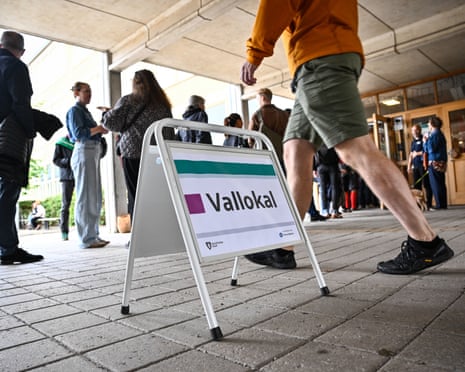
People queue to vote for Sweden’s general election at a polling station in Stockholm, Sweden. Photograph: Martin Pahlmblad/EPA
It comes after an unusually heated and polarised campaign punctuated by personal attacks between leaders, accusations of misinformation and Maga-inspired ads.
Polls suggest an extremely tight race, with one showing just 0.3 percentage points between the left and right blocs.
The right-leaning bloc, made up of what are known as the Tidö parties, has been in power for four years. It is formed of the Moderates, the Christian Democrats and the Liberals with a supporting role for SD, Sweden’s second biggest party.
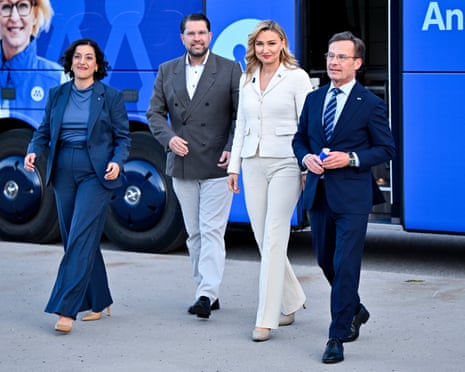
The Liberals leader Simona Mohamsson, Sweden Democrats' leader Jimmie Akesson, Christian Democrats' leader Ebba Busch and Moderate Party leader and prime minister Ulf Kristersson arrive for the Swedish Television (SVT)'s final election debate in Gavle, Sweden. Photograph: Anders Wiklund/EPA
The opposition left-leaning bloc is formed of Sweden’s biggest party, the Social Democrats, the Centre party, the Green party and the Left party.
The rightwing coalition broke a longstanding taboo in 2022 by going into partnership with SD, which has neo-Nazi roots.
SD has attempted to make itself more palatable to the mainstream by toning down its overtly racist rhetoric, while arguing that immigration is responsible for Sweden’s crime problems.
After four years in a supporting role for the Moderates-run coalition government, however, during which it has shifted much of the Swedish establishment to the right, SD’s approach to the election has been more brazen. If the right-leaning coalition wins, the party has been promised a prominent role in the government, including key ministerial positions.
The prime minister and leader of the Moderates, Ulf Kristersson, has put considerable focus in the final days of campaigning on the penalty discount applied to criminals convicted of various offences. He accused opposition leader Magdalena Andersson of not standing up for female rape victims. In response, she accused him of weaponising men’s violence against women.
Voters say the most important election issues are healthcare, law and order, immigration and the economy. But much of the election debate has been focused on personal finance, said Radio Sweden’s senior political correspondent, Fredrik Furtenbach.
“The parties have tried to outdo each other with promises of more money. It has been a sort of auction.”
Jakub Krupa
If you’re looking just for a single story to quickly catch up on the story of tonight, let’s cross to our Nordic correspondent, Miranda Bryant, for her preview.
'Not a referendum on far-right,' even if Sweden Democrats will be a key talking point, expert says
The prospect of far-right anti-immigration Sweden Democrats entering the government has understandably attracted a lot of international attention, particularly coming just days after the Alternative für Deutschland won the regional elections in Saxony Anhalt in Germany.
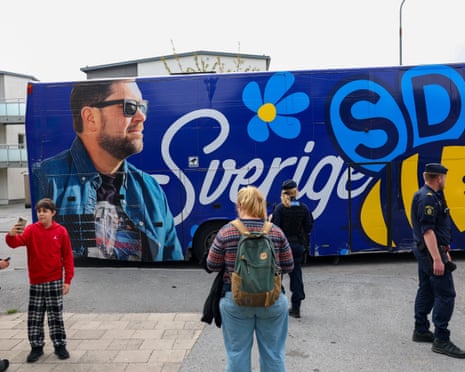
A bus carrying the leader of the far-right party the Sweden Democrats, Jimmy Åkesson, leaves after he cast his vote early ahead of Sunday’s general election in Rinkeby in Stockholm, Sweden. Photograph: Denis Balibouse/Reuters
As our Nordic correspondent Miranda Bryant notes in her preview,
“SD has attempted to make itself more palatable to the mainstream by toning down its overtly racist rhetoric, while arguing that immigration is responsible for Sweden’s crime problems. SD’s campaign slogan of “make Sweden Sweden again” was reminiscent of Donald Trump’s “make America great again”. Its controversial ads on buses – with messages including: “Do you miss Mogadishu? The repatriation grant will help you get home” – were taken down after drivers refused to work in vehicles displaying them.”
It is yet another example of far-right parties gaining ground across Europe.
But, Aylott says, “it would be misleading to describe the election as a referendum on the far-right” as the party’s creeping normalisation progressed over several years.
He says, however, that “the issue of the normalisation of the Sweden Democrats is a very big deal to a small subset of the electorate, and this subset may be very important in determining the outcome of the election.”
“As has been the case for a long time now, maybe 15-20, years, the two sides of Swedish politics are very evenly matched and if the prospect of Sweden Democrat ministers is so distasteful to some voters … that they would be prepared to vote for a party of the left bloc, that could tip the balance.”
Aylott says the party’s growing role in Swedish politics is already remarkable, as it has heavily shaped the country’s approach to migration and law and order issues in the last decade.
“The debate about certain topics these days is totally different to what it was here 10 years ago, 15 years ago. This is an absolutely enormous change, and of course the rise of the Sweden Democrats is a big part of that.”
He adds that its position going into this election is in stark contrast with “the sense of shock” among political elites when the party first entered into parliament in 2010, with parties “sort of having a competition … who could most aggressively ostracise” it.
If the party – which has neo-Nazi roots, for which it apologised last year – gets into government at this election, “it would be another step and would add to this broader trend in Europe of radical conservative populists forces becoming key players in national politics,” a trend already seen in France, Germany, the Netherlands, and elsewhere.
Aylott says the party could be best compared to Giorgia Meloni’s Brothers of Italy or Le Pen’s National Rally rather than Germany’s Alternative für Deutschland.
The party, led by Jimmie Åkesson, has “toned down” its euroscepticism dropping the call for “Swexit” – although remains critical of the EU’s migration and climate policies – and focuses heavily on domestic issues, particularly migration and law and order.
Despite historical scepticism, it also eventually supported Sweden’s bid to join Nato, and is unlikely to seek to challenge Sweden’s support for Ukraine.
However, as Miranda notes in her preview, a leading SD figure, Gustav Gellerbrant, came under national scrutiny recently after an investigation by the publication Expo connected his partner to Russian state actors and the spread of Russian propaganda.
His partner, who is Russian, works as a civil servant for SD in parliament. Gellerbrant said in response that it was “isolated information” intended to raise suspicion about her Russian origins and has since gone on leave.
90 minutes until the polls close
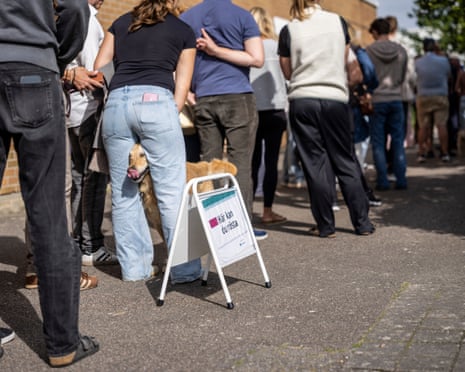
Voters queue to cast ballots at a polling station in a sports hall during Sweden's general election in Lomma, southern Sweden. Photograph: Johan Nilsson/EPA
Who are the key players?
Since 2022, Sweden has been governed by a three-party minority government led by the Moderates party (often referred to simply as M) leader Ulf Kristersson, with Ebba Busch’s Christian Democrats (KD) and Simona Mohamsson’s the Liberals (L).
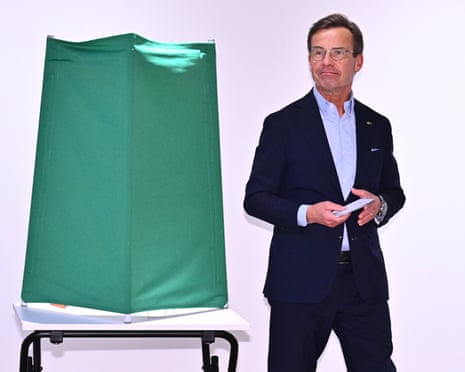
Swedish prime minister Ulf Kristersson, leader of the Moderate party casts his vote at a polling station at Multeum Cultural Center in Strangnas, Sweden. Photograph: Claudio Bresciani/TT News Agency/AP
They are currently supported by – but not formally joined in the government – by the far-right populist and anti-immigration Sweden Democrats (SD) party, led by Jimmie Åkesson. They are one of, if not the, key talking points of the night.
A win for the centre-right bloc of parties would most likely see them formally join the government, breaking another taboo in Swedish politics.
The opposition is led by former prime minister Magdalena Andersson’s Social Democrats (S – not SD), which is the largest party in the parliament. Other parties of the opposition bloc are: the Centre party (C) of Elisabeth Thand Ringqvist, the Left party (V) of Nooshi Dadgostar, and the Green Party (MP) of Daniel Helldén and Amanda Lind.
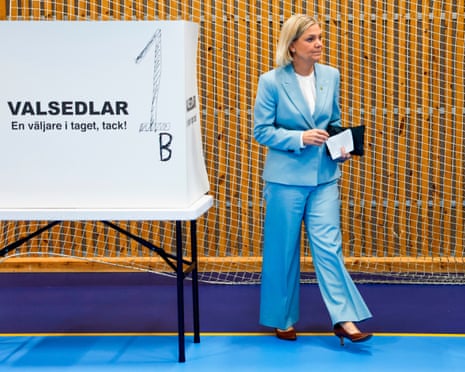
Social Democrats party leader Magdalena Andersson votes at a polling station in Nacka, Sweden. Photograph: Stefan Jerrevång/TT News Agency/AP
The left-wing bloc has been leading in the polls for the majority of the current parliamentary term, with Andersson’s party alone polling at times in mid 30s, leaving many experts thinking that a change of government was all but certain.
But in recent months the polls have substantially narrowed, giving the combined opposition only a very slim lead going into the election day. They are the favourites to win, but it’s still all to play for.
“The opposition parties have had a lead in the polls, often a very comfortable lead … so if there were to be any other outcome than an opposition victory, it would be sort of sensational because the lead has been so consistent and so long established – but it’s not impossible,” Aylott tells me.
“The big challenge the Social Democrats would face in the quite likely event that they will be forming a government is that their constellation of allied parties, which would comprise the majority, is very diverse,” he adds.
“One of the aspects of this diversity is that some of them take a much more permissive view on things like law and order and migration, so keeping this diverse constellation of currently opposition parties could be difficult.”
How do you cast your vote?
You would think it’s a sort of self-explanatory thing, right? Well, you would be wrong, as Sweden has a fairly complex seven-step process for casting your votes.
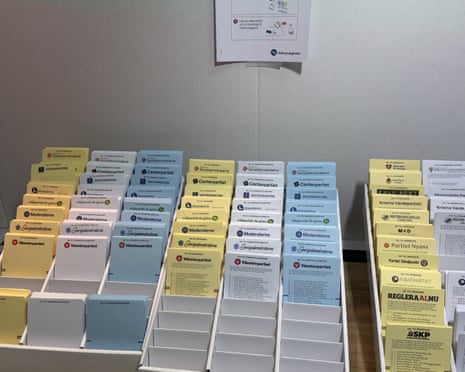
A view of election ballots in Stockholm ahead of Sweden’s general election. Photograph: Anadolu/Getty Images
Voters take pick ballots from a station with many available options. Yellow ballots are for the national parliament, Riksdag, white for the municipal assembly, and blue for the region assembly.
It’s complicated, so let me just point you towards the official guidance on how it’s meant to work:
Voters then take three ballot envelopes, stick their ballot inside, close them, and take it to a polling staff member who checks your name on the voters’ register, crosses you out, and then drops them into the ballot box.

Voters cast ballots in Sweden’s general election
Easy, right?
What is the Swedish electoral system and how it works in practice
There are 349 seats in the parliament, so theoretically it’s a race to 175 when it comes to securing a majority in the Riksdag. But it’s a bit more complicated than that.
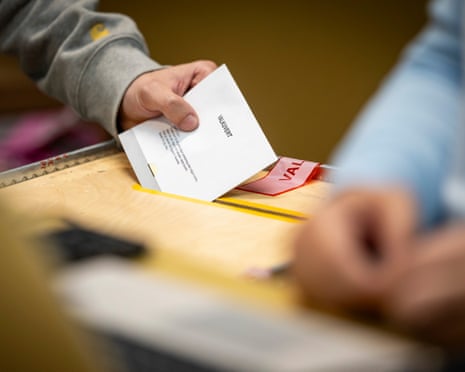
A person votes during Sweden’s general election at a polling station in Malmö, Sweden. Photograph: Johan Nilsson/EPA
It’s a proportional representation system, but to get in, you need to clear a 4% threshold – and that is particularly relevant for the Liberal party, which the current PM is likely to need to stay in power.
The party long polled well before the threshold, but surged in recent days, helped by their leader’s strong performances in TV debates and what is believed to be some tactical voting among the supporters of the “blue” bloc as they want to make sure they make it into the parliament.
We are expecting eight parties to be in the next parliament and this level of fragmentation can make government formation a bit tricky at times. But in theory they are divided in two blocks – blue and red – which are expected to come to some sort of agreement, if needed.
It’s also worth remembering that Sweden has a long history of minority governments.
“Sweden has a tradition of minority governments,” Aylott explains, with the concept of “negative parliamentarism.”
“If there’s a prime minister proposed, then if there is the absence of an absolute majority in parliament against the proposal, it’s interpreted as support. So a party that doesn’t really want to give full support to this proposed candidate - maybe because it’s not going to be part of the coalition, but which can just about live with it, and doesn’t have a better alternative – it can abstain from the vote, and that’s counted as passive support. This makes it much easier to form minority governments.”
Aylott continues:
“But it’s it’s worth remembering that nearly every, almost by definition, minority government eventually rests on a parliamentary majority, and these parliamentary majorities are usually not always, but usually fairly stable. This was the story of the last four years, with a minority government, but they had a very elaborate Tidö deal with the Sweden Democrats, which meant that there was a de facto majority in parliament. So, minority governments aren’t as fragile, usually at least, as they look.”
What you need to know to follow tonight's election
Jakub Krupa
Since you may not be ordinarily following the Swedish politics very closely, let me bring you up to speed on some of the key aspect of this year’s election.
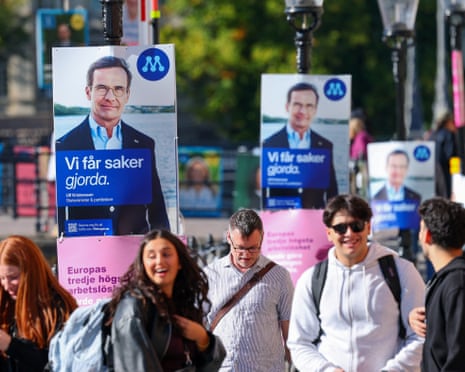
Posters featuring Swedish prime minister Ulf Kristersson of the Moderate Party is displayed near the Riksdag, Sweden's parliament. Photograph: Denis Balibouse/Reuters
Nicholas Aylott, senior lecturer at Södertörn University in Stockholm, joined me over coffee earlier to offer some commentary to help us make sense of it.
Key timings for tonight's race
The polls opened at 8am local time (7am UK) and will close 12 hours later, at 8pm local time (7pm UK).
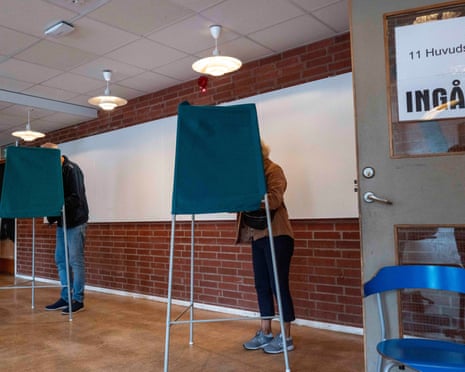
Voters take part in Sweden's general election in the Stockholm region on Sunday. Photograph: Joel Lindhe/ZUMA Press Wire/Shutterstock
And it is at 8pm local time when we should get the results of the Swedish public broadcaster SVT’s polling station survey, and a separate poll commissioned by private broadcaster TV4.
We should start getting first actual results not long after that and as the night goes on, we should be moving to on a firmer ground (he says hopefully).
For what it’s worth, SVT is hoping to release its “super forecast” with expected election result at some point after 9pm local time (8pm UK).
Don’t expect the party leaders to rush to stage for their victory speeches before we get a clear(er) sense of what is going on.
Understandably, we focus on the general election, but it’s worth noting that the local elections to regional and municipal councils are also held on the same day, and so voters get as many as three ballots in total.
Hej from Stockholm!
Jakub Krupa
in Stockholm
Hej, that’s hello in Swedish, from Stockholm, where I spent this morning eating Swedish pastry and meatballs talking to voters about the country’s prospects as they cast their votes in today’s parliamentary elections.
Here is what they told me, straight from Stockholm:
‘I hope for a decent period in politics’: views of voters as Sweden goes to the polls – video
Evening opening: Welcome to 2026 Swedish parliamentary election live blog
Jakub Krupa
in Stockholm
We kick off our coverage of the 2026 Swedish parliamentary election which could see the far right enter government for the first time if the country’s rightwing parties can form a majority – or a new centre-left government take control instead.
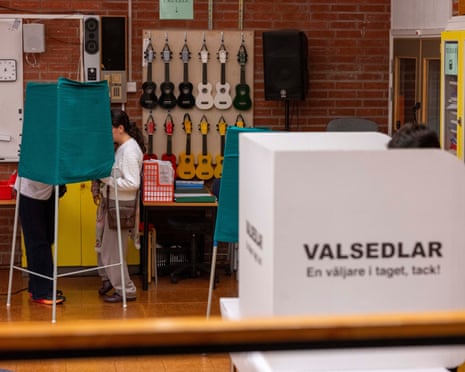
Voters take part in Sweden’s general election in the Stockholm region on Sunday. Photograph: Joel Lindhe/ZUMA Press Wire/Shutterstock
As our Nordic correspondent Miranda Bryant noted in her preview,
“In 2022, the current prime minister, Ulf Kristersson, the leader of the centre-right Moderates, broke a longstanding taboo to make a deal with the far-right Sweden Democrats (SD), so that his minority coalition could form a government. That agreement gave the SD outsized influence over government policy, especially on crime and immigration, and Kristersson has now gone further, promising ministerial posts for the SD if he is returned to power.”
The opposition “red” bloc is led by former prime minister Magdalena Andersson of the Social Democrats, but their lead has narrowed considerably in the final days of the campaign to less than one percentage point.
It could be a very, very close race.
The polls opened 8am local time and will close 8pm local time (7pm UK), when we should have two exit polls – conducted by Swedish broadcaster SVT and TV4 – for you.
A further projection will be published by public broadcaster SVT about an hour later, as we start getting actual results.
We could be in for a long night, but hope you will join us for lots of colour from Stockholm, the last hours of the campaign trail, and obviously the results.
Good evening.
Source note
First published by The Guardian World
This article was supplied by The Guardian World through its RSS feed and formatted for Crooli Signal. The reporting remains with the original publisher.
Read the original at The Guardian World
