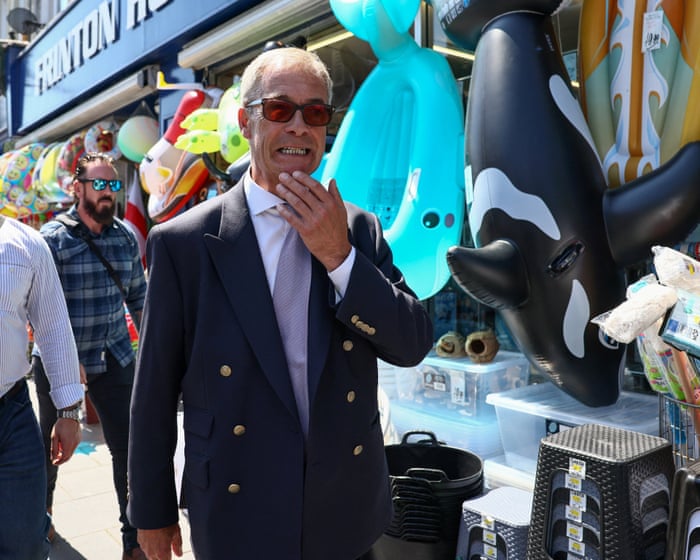
This time last year, Nigel Farage was making the political weather. His freewheeling weekly press conferences filled a sparse news agenda, setting out eye-catching policies on areas such as crime and immigration. This year? Less so.
The Reform UK leader is expected to hold a press conference in London next week. If so, it would be just his third since May’s local elections and the first in the capital in more than three months. The man who was everywhere now appears to be in hiding.
There is an obvious context. The UK has a new prime minister and Farage’s aides are clear it would be pointless to try to compete against the whirlwind of policies and attention from Andy Burnham’s first few weeks in office.
“Burnham was always going to get a lot of oxygen at this stage of the cycle,” one aide said. “Why would we waste key announcements?”
Farage’s party also disputes the idea that a lack of press conferences means he is invisible, pointing to occasional broadcast media rounds and a social media presence they say outstrips Burnham’s for views.
It is nonetheless clear that the Farage of summer 2026 is a less all-conquering political force than his equivalent 12 months ago. Repeated coverage of his and Reform’s finances, led by the Guardian’s revelation in April that he accepted an undeclared £5m gift from the crypto-billionaire Christopher Harborne, has made Farage less amenable to endless questions from journalists.
There is also next month’s byelection in his Clacton constituency, called by Farage in an attempt to rally local electors to his side, which turned into a somewhat quixotic solo quest after all the other main parties declined to stand.
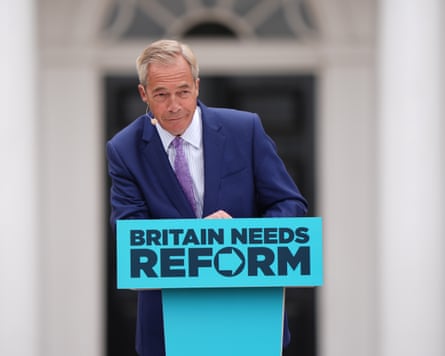
Reform says Nigel Farage, seen speaking at a rally in Norfolk recently, has not been totally invisible. Photograph: Joe Giddens/PA
Farage is not overburdened by electioneering chores. No one expects Count Binface, the most prominent of 33 novelty or fringe opponents also competing, to trouble the incumbent on 13 August.
But broadcasters are understood to be wary about featuring Farage due to strict rules about balance between candidates during an election, meaning his decision to seek re-election might have backfired in another way. Reform sources say he will be more visible again later in August.
The party has filled the gap in part with the likes of Zia Yusuf, the party’s combative home affairs spokesperson, and Robert Jenrick, the former Conservative ministerturned Treasury spokesperson for Reform.
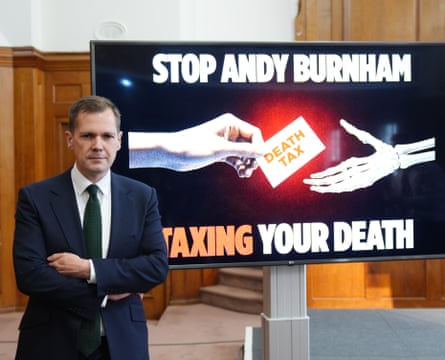
Robert Jenrick, the Reform UK Treasury spokesman, has filled the gap to challenge Burnham’s policies. Photograph: Ben Whitley/PA
Jenrick held a press conference on Thursday and “deployed his imagination”, as one observer put it, to set out a nightmarish vision of how Burnham would send tax inspectors to people’s deathbeds to finance his social care plans.
Farage insists Reform is not a one-man band, even if he has thus far only filled a handful of frontbench roles and there are still no spokespersons for key areas such as health or defence. Others, however, disagree with the Reform UK leader.
Robert Ford, professor of politics at the University of Manchester, said: “It’s always a net minus for Reform when the second stringers have to come out because the lead singer is unavailable. Nobody particularly likes the tunes when they’re sung by somebody else.”
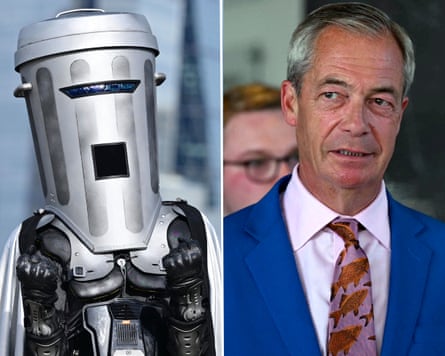
No one really expects Count Binface, left, to beat Farage in the Clacton byelection. Composite: Shutterstock/ AFP/Getty
And it is not only Burnham who is filling the Farage-sized gap. Kemi Badenoch has also held a series of press conferences, mimicking the Reform playbook by sometimes doing so without a particular policy to announce and taking questions from every journalist who turns up.
after newsletter promotion
Allies of the Conservative leader insist this is less a tribute act than a response to party research showing voters like Badenoch the more they see her, and also to give her a visible platform to respond to Burnham’s rush of policies, with her willingness to take more questions seen as a sign of growing confidence.
Whether all these variously changing political optics mean anything more significant or longer term is harder to gauge.
Much like the Greens, Reform was braced for a Burnham bounce, so while it will have been disappointing for the party to slip behind Labour in two polls this week after 300-plus consecutive surveys putting them in the lead, it is not a complete surprise.
But it does feel as if there are some deeper malaises at work. Farage’s love of the media had already soured somewhat even before the Harborne gift emerged. In December there were grumpy press conference appearances where he was quizzed about allegations of racism by school contemporaries, which he denies.
Ford argues that if there was a a positive feedback loop for Reform and Farage in 2025, with success bringing welcome attention and thus more success, this year the process appears to have reversed.
He said: “Last summer really was the halcyon days for them. They’d had the amazing local election results. They’d overtaken Labour and the Tories in the polls. That then generated bursts of new media attention.
“I said at the time it may have come too early – there was no way even the supportive press were going to write stories about Farage potentially being the next PM for three years. They were going to go somewhere else, and one of the obvious places was his finances.”
Does this matter, when Reform is still at or near the front of most polls? Ford points to another statistic: Farage’s falling personal approval ratings.
“It has sunk quite a lot this year, including the share who strongly disapprove of him. This is quite a significant number in terms of tactical voting. You’re more motivated to tactically coordinate to keep out somebody you strongly dislike than someone you mildly dislike,” Ford said.
Source note
First published by The Guardian UK
This article was supplied by The Guardian UK through its RSS feed and formatted for Crooli Signal. The reporting remains with the original publisher.
Read the original at The Guardian UK