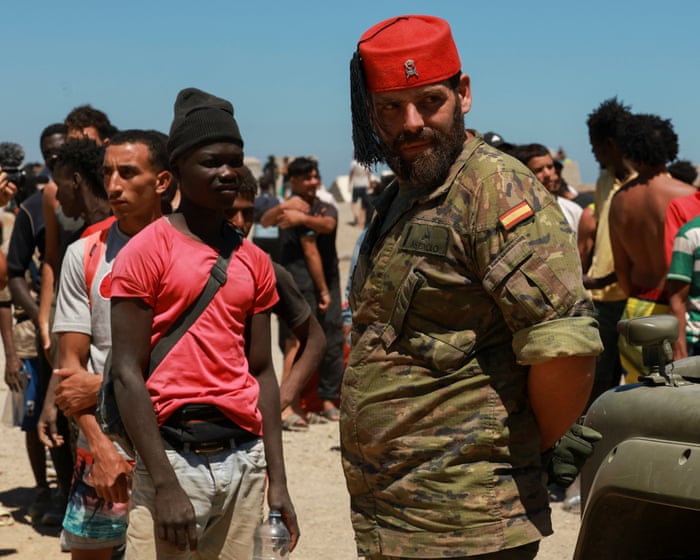
For the European hard right and the White House, it seemed almost too good to be true: left-liberal Spain punished with a migration crisis of its own making.
The histrionics came right on cue. As thousands of mainly Moroccan citizens streamed into the tiny Spanish enclave of Ceuta at the tip of north Africa, Spain’s far-right party Vox decried a migrant “invasion”, blaming Spanish prime minister Pedro Sánchez’s regularisation and leftist politics. The Trump administration did the same. A senior Israeli diplomat goaded Madrid over its “colonial” territories while Italy’s prime minister, Giorgia Meloni, called for Spain to be suspended from the Schengen area. Denmark and Finland backed Italy’s move and, by the weekend, 22 EU leaders had penned a letter pointing an implicit finger at Madrid over its presumed failure to “relentlessly combat illegal migration”.
But what these self-ascribed doyens of border control don’t want to understand is that it’s their panic and politicking over migration that has brought us here.
Ceuta is hardly a poster-child for Spain’s otherwise liberal migration policy. Rather, since the 1990s it has been the prototype for Europe’s relentless border security battle. Drones, heat detectors, motion sensors, digital watchtowers, Moroccan Auxiliary Forces: Ceuta’s border is so thoroughly militarised that it puts even Trump’s barrier-building – let alone that of Greece, Poland or Finland – to shame.
The paradox, as civil guards told me when I last visited in 2023, was that this militarisation had involved ceding control. “Rabat knows it can destabilise Spain with migration,” one chief said, as he reflected on the mass entry of Moroccans in 2021, after Madrid had angered its partner by taking in Brahim Ghali, the leader of Western Sahara’s Polisario movement, for urgent healthcare. The heavily guarded fences have become a perfect foil for staging a migration crisis.
While Morocco is usually tight-lipped about its intentions, at times its ministers have bluntly said it won’t play the “gendarme” of Europe unless its partners support its economic and political aims. The quiet at the border since 2021 had little to do with the aggressive security hardware, and everything to do with Madrid’s 2022 endorsement of Rabat’s plan for occupied Western Sahara. So why the latest crisis? While the facts and motives are still being established, it’s unlikely to be a coincidence that, only recently, Sánchez announced a “new phase” in relations with Algeria – Rabat’s arch-rival and supporter of Polisario.
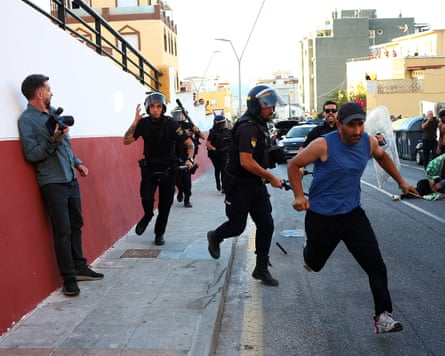
A man attempting to escape the police, Ceuta, 2 August 2026. Photograph: Pedro Nunes/Reuters
Sánchez blames the mass entry on people smugglers and misinformation about a recent Spanish supreme court ruling that prevents authorities from summarily expelling migrants who attempt to swim by sea to Spain’s territories in Africa. Yet blaming criminal organisations makes little sense: most of those who made it across were quietly returned within the day – unthinkable, if they had lost their life savings to pay smugglers. The official line from Morocco’s government is that the surge was due to “criminal organisations” and that cooperation with Spain is still “exemplary”. The social media rumour mill did mobilise people to cross; but crucially – according to Spanish intelligence – Moroccan law enforcement stopped controlling the border while its intelligence services failed to notify Spain about the online campaigns. Video clips and accounts from border crossers in numerous media outlets further suggest that law enforcement actively encouraged people to cross.
It’s clear to anyone who knows the Ceuta border that nothing dramatic happens there without the Moroccan authorities letting it happen. Yet Spain is unable to call out Morocco as it desperately depends on it. Instead, both Madrid and Brussels showered Rabat with praise this past week. This is the corner the EU has painted itself into: dependent on repressive and undemocratic regimes that use migration threats for their own purposes.
This has been a favoured tactic for years across the external EU borders, from Muammar Gaddafi’s threats to Ankara’s antics. And it’s all the more attractive to them thanks to the European obsession about unwanted migration – the higher the stakes, the bigger the rewards.
The geopolitics are looking unfavourable to the EU. Since the Abraham accords were signed in 2020, Morocco has strengthened its hand internationally through close alliances with the Trump and Netanyahu administrations. And those two governments see Spain as their arch-foe in Europe. This January, Rabat deepened its military cooperation with Israel. In April, a US House of Representatives committee stated that Ceuta and another Spanish enclave of Melilla were “in Moroccan territory”. Israeli and Republican figures have made increasingly frequent noises of this kind. Recently, Morocco named a highway through Western Sahara after Trump.
after newsletter promotion
What all this points to is not necessarily some grand conspiracy. Rabat may well have sought to benefit opportunistically and then lost control of events. But it does suggest that what occurred in Ceuta was a geopolitical game with people as its pawns, leaving more than 70 dead.
European leaders have become so obsessed with “security” that they can’t see their own best interests clearly. Notably, one of the governments waving the threat of Schengen suspension was Denmark, which should know something about geopolitical blackmail against Europe. Coercive migration pressure, evidence shows, works best when destination regions are politically divided and prone to slanging matches. This is exactly what the far right and government leaders are now indulging as they nervously blame Spain and raise the spectre of another 2015 migration crisis.
Having shown their hand to “partner” states and unfriendly regimes alike, these leaders will know exactly which button to push for maximum impact. Through their reaction, EU politicians are not only undermining European solidarity – they are actively encouraging more crisis-generation, while abetting the anti-European forces in the White House and further afield.
We need a different kind of migration politics that de-escalates panic instead of inviting it, that prioritises frank diplomacy over one-eyed “combat”, and that weakens the hand of hardmen and smugglers. European leaders could make a start on shifting this dynamic by not turning themselves into useful idiots at the first opportunity.
Ruben Andersson is professor of social anthropology at the University of Oxford and author of Age of Security: The Rise of a Global Obsession (William Collins) out 13th August
- Do you have an opinion on the issues raised in this article? If you would like to submit a response of up to 300 words by email to be considered for publication in our letters section, please click here.
Source note
First published by The Guardian US
This article was supplied by The Guardian US through its RSS feed and formatted for Crooli Signal. The reporting remains with the original publisher.
Read the original at The Guardian US

