Almost three-quarters of England is now in drought, as much of Europe braces for its fifth climate crisis-driven heatwave this summer.
Four more regions of England have officially been declared to be in drought: the East Midlands, Lincolnshire and Northamptonshire, Kent and East Sussex, and Solent and the South Downs.
They join seven regions already under drought status since last month: East Anglia, Hertfordshire and London, Thames Valley, Hampshire and the Isle of Wight, Devon and Cornwall, the West Midlands, and Wessex (covering Dorset, Somerset, Wiltshire and south Gloucestershire).
Farmers have reported their earliest harvests in 20 years, with reduced yields, while reservoir levels have fallen to 69% – 11.6% lower than expected for this time of year.
Yorkshire and the North East have joined Cumbria and Lancashire and Greater Manchester, Merseyside and Cheshire in prolonged dry weather status – the stage before drought – meaning nowhere in England is deemed to be in normal status.
This flash drought, which developed quickly because of very low rainfall and higher temperatures, means 27 million people have restrictions on their water use.
Prof Liz Bentley, chief executive of the Royal Meteorological Society, said it was a “stark reminder that climate change isn’t just about rising temperatures – it’s making droughts develop faster and hit harder.
“With three droughts in the past five years, we’re seeing the growing influence of a changing climate. We need to adapt to more frequent periods of extreme heat and drought while taking action to reduce the emissions driving these changes.”
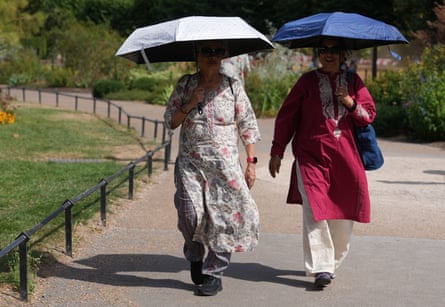
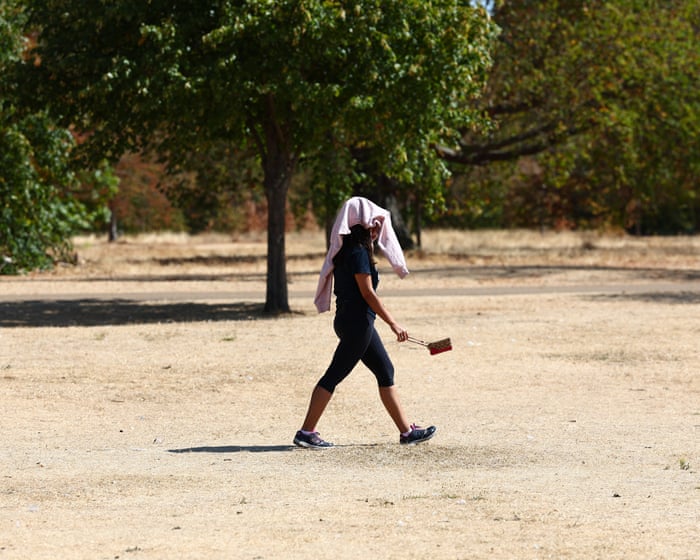
People using umbrellas as parasols in Hyde Park, London. Photograph: Maja Smiejkowska/PA
Southern Water has applied for two drought orders. The first is to maintain normal abstraction rates from the River Test even during low river flows and the second is for a non-essential use ban. These are both under consideration by the government. South East Water said last week supplies in its area were “critically low” and warned customers they might lose supply unless demand for water in the area dropped.
The drought announcement comes as England braces for its fifth heatwave of the summer, with temperatures possibly exceeding 36C in some places. This year has so far seen 34 days where temperatures have reached 30C or above somewhere in England, including 13 consecutive days in July.
Rivers, reservoirs and groundwaters are also continuing to decline, with 22% of rivers now classed as exceptionally low.
Glenn Watts, director of water science at the UK Centre for Ecology & Hydrology, said river flows across England and Wales were approaching or worse than previous records set in 1976.
The record temperatures and extremely dry weather are having wide-ranging impacts: 245 wildfires have been recorded on the country’s most protected sites this year alone and the government said important wetland and sensitive peatland habitats were drying out.
after newsletter promotion
Paul Tompkins, the deputy president of the National Farmers’ Union, said that with no meaningful rain forecast in the coming weeks, the situation for farmers was increasingly concerning.
“Many farmers have completed the earliest harvest on record, with poor yields in key crops reported in some areas of the country. Livestock and dairy farmers are already using winter feed because grass has stopped growing, while growers are working hard to keep fruit and vegetables watered, but many are struggling to access the water they need,” he said.
The government said it was considering ways to give more support to the farming sector. The water minister, Emma Hardy, said this would include making it easier to build on-farm reservoirs.
River temperatures are rising, reaching 28C on the River Misbourne, a chalk stream in Buckinghamshire, 27C on the Hampshire Avon and 27C on the River Trent – around 2C higher than to be expected.
England is on track to record its highest number of heat-related deaths this summer, after the UK Health Security Agency announced that an estimated 2,877 people died in the May and June heatwaves.
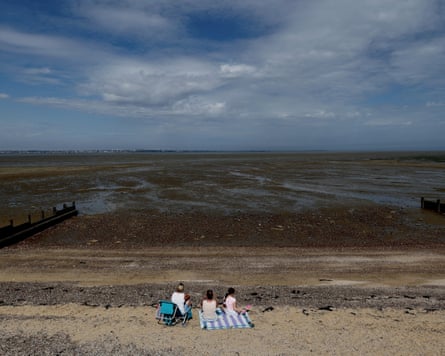
People sit on a beach at Allhallows on the Thames estuary as a yellow heat-health alert remains in force. Photograph: Kevin Coombs/Reuters
The UKHSA has updated heat health alerts for nine regions in England, warning that rising temperatures this week may increase health risks, particularly for vulnerable groups.
The National Drought Group, whose members include the government, water companies, the National Farmers’ Union, the Met Office and conservation experts, met on Monday to assess the situation across England.
Many other parts of Europe are also bracing for another heatwave. The French national weather agency said on Monday that temperatures in the south-east could reach 35C, spreading further across the country, while Italy and coastal Croatia are already experiencing extreme heat. Countries including Slovakia, Austria and Hungary have registered record temperatures in recent days.
Additional reporting by Andrew Gregory
Source note
First published by The Guardian UK
This article was supplied by The Guardian UK through its RSS feed and formatted for Crooli Signal. The reporting remains with the original publisher.
Read the original at The Guardian UK