Respect my authoritah
Congress set ownership limit at 39%, but FCC claims authority to kill the rule.
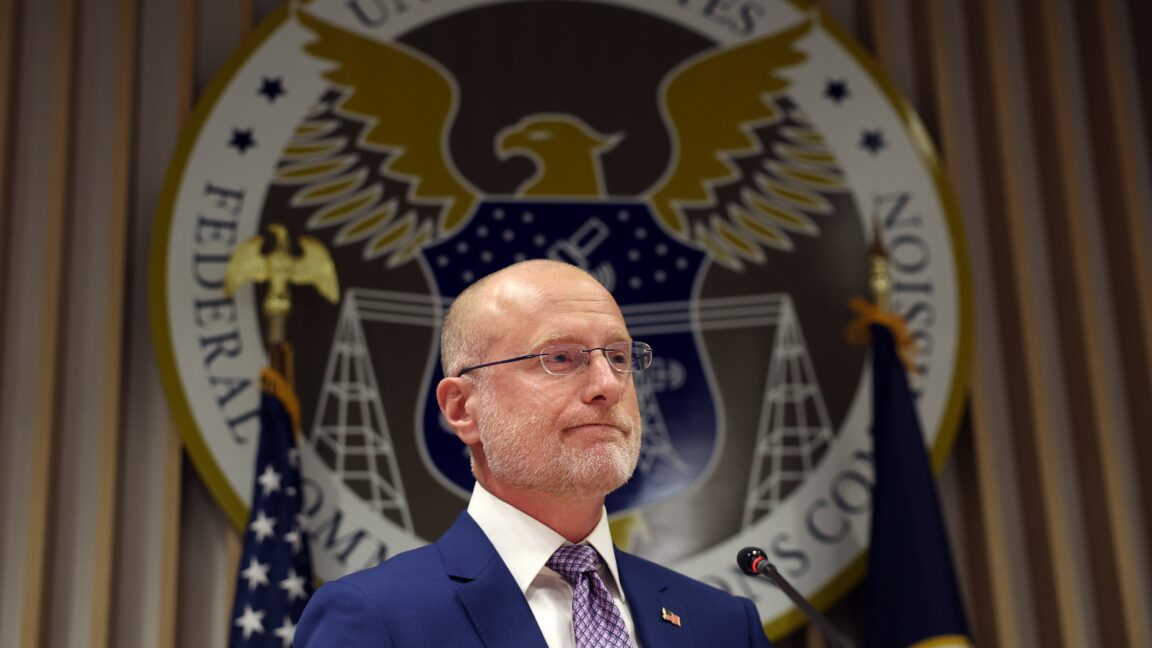
FCC Chairman Brendan Carr speaks at a news conference following an FCC meeting on February 18, 2026 in Washington, DC. Credit: Getty Images | Kevin Dietsch
Tom DeLay, the Texas Republican who was House majority leader from 2003 to 2005, said the Federal Communications Commission has no legal authority to repeal the National Television Ownership Rule. Despite DeLay’s warning, the Trump FCC appears ready to eliminate the rule at its meeting this week.
DeLay wrote an op-ed describing how he helped write the law that prohibited any single broadcast station owner from reaching more than 39 percent of all TV households in the US. DeLay said that only Congress, not the Trump FCC, can change the cap because the 39 percent limit is specified in US law and wasn’t chosen by the commission.
DeLay gave his view in an op-ed for The Daily Wire yesterday, less than three weeks after FCC Chairman Brendan Carr announced a plan to eliminate the cap. The FCC is scheduled to vote on Carr’s proposal on Thursday.
“I am a Republican,” DeLay wrote. “I support deregulation and the Trump administration. But my ultimate loyalty rests with the Constitution, which gives certain prerogatives to Congress. Regulatory agencies cannot defy or modify laws enacted by Congress. If Chairman Carr wants to raise the statutory cap, he should ask Congress to pass a law giving him authority to do that.”
DeLay left his post as majority leader in September 2005 and resigned from Congress in 2006 after being indicted on money laundering and conspiracy charges stemming from a campaign finance scheme. He was convicted by a jury in 2010, but the conviction was overturned by a Texas appeals court in 2013.
Carr would be first to test whether FCC can kill cap
The TV ownership cap was originally implemented by the FCC and changed several times before Congress directed the FCC to set it at its current level of 39 percent. The FCC first used its authority to implement a 25 percent nationwide audience reach cap in 1985. In the Telecommunications Act of 1996, Congress directed the FCC to amend its rules to increase the cap to 35 percent.
Congress acted again after the FCC decided in 2003 to raise the limit from 35 percent to 45 percent. The FCC’s 2003 change was controversial, and Congress overrode the FCC decision in January 2004 with a provision inserted into the Consolidated Appropriations Act of 2004.
Specifically, Congress amended the Telecommunications Act to require the FCC to enforce a cap of 39 percent. The law change also said the FCC cannot repeal or modify the cap during its quadrennial reviews of media rules.
Both Democratic and Republican FCC leaders have asserted authority to change the cap. Under Democratic Chairman Tom Wheeler, the Obama-era FCC concluded in 2016 that “the Commission has the authority to modify the national audience reach cap” as long as it doesn’t do so during the quadrennial review. The Wheeler FCC ended up repealing a rule related to the cap, but that decision was reversed by the FCC the next year, during the first Trump administration.
The 39 percent cap has thus survived for over two decades, but Carr scheduled an FCC vote to repeal the 39 percent limit and replace it with a “case-by-case review” of each proposed merger. This would make it easier for the FCC to pick and choose which station groups get to expand, potentially helping Carr achieve his goal of securing more positive news coverage for President Trump.
Carr already seems to be using the case-by-case approach even though his FCC hasn’t formally adopted it yet. In March, the FCC granted a waiver letting Nexstar Media Group buy Tegna in a deal that let it reach over half of TV households.
The Wheeler FCC issued similar legal conclusions about the FCC’s authority to change the cap, but that doesn’t necessarily mean Carr would beat challenges in court. Carr would be the first FCC chairman to test whether the agency can eliminate the cap entirely. He may have to show that the FCC has explicit authority to remove the cap in light of a 2024 Supreme Court ruling that sharply narrowed the leeway federal agencies are given to interpret ambiguous laws.
DeLay explains how Congress decided on 39% cap
Courts reviewing whether an agency decision is lawful often try to determine what members of Congress intended when they passed a law, particularly when the law is vague. According to DeLay, the intent of Congress was clear when it mandated the 39 percent cap.
Although Republicans controlled the House, Senate, and White House in 2003, “Congress was at an impasse” over a budget bill because of a proposal by Sen. Ted Stevens (R-Alaska), DeLay wrote. Stevens “was an ally of the broadcast affiliates,” and he proposed “to codify in law the Federal Communications Commission’s rule that no broadcast group could reach more than 35 percent of American households,” DeLay wrote.
DeLay supported the Bush-era FCC’s deregulatory agenda and refused to back any budget bill that contained the Stevens proposal. DeLay said this week that he also worried about the potential impact on then-recent media mergers. After the FCC raised the cap to 45 percent, “CBS and Fox had acquired stations that had them reaching nearly 39 percent of the nation’s households,” DeLay wrote.
DeLay said he didn’t want to require those networks to divest stations they had lawfully purchased, and he made a compromise with Stevens to pass the budget bill and keep funding the federal government. “In the end, Stevens and I agreed to legislation that set the cap at 39 percent and prohibited the FCC from changing the cap in its biennial review of media ownership rules. The FCC was not allowed to waive the requirement, except to help companies come into compliance,” DeLay wrote.
The budget bill changed the FCC’s biennial reviews to quadrennial and said the FCC authority to repeal or change regulations during its quadrennial reviews does not apply to the 39 percent TV ownership cap. During each quadrennial review, “The Commission shall repeal or modify any regulation it determines to be no longer in the public interest,” the US law says. “This subsection does not apply to any rules relating to the 39 percent national audience reach limitation in subsection (c)(1)(B).”
DeLay said he has “sympathy for Carr’s objectives” and would have preferred to give the FCC more authority over the cap during negotiations with Stevens.
“In fact, I would have happily given the FCC authority to review the cap in 2004, but Stevens would never have gone along with that,” DeLay wrote. “It was his intention to rein in the FCC. My end of the deal was that the cap would be raised to 39 percent, and in return, Stevens received certainty that the FCC wouldn’t and couldn’t raise it higher.”
Stevens died in 2010. “If you had told me in 2004 that I would one day find myself defending Stevens’s side of the argument, I would have found it ironic,” DeLay wrote. “But I was in the room when the deal was struck, and today, I feel compelled to uphold my end of the bargain after Ted’s passing.”
Ex-FCC Republican also said FCC can’t change cap
DeLay quoted former FCC Commissioner Mike O’Rielly, a Republican, as saying that the 39 percent cap is “a statute, not a suggestion.” O’Rielly opposed changing the cap during both Democratic and Republican administrations. He said at a December 2017 FCC meeting, “I do not believe that the Commission has the authority to modify the national audience reach cap… it is up to Congress to make that determination, not the commission. This was the clear intent of Congress when it partially rolled back the FCC’s proposed cap increase of 45 percent in 2004.”
When O’Rielly said that, the FCC under Republican Chairman Ajit Pai was voting to begin a review of the cap and the UHF discount, a provision specifying that only half of the households reached by a UHF station are counted toward the cap. O’Rielly said the FCC had no authority to change the 39 percent cap or to eliminate the UHF discount.
The UHF discount was eliminated just a year earlier by the Wheeler FCC, with dissents from Pai and O’Rielly. After Pai became chairman, he led a vote to reverse Wheeler’s UHF decision but also called for a review of the 39 percent cap and the UHF discount. After all that wrangling, the Pai FCC left both provisions in place.
Eliminating the UHF discount would have effectively made the national TV ownership rule stricter. The Wheeler FCC argued that the transition to digital television eliminated UHF’s technical disadvantage and that maintaining the carveout acted “only to undermine the national audience reach cap.” With the discount in place, a company that only owns UHF stations would be able to reach 78 percent of US households, the Wheeler FCC said.
Carr’s legal arguments
The Carr FCC makes several arguments to support its claim that Congress didn’t intend to forbid the FCC from changing or repealing the cap. A draft of the FCC proposal scheduled for a vote this week claims the FCC has the authority to repeal the cap because Congress imposed the 39 percent limit “by directing the Commission to modify its rules rather than by enacting a fixed cap into law.” The 2004 law change has no language requiring the FCC “to maintain the national cap at 39 percent indefinitely or for any period of time,” Carr’s proposal said.
The Carr FCC said multiple court rulings show Congress always intended the FCC to have power over the cap. The FCC pointed to a 2002 DC Circuit appeals court decision in which judges wrote that Congress’s 1996 “choice of 35 percent rather than any other number determined only the starting point from which the Commission was to assess the need for further change.”
But while the 1996 Telecommunications Act did not explicitly prohibit future changes to the cap, the 2004 law shaped by the DeLay/Stevens compromise went further. It ordered the FCC to set the cap at a specific level and added language restricting the FCC’s ability to change the cap.
As DeLay noted, the law forbids the FCC from changing the cap during its quadrennial media review. But the Carr proposal claims the FCC can change the cap at any other time. The law “simply separates the Commission’s decisions to review the national cap from the statutorily mandated review of other media ownership rules that are to occur every four years,” the Carr FCC says.
To support this view, Carr quotes a sentence from a 2004 3rd Circuit appeals court ruling in which judges said the FCC can issue rule changes “outside the context of” the quadrennial review. One problem for Carr is that the quoted portion of the court ruling refers to “defining the UHF discount,” not to setting the cap at 39 percent or some other number.
But Carr found backing in the Wheeler FCC’s 2016 order, which said the FCC “retains authority under the Communications Act to review any aspect of the national audience reach cap; it simply is not required to do so as part of the quadrennial review.” Although the Wheeler FCC was trying to strengthen the 39 percent cap by eliminating the exception for UHF stations, it argued that “no statute bars the Commission from revisiting the cap or the UHF discount,” indicating it had power to change both if it wished.
Another potential problem for Carr is that Congress’s 2004 law change said the FCC cannot forbear from applying telecom regulations to TV station owners that exceed the 39 percent limit. This limiting language did not appear in the 1996 law.
Carr’s proposal claims the forbearance language “does not preclude the Commission from altering the cap itself” and that the FCC’s “ability to forbear from enforcement of its rules is distinct from its power to alter or eliminate those rules.” The Carr proposal also said Congress’s instruction about regulatory forbearance was unclear because the FCC’s “forbearance authority does not apply to the regulation of broadcasters under Title III of the Communications Act.”
TV providers “confident” courts will overrule FCC
In March, the Carr FCC used the same arguments when it granted the waiver letting Nexstar Media Group buy Tegna. It claimed it could issue a waiver even though the 39 percent cap was still in place, saying Congress instructed it to set that cap “through its rulemaking authority, which necessarily leaves the agency with the discretion to modify or waive its rules.”
Nexstar completed its acquisition of Tegna, but a federal judge ordered the companies to stop integrating their assets and operations. The post-merger integration remains on hold while an antitrust lawsuit filed by DirecTV proceeds.
The repeal plan is likely to pass 2–1 this week, with Carr and Republican Commissioner Olivia Trusty supporting it. Anna Gomez, the only Democrat on the FCC, has repeatedly said the FCC has no authority to abolish the cap. “The 39 percent cap is not an FCC rule that the commission can change on its own,” and repealing it is an “unlawful effort to hand control of the public airwaves to billionaire buddies of this administration,” Gomez said last month.
A legal challenge could come from TV providers that have complained about the ability of national TV networks and broadcasters to demand higher fees to carry their channels. The American Television Alliance—a group whose members include CenturyLink, Charter, Dish, DirecTV, Verizon, and USTelecom—said after Carr unveiled his plan that “the commission’s attempt to repeal the broadcast ownership cap ignores Congress’s clear instructions… We are confident that reviewing courts will quickly overturn this misguided action.”
Jon is a Senior IT Reporter for Ars Technica. He covers the telecom industry, Federal Communications Commission rulemakings, broadband consumer affairs, court cases, and government regulation of the tech industry.
62 Comments
Source note
First published by Ars Technica
This article was supplied by Ars Technica through its RSS feed and formatted for Crooli Signal. The reporting remains with the original publisher.
Read the original at Ars Technica