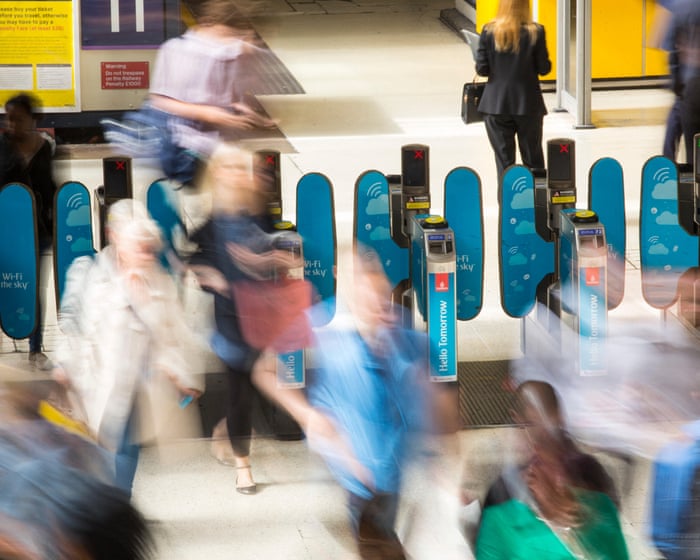
There is more than one way to commit fraud and, for some rail travellers, it has been as simple as a couple of taps on their phone as their train approaches its destination.
That telltale last-minute purchase of a digital ticket – for the shortest journey that will allow them to bleep through the gates, regardless of how far they have travelled – is one of a number of illegal wheezes that train operators are trying to eliminate, with the enthusiastic backing of the government department that will directly oversee most of England’s rail services when they are renationalised next year.
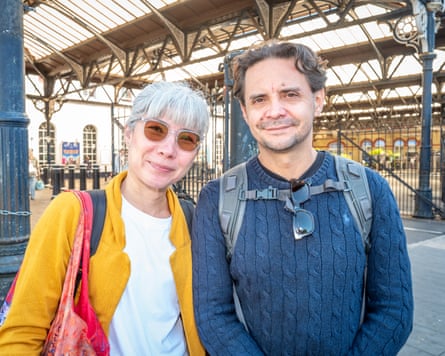
Deanna Smith (left) said fare dodging was ‘just like tax dodging – we all fall victim to their behaviour’. Pictured with Daniel Pizarro. Photograph: Andrew Hasson/The Guardian
Two rail companies, South Western Railway (SWR) and GTR, which operates Thameslink, Southern and other services, this week introduced measures to clamp down on “short-faring” – a trick by which passengers buy a last-minute digital ticket only for the final part of their journey, even if they boarded in a station without barriers much further away.
Don’t bother trying to download a digital ticket from Vauxhall to Waterloo, the terminus for many trains to London from the west – or on a number of other routes, apparently including from Norwood Junction to London Bridge, where many services from the south coast hit the capital. For those and some other routes, you will now need to collect a physical ticket from a physical ticket machine, after operators found that up to 95% of tickets on some short routes were being used fraudulently.
Fare evasion on Britain’s railways did not begin with digitisation – you don’t need a QR code to vault a barrier or hide in the toilet from a ticket inspector. But the increasing reliance on digital ticketing has widened some of the loopholes for those minded to cheat – and added to an ever-growing problem for train companies.
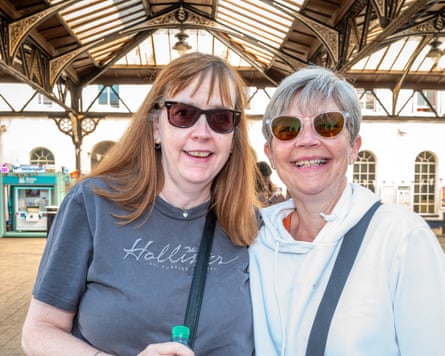
Katie Bell and Nicola Garrett. Garrett said she was annoyed by fare dodging. Photograph: Andrew Hasson/The Guardian
Up to £400m is lost to fraud each year on the rail network, according to the Department for Transport, through high-tech and decidedly low-tech methods. As well as short-faring, operators point to “quick scanning” (buying a ticket on your phone seconds before being approached by an inspector), “tailgating” (squeezing behind a paying customer as they pass through a ticket gate) and “donutting”, a scam by which a passenger buys a cheap ticket covering the first part of their journey and another covering the last, but avoids paying the higher cost of the full trip. A former senior executive at HSBC, Joseph Molloy, received a suspended sentence earlier this year for using this technique 740 times to commute between Orpington in Kent and London Bridge, saving him £5,911 over 11 months.
“It’s quite a big problem, because we’re coming to terms with a completely different form of ticketing,” said the railway commentator and author Christian Wolmar. “No longer do you go to the ticket office and buy little red and yellow cards. You now buy online, and that affords these new opportunities. The system is clearly open to abuse.”
Though a push to reduce staff numbers has been a factor, he says, “how you tackle this is very difficult because you can’t have guards at every stop. It’s through digital analysis that they are going to find a solution to this.”
The government appears to agree, widening the introduction earlier this month of an app that calculates ticket fares by tracking the user’s phone. While currently being trialled on a number of routes in the East Midlands and Yorkshire, the technology could eventually be brought in across Great British Railways, the public body that will take over the running of the soon-to-be renationalised network, expected to be up and running next year.
“Fare evasion is illegal and selfish – it actively makes journeys worse for all rail passengers by diverting money that could otherwise be used to improve services,” said the transport secretary, Heidi Alexander. “We are committed to tackling ticket cheats, and that’s one of the expected benefits of expanding our digital ticketing app to more people across the trial areas.”
Her department has also recently given £33m for new or enhanced ticket gates at “fare dodger hotspots” across England, and has closed a loophole that allowed some passengers to dishonestly claim a refund even though they had used a service.
SWR said its introduction of new anti-fraud measures came after one intervention at Brighton station found that half of those travelling on the wrong ticket were using the short-faring scam.
To passengers disembarking at the station on Friday morning, a clampdown on cheats was very welcome. “Obviously fares go up anyway because of inflation, but they are probably pushing up our fares as well, so we all suffer,” said Deanna Smith, who had travelled on Thameslink with her partner to visit a coffee festival. “It’s just like tax dodging – we all fall victim to their behaviour.”
Nicola Garrett, who was on a day trip to Brighton with a friend from her home town of Leigh-on-Sea, said: “I’m someone who has always paid for everything, so I get a bit pissed off [by fare dodging]. Nobody seems to think that they have to pay for anything these days. It’s just like, if you can get away with doing it, why wouldn’t you?”
Source note
First published by The Guardian Business
This article was supplied by The Guardian Business through its RSS feed and formatted for Crooli Signal. The reporting remains with the original publisher.
Read the original at The Guardian Business