Donald Trump has said he cancelled planned military strikes against Iran on the basis of “rapidly” reaching a deal on its nuclear programme and the full reopening of the strait of Hormuz.
The US president paused the strikes in expectation of a breakthrough and in response to requests from Iran and other countries in the region, he claimed on his Truth Social platform on Saturday.
“Based on this request, I have agreed, for the future benefit of the WORLD and, likewise, the survival of a successful and prosperous Iran, to cancel the attack, subject to being able to rapidly make a DEAL.”
The deal would include the immediate and complete reopening of the strait and “an end to Iran’s nuclear threat”, he posted. It marked the latest climbdown from extravagant threats to pound the Islamic Republic in the months-long conflict.
However, hopes of a breakthrough faded on Sunday when Iran’s Mehr news agency said Trump’s claim that Tehran had requested a pause “was nothing but a new lie” and that the Iranian armed forces were “on high alert and ready for any eventuality”.
Another Iranian news agency, Fars, citing a source close to Iranian negotiators, said that as long as the US “maintains its hostile actions” the strait would remain closed.
Iran’s acting defence minister, Majid Ebn-e-Reza, said Trump had backed down “within the context of psychological operations and a war of calculations”. Iran’s forces would remain on alert, the minister said on X. “We will neither be taken by surprise nor will we be passive.”
Mediation efforts were continuing amid the standoff. Hassan Ghashghavi, a spokesperson for the Iranian parliament’s national security commission, said in a video interview that mediators were trying to revive an agreement brokered by Pakistan in June, Agence France-Presse reported.
The decision to halt fresh strikes came after the Saudi crown prince, Mohammed bin Salman, called Trump on Saturday to express concerns, it was reported. Trump’s reversal also followed Iranian threats to retaliate decisively against its neighbours in the event of US strikes, while Kuwait reported being hit by Iranian drones on Saturday and two ships were attacked off Oman in the strait of Hormuz.
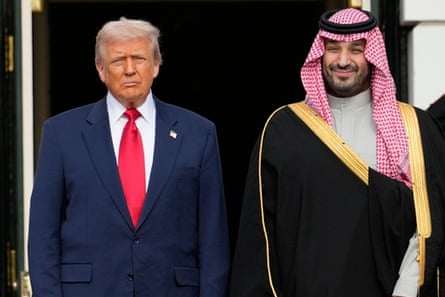
Saudi Arabia’s crown prince, Mohammed bin Salman (right), called Trump on Saturday to express concerns about strikes on Iran. Photograph: Mark Schiefelbein/AP
One source described as having knowledge of the Trump-Prince Mohammed call told Axios that the Saudi crown prince had “urged Trump to de-escalate and refrain from launching the strikes”.
The Associated Press (AP) also reported the conversation, citing its own source. It said the Saudis were concerned that if the US targeted Iran’s energy infrastructure or carried out massive strikes on other key infrastructure, Tehran could respond by carrying out similar attacks on the kingdom and other Gulf countries.
The crown prince during Saturday’s call sought clarity from Trump on what potential new action he was weighing to take against Iran, AP reported.
A White House official, who was not authorised to comment publicly and requested anonymity, confirmed to AP that Trump and Prince Mohammed spoke on Saturday, but did not offer any detail about the substance of their conversation.
Saudi Arabia earlier this week joined the US in striking logistics and weapons sites used by Iranian-backed militias in Iraq, but has been urging the US and Iran to return to the negotiating table.
CBS News reported that the US and Israel were planning joint strikes, possibly throughout the weekend, with oil refineries and power plants among possible targets.
Tehran warned this weekend against any “adventurous action” by the US and said it would retaliate decisively. The comments by Iran’s foreign minister, Abbas Araghchi, in separate phone calls on Saturday with senior Turkish, Pakistani and Saudi officials came just hours after Kuwait’s army said it had destroyed hostile drones launched by Iran against several vital facilities.
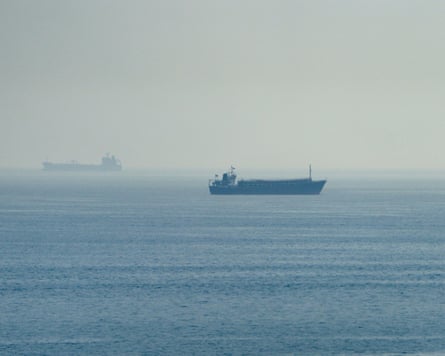
Vessels in the strait of Hormuz, as seen from Musandam, Oman, on Friday. Photograph: Reuters
A government facility in northern Kuwait and civilian property belonging to a company on Bubiyan Island were hit, with falling shrapnel causing material damage but no casualties, the Kuwaiti army said.
Araghchi told regional counterparts that any attacks by the US and Israel or participation by regional countries in such actions would be met with a “proportionate response”. Nournews, a media outlet affiliated with Iran’s top security body, said on Saturday that US attacks on Iranian energy infrastructure would prompt Iranian strikes on oilfields in Saudi Arabia and the United Arab Emirates, as well as the gasfields of Qatar and Israel.
The developments appeared to have given Trump pause for thought, as he posted on Saturday night in characteristically grandiose language that “the USA is locked and loaded” to strike Iran with “military terror, strength, and power not seen since World War II”.
Reuters, Agence France-Presse and Associated Press contributed to this report
Source note
First published by The Guardian World
This article was supplied by The Guardian World through its RSS feed and formatted for Crooli Signal. The reporting remains with the original publisher.
Read the original at The Guardian World