Donald Trump has declared a breakthrough in negotiations over the disarmament of Hamas in Gaza and the withdrawal of Israeli forces, issues that have so far stalled implementation of last October’s ceasefire, but Israel has yet to respond officially to the plan and government officials have voiced scepticism over the deal.
Announcing the agreement in a social media post on Thursday night, Trump said it involved the “complete disarmament” of Hamas and other armed groups in Gaza and was “a monumental step toward ending the fighting”.
Israel has pointed to Hamas’s failure to disarm as justification for its continued strikes and refusal to allow any reconstruction in Gaza, and for Israeli forces’ steady edging forward from the demarcation line agreed in October.
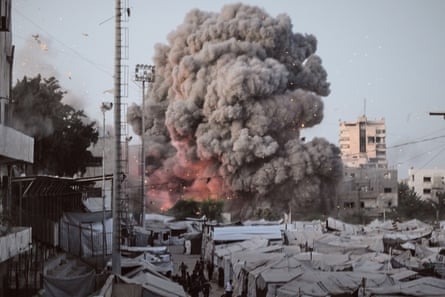
Smoke rises after an Israeli military strike in Gaza. Until now, the Israeli military has continued to expand its military occupation. Photograph: Jehad Alshrafi/AP
After months of negotiations in Cairo, the Board of Peace (BoP), set up by Trump last year, managed on Thursday to secure Hamas’s agreement to a “roadmap” for phased disarmament, in parallel to Israeli withdrawal, along with a transfer of power in Gaza from Hamas to a Palestinian interim administration of technocrats, supported by specially trained Palestinian police and an international stabilisation force (ISF).
The 14-point plan, posted on the X social media platform on Friday, urges Israel, Hamas and other Palestinian factions to halt all military operations, calling for an international verification committee (IVC) to be set up. It outlines a 14-day period after all parties have accepted the roadmap, with a timetable and implementation mechanisms to be worked out.
Control of Gaza would then be handed to a National Committee for the Administration of Gaza (NCAG), a panel of Palestinian professionals and experts set up by the BoP in January who have been waiting in Cairo since then to take over. The NCAG would take over all administrative functions, backed by the new police force and the ISF. That would enable a “process to decommission and store heavy weapons, military production sites, depots of weapons, and tunnels”.
The disarming of Hamas and other groups would be “gradual, sequential and time-bound” and would be “linked to an Israeli withdrawal, in phases, from the areas under its control in Gaza”. The ISF would deploy between NCAG and Israeli-controlled areas of the territory, while internal security would be the responsibility of NCAG and its police force.
Nickolay Mladenov, a Bulgarian diplomat appointed as the BoP’s high representative for Gaza, said: “Today, agreement has been reached on the decommissioning of weapons and civilian transition in Gaza. It took months of very difficult negotiations to get here. There were several points when I did not believe we would make it.
“What the agreement says matters. What happens next matters even more. Implementation and verification have to be real. Withdrawal must move in lockstep with decommissioning.”
There was no confirmation from the Israeli government by Friday afternoon that it accepted the agreement. The far-right national security minister, Itamar Ben-Gvir, dismissed it as “unacceptable”.
“The assassinations in Gaza must continue, the encouragement of immigration must happen, Israel must win,” Ben-Gvir said on the Telegram messaging platform.
Hours after Trump announced the Hamas agreement, Israel carried out an airstrike in Gaza, wounding several Palestinians. Israeli forces have killed more than 1,000 Palestinians in Gaza since the October ceasefire.
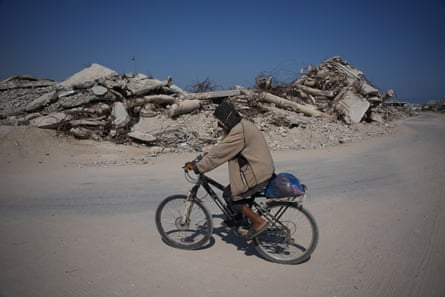
A Palestinian man cycling past the rubble of buildings destroyed by Israeli strikes in Khan Younis, Gaza. Photograph: Abdel Kareem Hana/AP
An Israeli official told Reuters: “Israel demands the complete disarmament of Hamas, including the removal of weapons from Gaza and the complete demilitarisation of the strip as a precondition for any process.” They said the plan under discussion did not “provide a satisfactory response to these demands and Israel conveyed its objections”.
Hamas said it agreed to the roadmap on condition that disarmament was carried out at the same time as Israeli withdrawal. “We will not take any action regarding disarmament prior to Israel’s withdrawal from the strip,” Ghazi Hamad, a member of the Hamas negotiating team, told Al Jazeera.
Hamad told Agence France-Presse in a separate interview: “The agreement contains a clear provision stating that Israel must commit to and implement its obligations. If Israel does not implement the agreement, neither will we.”
By agreeing to Mladenov’s roadmap, Hamas has increased the pressure on Israel to fulfil the commitments it made in the October ceasefire. A US official briefing the press on Thursday night acknowledged that Israel was “very sceptical that Hamas will disarm” but added that Trump would be “very, very disappointed” if Israel did not meet its obligations under the agreement.
It is unclear how long the agreement would take to implement. The 13 members of the NCAG have so far been barred by Israel from entering Gaza, the special training of Palestinian police has yet to start, and troops from the countries volunteering to support the ISF, such as Morocco and Kosovo, have yet to arrive.
“The whole point of this is the sequencing, the verification and the reciprocity, less [about] timetables,” a BoP official told the Guardian. “If something isn’t adhered to, the next step isn’t compelled. If something requires more time, the IVC allots more time. There is a recognition that this won’t be easy. There will be challenges, and things may take more or less time.”
Hamas had previously said it was ready to disarm but had insisted it would not agree to any new deal before Israel had fulfilled Hamas’s obligations under the first phase of the ceasefire, stopping the bombing and pulling back to the agreed demarcation line.
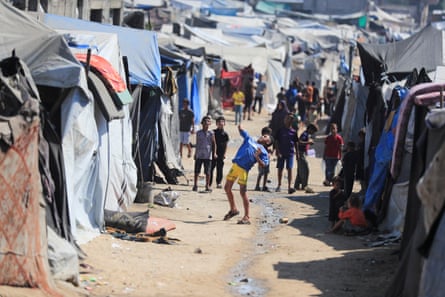
Displaced Palestinians shelter at a tent camp in Gaza City. Photograph: Dawoud Abu Alkas/Reuters
According to Muhammad Shehada, a visiting fellow at the European Council on Foreign Relations, Hamas relented as it was facing increasing resentment inside Gaza.
“Hamas is eager to get rid of the governing burden of Gaza, having to pay the salaries of 35,000 employees. They see this as a burden,” Shehada added. Hamas leaders had also hoped Iran would make the Gaza ceasefire a condition for its June memorandum of understanding with the US, which did not happen.
“There is disappointment with Iran, as Gaza was not mentioned explicitly,” Shehada said. “The other reason is the fear that Israel would relaunch the war back to its full might.”
There is little optimism in Gaza that the agreement will be carried out, he added.
“As a precondition, Israel would have to fulfil a number of minimal obligations, like 600 trucks of aid in a day, suspending military operations, withdrawing to the [agreed demarcation] line,” Shehada said. Before Israeli elections, that would “be seen from the Israeli government’s perspective as political suicide”.
Source note
First published by The Guardian World
This article was supplied by The Guardian World through its RSS feed and formatted for Crooli Signal. The reporting remains with the original publisher.
Read the original at The Guardian World