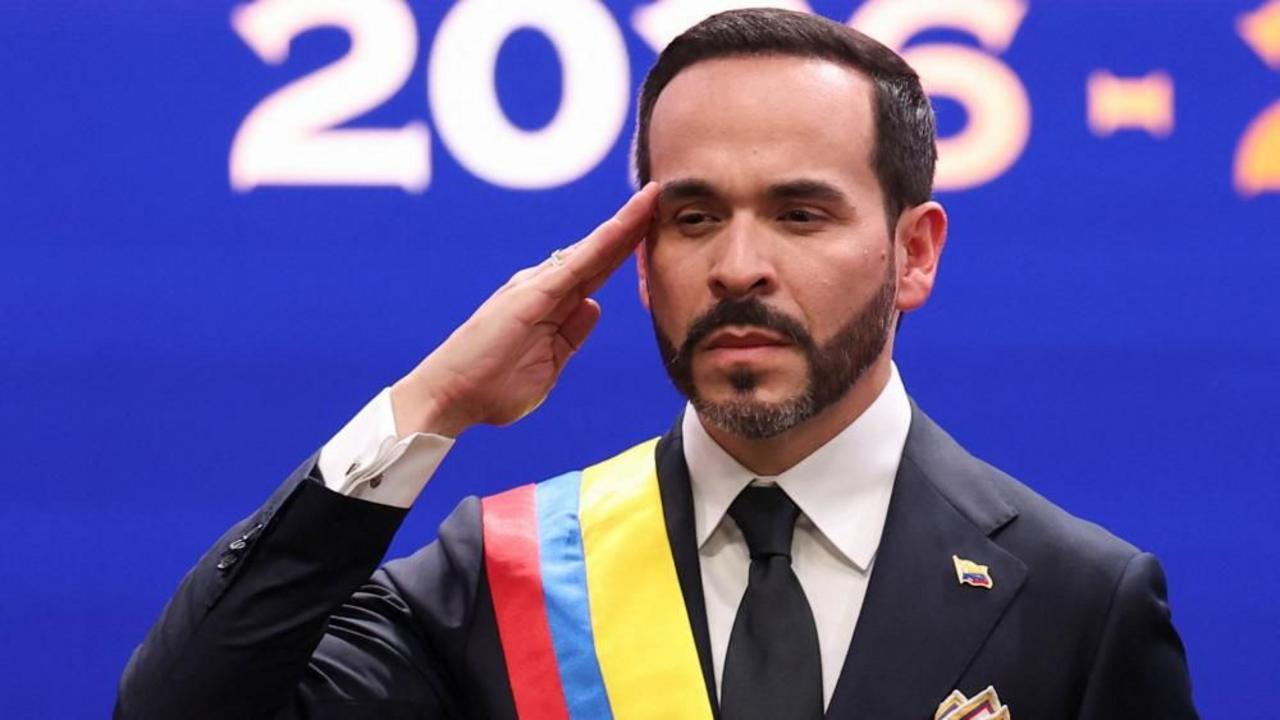
The US has pledged $1bn (£740m) in assistance to Colombia, after the country's new right-wing president was sworn in on Friday.
Abelardo de la Espriella, an ally of US President Donald Trump, used his maiden speech to promise an "all-out war" on what he calls "narco-terrorism".
The US state department announced the financial support as part of a "security package" to help de la Espriella achieve "our shared goals", which include fighting organised crime and illegal immigration.
The new president's inauguration marks a dramatic shift to the right for Colombia, as he replaces the left-wing former leader Gustavo Petro, who frequently clashed with Trump.
Trump endorsed de la Espriella during the election, and said he predicted a "much better relationship" with his new counterpart after his victory in June.
A US delegation led by then-acting Attorney General Todd Blanche, who has since been confirmed to the post, attended the inauguration. It was also attended by embattled Fifa president Gianni Infantino.
De la Espriella chose to take the oath of office not in Colombia's capital, Bogotá, but in the volatile city of Cali, in the west. The change was intended to signal a tough approach to illegal armed groups operating in the region.
In his fiery maiden speech - addressing troops at a nearby military base - de la Espriella pledged to crush armed insurgents, rebuild Colombia and defend democracy "by reason or by force".
He said "in the age of the Tiger" - his self-appointed nickname - the state would be forceful and decisive against crime.
"There will not be a single place in our territory where criminals can feel safe," he said.
De la Espriella has vowed a sharp break with his left-wing predecessor. Instead of holding peace talks with armed groups, he has promised a brutal crackdown on their activities and the construction of mega-prisons.
He has also promised a strong military alliance with the US and Israel, in stark contrast to Petro, a long-time critic of Israel's Prime Minister Benjamin Netanyahu.
In one of his first acts as president, de la Espriella said Colombia would join the "Shield of the Americas" security partnership founded by Trump.
The US welcomed this, and said it "stands ready to support the de la Espriella administration's efforts to defeat the vicious narco-terrorist and criminal organisations" that threaten security.
The state department also said shared goals included halting illegal immigration through "closer coordination on border security".
What Washington calls de la Espriella's "pro-growth agenda" has created an opportunity to "increase trade and deepen economic ties between our countries", it added.
Trump has sought to strengthen US influence in South America during his second term as president, in part by lending support to politicians aligned with his goals.
Last year the US Treasury bailed out Argentina, led by libertarian Trump ally Javier Milei, with a $20bn currency swap. Trump said that if a socialist candidate defeated Milei in the next presidential election, he would feel "a lot differently" about supporting the country.
By contrast, US forces seized Venezuela's socialist president Nicolás Maduro and his wife, Cilia Flores, in a deadly night-time raid on his home, and charged them with weapons and drug offences, which they deny. The attack cleared the way for US firms to tap Venezuela's oil reserves.
Trump has also been accused of violating international law for several deadly air strikes on what the US has claimed were drug-smuggling boats in the Caribbean. The highly controversial attacks have killed dozens of people without due process.
And diplomatic tensions have been rising between the US and Brazil, led by the veteran left-winger Luiz Inácio Lula da Silva, ahead of the country's elections.
Colombia's new president is a political outsider with no prior experience in public office. He has been a US citizen since 2023 after living and working in Miami for many years.
Before entering politics, he had a successful career as a lawyer representing drug-trafficking paramilitaries - the kinds of criminals he now intends to lock up.
As a campaigner, de la Espriella has a flair for the dramatic, frequently performing military-style salutes and wearing the Colombian national football jersey, which critics accuse him of politicising.
Some have warned that his confrontational style could deepen divisions in an already highly polarised country.
But he has found an admirer in Trump, who said de la Espriella had the "total support and strength of the United States behind him" before the election.
His predecessor Petro was the first left-wing president in Colombia's modern history.
A former rebel, Petro pursued what he called a "total peace" strategy to the country's internal armed conflict between armed guerrilla groups, the state and cartels, which prioritised negotiation.
Critics say the method failed. Membership of armed groups has expanded in recent years, and a brutal conflict between rival rebel groups along the Colombia-Venezuela border displaced tens of thousands of people last year.
De la Espriella has pledged to abandon this approach, instead promising a military crackdown.
He has also departed from Petro in his stance towards Israel, which he has said will be a major ally. Petro, by contrast, cut ties with the Israeli government over its offensive in Gaza and was a vocal advocate for the Palestinian cause.
Source note
First published by BBC World
This article was supplied by BBC World through its RSS feed and formatted for Crooli Signal. The reporting remains with the original publisher.
Read the original at BBC World