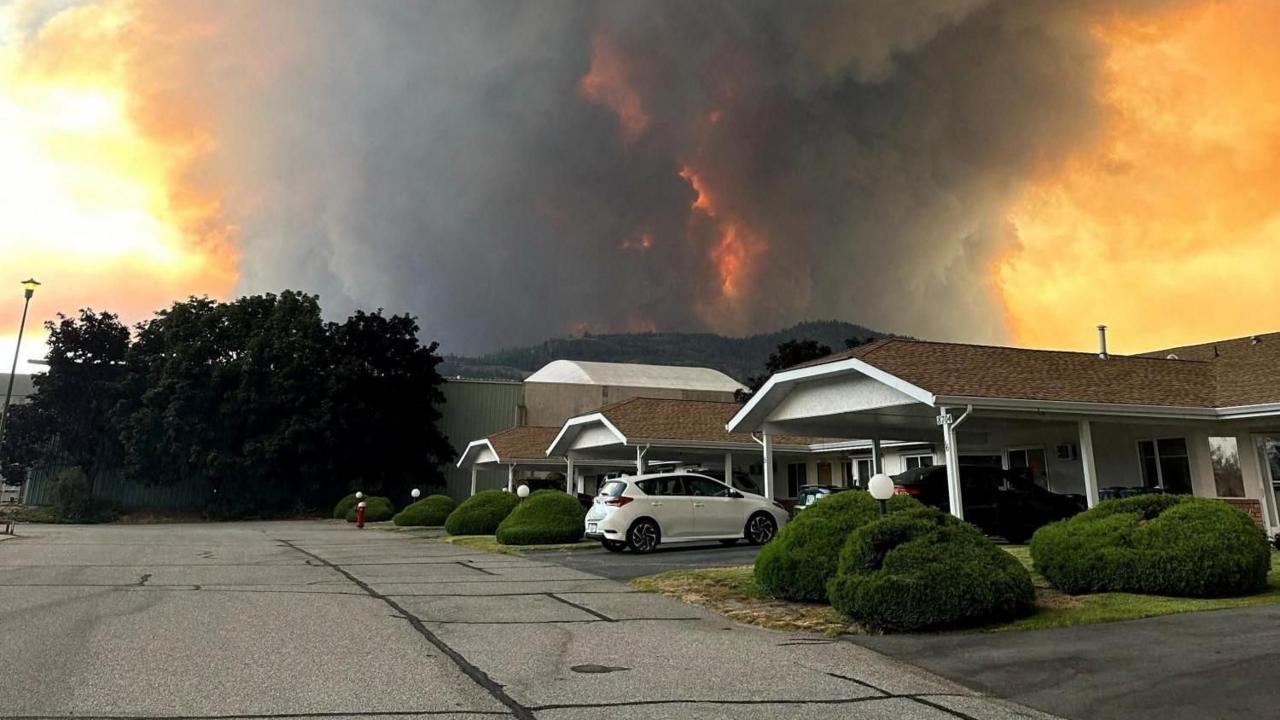
Figure caption, "That fire came so fast": Wildfire rages in British Columbia
ByNadine YousifSenior Canada reporter and Brandon DrenonBBC News
Updated 1 hour ago
Earl Kurz and his wife have lived in Peachland, a town overlooking Okanagan Lake in Canada's British Columbia, for 30 years. In the last 10, he said he has grown used to wildfires threatening his community.
But this is the first time he's been forced to flee, and surveying the damage left behind by the Bald Range wildfire, which broke out on Friday and grew in a matter of hours to 53 sq miles (136 sq km) in size, has been difficult.
"It's total incinerated destruction," Kurz said. "The hot spots are just barren areas of nothing except 12 inches of ash."
Officials in British Columbia are still trying to determine how many homes were lost to the fire, which remains out of control as of Monday.
More than 12,000 residents in the area are still under an evacuation order.
One woman, aged 80, died while trying to flee from the wildfire, police said on Sunday.
With dry lightning, high temperatures and winds in the forecast, officials warned on Monday that the fire continues to be a threat and that new ignitions are possible.
The Okanagan area of British Columbia, known for its world renowned vineyards and picturesque scenery, has been grappling with extreme drought in recent years. As of July, the level of the Okanagan Lake was at its lowest since 1992, according to the Okanagan Basin Water Board.
The Bald Range wildfire is one of more than 100 burning in British Columbia as of Monday - 70 of which started in the last week alone.
The west coast province's premier, David Eby, declared a state of emergency over the weekend, urging residents to heed evacuation orders and warning that the fires continue to move "incredibly quickly".
Image source, Supplied/Keegan Radomski
Image caption, Keegan Radomski's home, photographed here before the fire, was built by her grandmother in 1996.
Keegan Radomski is one of thousands who have had to flee their homes in Summerland, a town on the Okanagan Lake just south of Peachland. The 18-year-old told the BBC she barely escaped with her mother's ashes before she saw the fire breach her property.
"We've had a lot of close calls before, but it's never been like this," Radomski said. "You always think it's not going to be you, and then it's you."
The home she fled was built by her grandmother 30 years ago, she said. Living in the Okanagan for decades meant that Radomski and her family are familiar with wildfires and evacuation notices, but they were still caught off guard by the speed of this fire.
The family noticed wildfire smoke from the distance while eating dinner on Friday evening. Less than four hours later, Radomski said she was scrambling to get everyone out as she saw a hill on her property begin to burn.
She added she is still unsure if her family's home survived, and when she can return and check for herself.
Image source, Supplied by Keegan Radomski
Image caption, Radomski says she is unsure of when she is able to return to her property and assess the damage
Doug Holmes, the mayor of Summerland, told CBC News on Monday that some people's homes have been lost, but "we don't know how many".
"I think we need to prepare for the fact that everybody is going to know somebody that has lost a home," Holmes said.
Some residents in the farming community were forced to leave their livestock behind in the quick evacuation, said Kaz Nowlin, who has been helping rescue stranded animals in the Okanagan area since wildfires broke out last month.
Nowlin said he and a group of volunteers have so far rescued dozens of animals, including 57 horses.
He told the BBC he is in the process of acquiring a permit to enter Summerland and round up 14 alpacas and eight horses that have remained. "It's for the animals' well-being," he said of his efforts. "They don't deserve what's going on."
Image source, Supplied by Kaz Nowlin
Image caption, Dozens of horses have been rescued by a volunteer group in and around the Okanagan Valley since wildfires broke out last month.
The Bald Range wildfire comes on the heels of another fire in the Okanagan, called Bradley Creek, which is believed to have destroyed more than 200 homes.
Officials said the Bradley Creek fire is now being held after "tireless work" by wildfire crews to contain it.
Drought conditions have also contributed to fires in the US state of Washington, just south of British Columbia, where more than 65,000 people were forced to flee their homes.
Devastating fires have also burned this summer in Spain and France as Europe grapples with drought and record high temperatures.
France has seen its worst fires in two decades, while officials in the Spanish capital Madrid say theirs are the worst the region has ever experienced.
Fires are part of the natural cycle of Canada's vast boreal forest, but experts say climate change - particularly hotter and dryer weather - has made them more intense and frequent in the last decade. In 2023, the country saw its worst wildfire season in history in terms of the total area burned.
Source note
First published by BBC World
This article was supplied by BBC World through its RSS feed and formatted for Crooli Signal. The reporting remains with the original publisher.
Read the original at BBC World