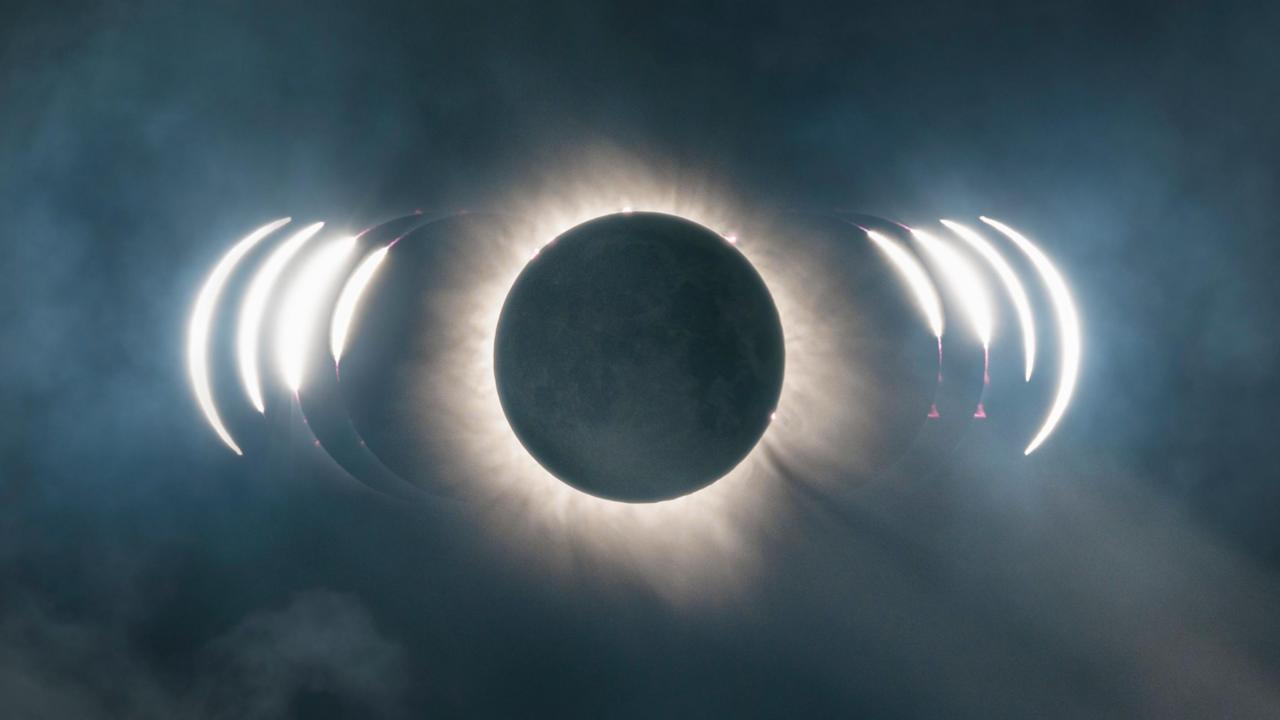
According to Royal Museums Greenwich, viewers in the West Country will see the eclipse begin at 18:17 BST.
The maximum eclipse will occur at 19:12 BST, before the event ends at 20:06 BST.
Because the eclipse takes place during the evening, a clear view of the western horizon will be key.
Simon Holbeche, chair of the Bath Astronomers, said: "Other than the weather, the only other criteria is a good view all the way to the horizon looking West.
"This is because it's an evening eclipse and the sun/moon will be dropping closer to the horizon during the eclipse.
"So, in terms of locations, some might choose to pop upstairs if the house is westerly facing, or pop up the local treeless hills, [for example in Bath that could be] Roundhill, Twerton or Little Solsbury Hill."
Astronomers recommend elevated locations with unobstructed views to the west.
Bristol
The Downs Sea Walls Viewpoint, Clifton with Bristol astronomers, Victoria Park and Brandon Hill and Cabot Tower.
Wales
Cardiff, Gower Peninsula, Swansea, and Rest Bay Beach, Porthcawl.
Wiltshire
Warminster Town Park with Starquest Astronomy Club, Cley Hill, Avebury Stone Circle and Barbury Castle.
Gloucestershire
Cleeve Hill, near Cheltenham, Robinswood Hill, Gloucester and Chosen Hill.
Somerset
Wells Cathedral Green with the Wells & Mendip Astronomers, Beckford Tower with the Bath Astronomers and Little Solsbury Hill.
Devon
Exmoor National Park, Norman Lockyer Observatory, Sidmouth and The Poltimore Inn, North Molton, with the Space Detectives.
South West and Cornwall
Lowery Cross Car Park, Plymouth with Plymouth Astonomical Society, Penzance and Sennen, near Lands End.
Isles of Scilly
St Mary's Island, from Hugh Town, West facing beaches and Community Observatory, St Martins.
Source note
First published by BBC Science
This article was supplied by BBC Science through its RSS feed and formatted for Crooli Signal. The reporting remains with the original publisher.
Read the original at BBC Science