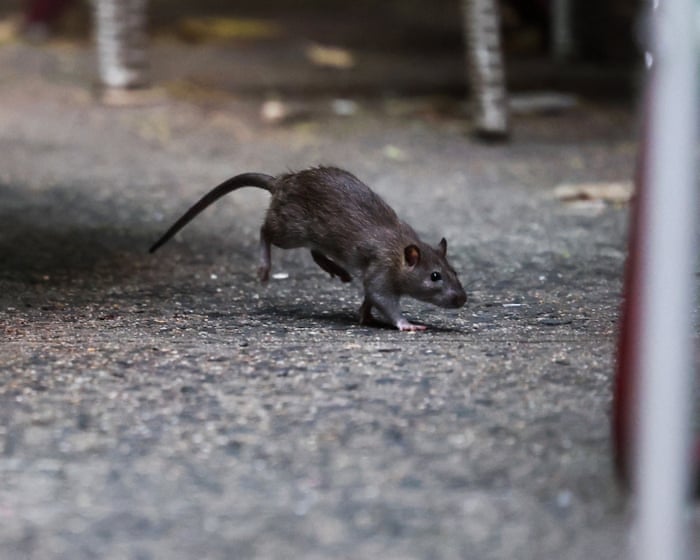
Is New York finally winning its war on rats? Or are New Yorkers’ vermin neighbors merely adapting to changing circumstances and, at least in some neighborhoods, staying out of sight?
With an estimated one rat for every three people, New York’s long-running rat war is in a period of uneasy detente.
Last week Bloomberg reported that New York is on track to record the fewest reported rat sightings since the pandemic, down 22% in the first seven months of 2026 compared to a year earlier, a drop attributed to a “war on rats” campaign initiated by former mayor Eric Adams.
The city’s population had spiked during the Coivd pandemic when rats flourished unchecked due to uncollected trash, an increase in take-out and delivery food, and outdoor dining sheds that provided snacks and refuge.
As mayor, Adams was fixated on rats. His administration posted an advertisement for a “rat czar” that would require applicants to be “highly motivated and somewhat bloodthirsty” and possessed of both “stamina and stagecraft” and a “swashbuckling attitude, crafty humor and general aura of badassery”.
When Adams appointed Kathleen Corradi to the post in early 2023, he said sagely: “Rats impact how you feel about the city you’re in … many of us live in communities where rats think they run the city.”
The measures Adams’ instituted included “Rat Pack” teams, a bin program that Adams called the city’s “trash revolution” requiring trash cans throughout the five boroughs to reduce household waste left on the streets for collection in plastic trash bags.
During his tenure, Adams ordered the formation of specialized teams to tackle the estimated 600,000 rats that live in the city’s street tree beds. Thousands live in holes in the city parks, venturing out only at night to feed on trash.
All businesses and low-density residential buildings, producers of around 70% of the city’s trash, were required to containerize in 2024. Full containerization of the city’s trash is expected to be complete by 2031.
Leading rodentologist Robert Corrigan said he felt “very positive” about the containerization effort. He told Bloomberg that garbage is a rat’s favorite food and lids on trash cans are “the true hero of rat management”.
The first concerted effort to tackle the issue came in late 2022 when Adams and then-Sanitation commissioner Jessica Tisch launched a “Get Stuff Clean” initiative, cleaning up neglected areas and combatting litter. Tisch was asked if a sanitation department flyer featuring a travel influencer rat with a suitcase was too cute. Tisch said the point was to get people’s attention.
“Everyone that knows me, they know one thing: I hate rats,” Adams told reporters when the city narrowed the window when trash can be put out on the curb. He acknowledged that he’d be branded a murderer. “Well, you know what? We’re going to kill rats.”
The current mayor, Zohran Mamdani, does not appear to share Adams obsession with rats. He dropped the “rat czar” position but has expanded the city’s “containerization” program to six districts, bringing oversize “Empire Bins” to 25,000 new residences. The city is set to lose 30,000 parking spots as a result, alongside a city council proposal threatening up to 300,000 spots.
“In the wealthiest city in the wealthiest nation in the history of the world, no New Yorker should have their sidewalks covered in garbage. By finishing the job on containerization, we will ensure New York City’s streets remain the envy of the world,” said Mamdani said in April.
But is it really as simple as that? Not all of the city’s neighborhoods have seen the same improvements. West Harlem, which as been fully containerized since June 2025, reported rat sightings fell 34% in the first seven months of 2026 compared with last year.
Though overall rat sightings are down so far this year, it’s not uniform across community districts. Parts of Brooklyn’s Dumbo and Brooklyn Heights are down 48%. But the gentrified East Village, Lower East Side and parts of Chinatown have seen a 37% surge in rodent reports compared to this time last year.
Overall numbers of rats, or rat sightings, have dropped, but they are not below pre-Covid levels, suggesting that the New Yorker’s furry frenemies are still very much in situ despite the loss of Covid dining sheds and easy-to-access refuse.
Gil Bloom of Standard Pest Management, a company that consults for local and federal government agencies, says rat sightings dropped to a record low in 2019. “Covid rearranged the topography and rats went wild. They were running around horribly once we had these food shacks up all around the city and the population skyrocketed.”
Bloom says the city’s rat population has certainly gone down with trash containerization, but warns it would be unwise to declare victory given the adaptability of rodents. “We have to consider who our adversary is,” he says. “They’re still in the underground and catch spaces of the city.”
With some trash still in bags, and the time between trash being left out and collected, rats “have reset their clocks. They know when the trash is going out. People litter. There are food and fruit stands. There’s still enough food around for rodents to survive.”
While the visibility of rats has been reduced that doesn’t necessarily reflect the total number. New Yorkers relationship to rats, like many attributes of city life, is psychological bordering on metaphysical. “If they’re out at night and people don’t see them is it still a rat? It’s still a rat, but no one is seeing it,” Bloom says.
The East Village has older buildings, the large Tompkins Square Park and city infrastructure in disrepair below ground. Plus it has a younger population more likely to be out at night. Parks don’t used rodenticide because of the hawks and birds, but use traps with liquid nitrogen to freeze the holes.
The variables are endless, Bloom says.
“Rats are burrowing animals and in a city with limited earth and space, a rat is going to find you. We’ve learned over the last 15 or 20 years that a rats’ range is much greater than we previously thought,” he says. “ Rats only require one ounce of food and water a day, they don’t need a whole sandwich.
“So there’s a direction toward control, and the numbers are down to pre-Covid levels. But pre-Covid there were still a lot of rats, so no one is saying, ‘Hey, there’s no rats,’”
Source note
First published by The Guardian US
This article was supplied by The Guardian US through its RSS feed and formatted for Crooli Signal. The reporting remains with the original publisher.
Read the original at The Guardian US