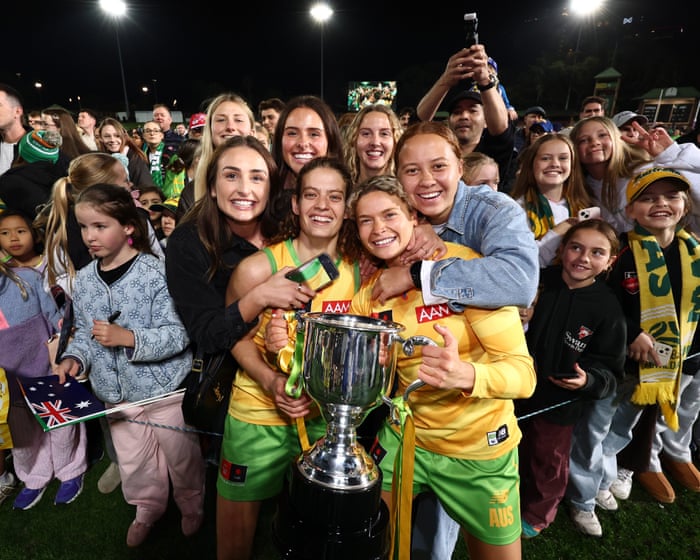
In Australia, it is called the Matildas effect. Elsewhere, it has increasingly become known by a different name: business as usual.
The Professional Women’s Hockey League is one of several North American competitions making a habit of not only attracting spectacular women’s sports crowds, but doing so at a domestic level. Just three years into its existence, the ice hockey league is doing a mighty fine job of it too, with last season’s attendance up 71% on their inaugural campaign.
The secret weapon? An initiative called the “Takeover Tour” where regular season games are staged in cities that are battle-tested NHL markets, despite not yet having a PWHL franchise. The games “take over” NHL venues, and the crowds have risen to the occasion. It has been so successful a venture that clubs have begun to stage home games at NHL venues too, notably selling out Madison Square Garden a few months ago.
Yet the simple fact of the crowds is not the most compelling part. Speaking at the espnW Sports Summit’s Women at the Helm panel in May, the Seattle Torrent general manager, Meghan Turner, shared an astonishing insight: of the crowd in attendance at this past season’s Takeover Tour games, roughly 80% had never before attended an NHL game.
This is, in a word, revolutionary. We’ve long understood women’s league attendance to lack a level of overlap with the men’s competitions, but it has never been imagined quite to this extent. These are towns where ice hockey is deeply entrenched; where people already have access to live, professional ice hockey. But even with so much opportunity at their doorstep, it was the PWHL that managed to finally draw them in.
It was women’s ice hockey that got them, and they barely tapped into the men’s attendance base in the process.
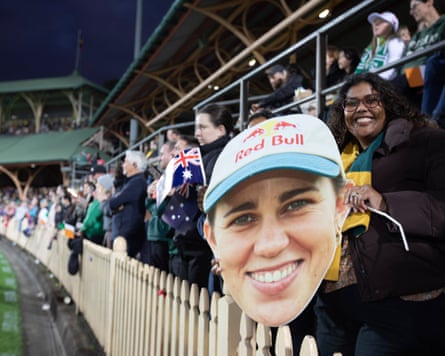
The AFLW international match between Australia and Ireland at North Sydney Oval was sold out with a crowd of more than 9,000 fans. Photograph: Jessica Hromas/The Guardian
There seems little reason why the same principles couldn’t hold true in Australia. After all, much like these ice hockey heartlands, Australia’s major sporting codes are woven into the very fabric of our communities. We know there exists a specific appetite for women’s sport that does not always extend to men’s leagues, and we have seen this very crowd mobilised for historic international events and World Cups.
And yet, there is a vast difference of approach in Australia’s domestic scene. Where the major women’s leagues and franchises in North America stand apart from their men’s iterations, Australia’s largest sports tend to be intertwined, meaning governance of both leagues is inseparable. The clear advantage of this is the money, affording women’s competitions a level of financial cushioning in their less profitable infancy.
But perhaps this interconnectedness, this funding bubble, has bred the risk-averse behaviour that we see from our administrators. By buffering any existential threat to the women’s league, there simply isn’t that same push for ambition or innovation. The audience is assumed to be built-in by design, and converting fans of the men’s league appears the path of least resistance. Aggressively courting a discrete women’s sports demographic is not so pressing a need.
With their venture into double headers with the men this AFLW season, a decade into the women’s league’s existence, the AFL seems to reflect this mindset. It is a big swing by AFLW standards, and holding games at larger stadiums is something that fans and players alike have demanded for years. But the unwillingness to separate from AFL games, the reliance on them as a safety net, shows that the league’s priorities still lie with converting the men’s crowd.
after newsletter promotion
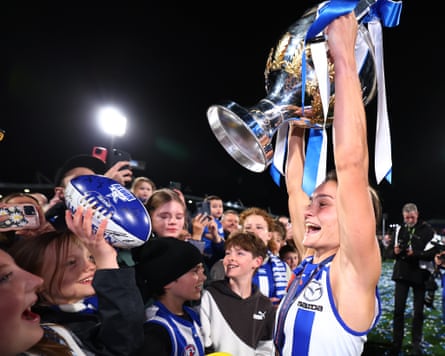
North Melbourne have defeated Brisbane in the past two grand finals in front of a sold out crowd at Ikon Park. Photograph: Morgan Hancock/AFL Photos/via Getty Images
The Australia and Ireland women’s football game saw the same lack of confidence: here was the AFLW’s best approximation of a Matildas-scale event, yet instead of boldly leaning into the momentum, venue choice was based on existing ticketing sales. It was a successful event, but the strength of engagement metrics suggests there were attendance gains left on the table.
They are certainly on the right track, but it is difficult to ignore how the PWHL gets their crowds – by having the mettle to back the strength of their product. What would it look like if the AFL borrowed some of that gumption in its attempts to grow the AFLW?
It would mean leadership taking a proper big swing, for starters – one that they really put their backs into. Total strategic overhaul, with a monumental shift in both ambition and investment. Stand-alone games at larger venues, without caveat, to communicate to fans that the administration believes in the league. More marketing, and more marketing that targets that specific demographic.
The PWHL may not yet know what draws so many first-timers to their Takeover Tour games, but what they do know is that the cost of creating this environment is steep. It involves putting something on the line, risking half-empty stadiums in pursuit of a magical women’s sports crowd moment. And as we have so often seen in women’s sports, that bravery has been rewarded in spades. Perhaps, with a little bravery of their own, the AFLW can enjoy the same.
Source note
First published by The Guardian US
This article was supplied by The Guardian US through its RSS feed and formatted for Crooli Signal. The reporting remains with the original publisher.
Read the original at The Guardian US