
Troy Jackson is ready to move on.
In fewer than 100 days, the new Democratic nominee has to convince Maine voters to send him to the US Senate – and he’s trying to do it without dwelling on Graham Platner, who dropped out of the race after accusations of rape, which he denies.
“The movement represented in this room did not just begin two weeks ago,” said Jackson, a progressive lumberjack and former state lawmaker who won nearly all the delegates at a hastily organized special convention last Saturday. “I’ve always known that your trust has to be earned.”
On stage, no one mentioned Platner by name, but the fallout from the oyster farmer’s campaign collapse hung over the room. He had ridden an anti‑establishment wave before crashing under a series of scandals – which included problematic online posts, a tattoo resembling a Nazi symbol and allegations of abusive behavior in past relationships.
Jackson, who previously launched an unsuccessful bid for governor this year, now faces a compressed timeline to build the same momentum his predecessor generated against Susan Collins, the moderate Republican who has weathered every challenger during her three decades in the Senate. Maine is central to Democrats’ effort to pick up the four seats they need to regain control of the upper chamber in the midterms.
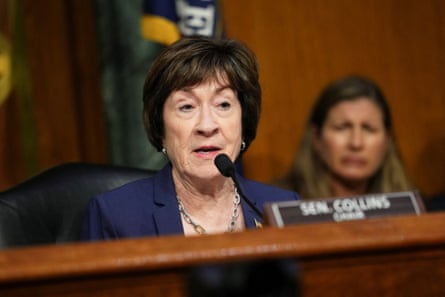
Susan Collins speaks during a Senate appropriations committee hearing on 21 July 2026 in Washington DC. Photograph: Eric Lee/Reuters
But some in the party worry that Jackson faces a steep climb in a short window. “He won an interparty fight – which is nothing like the fight he’s got ahead of him,” said Lynn Bromley, a former Democratic state senator. “He’s going to have to build a statewide coalition. That’s a whole different process.”
“I would say Jackson has momentum, but I would also say momentum isn’t the same thing as trust,” she added.
Who Jackson needs to win
Jackson quickly emerged as the natural heir to Platner’s anti‑oligarchy message. More than 17,000 voters turned out for the county‑level delegate elections, and by the time the roughly 500 selected delegates arrived in Bangor, most had already pledged to support Jackson.
In a Tuesday interview on political talkshow Morning Joe, Jackson acknowledged that Platner was the more compelling orator, but said his focus now is making sure voters understand the election is about “the movement”, not any one candidate. To win in November, he still has to consolidate Democratic support and reach voters outside Platner’s core supporters.
The most crucial demographic for Jackson is 2020 ticket‑splitters in Maine – those who backed Susan Collins for Senate and Joe Biden for president. Back then, Collins ultimately won by nine points, defeating Democrat Sara Gideon, the former state house speaker, despite trailing in most public polls.
A Guardian review shows that more municipalities voted for both Biden and Collins than they did for a straight Democratic ticket that year.
One of those voters is Wendy Tooth, a physiotherapist in Manchester, who’s been “disappointed” with Collins since her 2020 vote for the incumbent, and particularly since Donald Trump’s re-election.
“I wasn’t really a Graham Platner fan,” Tooth, 58, said. “[Collins] doesn’t seem as centrist as she used to be. She seems to go along with a lot of Trump’s policies, which I don’t agree with.”
Part of the unenrolled bloc that makes up about a third of voters in the Pine Tree state, Tooth says she needs to see Jackson “work across party lines” – and Collins take firmer positions against the war in Iran and the deadly federal immigration crackdown across the country – before making her decision.
Democrats such as Alan Blake of Thomaston say the party must now rally behind Jackson regardless of any concerns about the chaos that has plagued the race so far. “We’re just going to carry Jackson in there because we absolutely need the policies he stands for,” Blake, 74, added. “It’s not drastic to say we’re trying to save democracy here.”
And Ellie Gunnoe, 39, a psychiatric nurse practitioner and registered Democrat in New Gloucester, said Jackson – a fifth‑generation logger from Aroostook county – can reach voters across the state as a “working‑class Mainer”.
“We just need someone fighting in our corner,” Gunnoe added, noting that the fatal shooting of 26-year-old Joan Sebastián Durán Guerrero, by an ICE agent in Biddeford, is one of the key motivators pushing her to the ballot box this year. “My husband is Mexican American and is the exact same age and brown, and so it’s just been feeling increasingly unsafe for people like us,” she added.
A slice of moderate Democrats who voted for Janet Mills, Maine’s term-limited governor, in the June primary – after she had suspended her campaign but remained on the ballot – are also in play. One of them, Brenda Garrand, 69, of Rockland, said she plans to vote for Jackson even though she doesn’t consider herself a progressive. “I don’t think he’s the best and brightest, I don’t think he is Senate material,” she said. “But we’ve got to have a Senate majority.”
Mills, for her part, told a local ABC affiliate this week that Collins is “vulnerable” and “should be defeated”, but did not endorse Jackson directly.
Jackson’s run could be buoyed by the anti-Trump animus that’s grown since the financial fallout of the ongoing war. According to a recent New York Times/Portland Press Herald/Siena poll, only 39% of likely Maine voters approved of the president’s job performance since he returned to the White House.
“Susan Collins keeps telling us everything is just fine. And you know they act like you know we’re idiots. We know it isn’t. We all have eyes,” Jackson said in Bangor.
He used his victory to highlight Collins’ votes to confirm the supreme court justice Brett Kavanaugh and advance the president’s $70bn bill to guarantee funding for federal immigration enforcement. “Who has she served?” Jackson asked the audience. “She has served Donald Trump. She voted with them 96% of the time.”
after newsletter promotion
Meanwhile, Collins has sought to brand Jackson a “Bernie bro”, pointing to his long relationship with Bernie Sanders, the independent senator from Vermont, and his role leading Sanders’ 2016 presidential campaign in Maine.
Ronald Schmidt, a politics professor at the University of Southern Maine, said that attack puts the onus on Jackson to “flip that playbook” of being affiliated with an outsider and “link [Collins] to Trump”.
But some local Republicans counter that Jackson’s more than two decades as a state legislator, and a failed run for Congress in 2014, mean he lacks Platner’s outsider profile. “He is Maine’s establishment,” said Chuck Ellis, chair of the Cumberland county GOP. “All the appeal of Platner being anti‑establishment is lost when you replace him with a career politician.”
The long road ahead, paved with attack ads
An ad offensive from conservative Pacs has begun painting Jackson as an extension of Platner, often using footage from their time on the campaign trail when they endorsed each other.
After Jackson clinched the nomination on Saturday, the National Republican Senatorial Committee (NRSC) even pushed out an AI video of Platner morphing into Jackson with the caption: “No tattoo, same crazy.” James Blair, a former White House adviser now leading Trump’s midterm operation, wrote that Jackson carried “all the baggage” of Platner “without the ‘rizz”. And the Senate Leadership Fund (SLF) – the top Senate GOP Super Pac, which has pledged more than $40m to the race – is highlighting the many scandals that plagued the unvetted Platner, alongside reporting about Jackson’s alleged fiery temper during his time in the state legislature. “Jackson is like Graham Platner but worse,” the voiceover in a video says.
Meanwhile, the Republican National Committee (RNC) quickly cast Jackson’s nomination as illegitimate, drawing a parallel to the 2024 Democratic convention, where Harris became the nominee after delegates originally pledged to Biden backed her following his withdrawal from the race. “This coronation is proof that Democrats are willing to shove socialism down the throats of Maine voters,” spokesperson Kristen Cianci said.

Delegates cheer as Troy Jackson is announced as the Democratic nominee to replace Graham Platner on 25 July 2026 in Bangor, Maine. Photograph: Joe Raedle/Getty Images
Collins told reporters in Casco last weekend that her challenger’s platform economic populism – which includes many of Platner’s policies such as Medicare for All and taxing the ultra-wealthy – is untenable. “It is disturbing for me to hear Troy say that everything should be free, when in fact it’s going to be middle- and low-income taxpayers who are going to be paying the bill,” she said.
Jackson’s ground game is also in need of a significant financial boost to compete with Collins’ war chest of more than $11m cash on hand, according to her latest disclosures. As of now, Jackson’s campaign reports he has amassed $2m since he won the nomination. That’s on top of the $1m he raised since he formally entered the Senate race in early July.
Perhaps more daunting than the attacks or the finances, however, is the support Collins has built over five terms, and a record of political survival that has been impossible to beat – even when the odds appear to be against her.
“She’s an intimidating political presence, and I think people underestimate that,” said Matt Gorman, a Republican strategist.
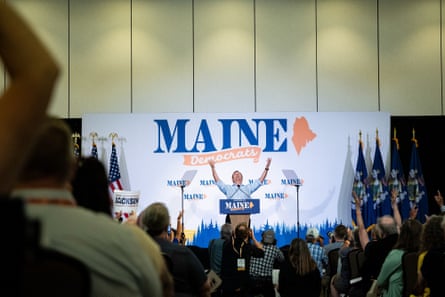
Troy Jackson speaks during the Maine Democratic party’s special state convention to select a nominee for the Senate in Bangor, Maine, on 25 July 2026. Photograph: Bloomberg/Getty Images
Collins has spent much of the race, and the years leading up to it, underscoring the millions of dollars in federal funding she’s steered to Maine as chair of the powerful Senate appropriations committee. Her campaign spokesperson, Shawn McRoderick, said the senator looks forward to “waging a vigorous, issues‑oriented campaign that will distinguish her record of accomplishment against Troy’s angry soundbites”.
In a small state, tangible results are hard to ignore. “I was speaking to a town official from upstate who was able to get fire department money to improve the local volunteer fire department with the help of Collins’ office,” Schmidt recalled. “People who’ve directly been helped by her staff probably will vote for her again in this election, regardless of their party ID.”
While antipathy toward the gerontocracy may color many midterm races this year, Collins’ seniority in Congress – despite serving alongside an administration many Mainers can’t stomach – may be her strongest asset.
“With Collins you actually have serious influence that can successfully make progress at cooling off the Trump administration when she feels like that’s necessary and that’s appropriate,” said Ellis. “To lose that, you would have to be able to say that we have a substantial upgrade that’s going to do so much better for us.”
Andrew Witherspoon contributed reporting
Source note
First published by The Guardian US
This article was supplied by The Guardian US through its RSS feed and formatted for Crooli Signal. The reporting remains with the original publisher.
Read the original at The Guardian US